GMCSCO Media Group

AI Chatbot

WhatsApp CRM Lead Automation

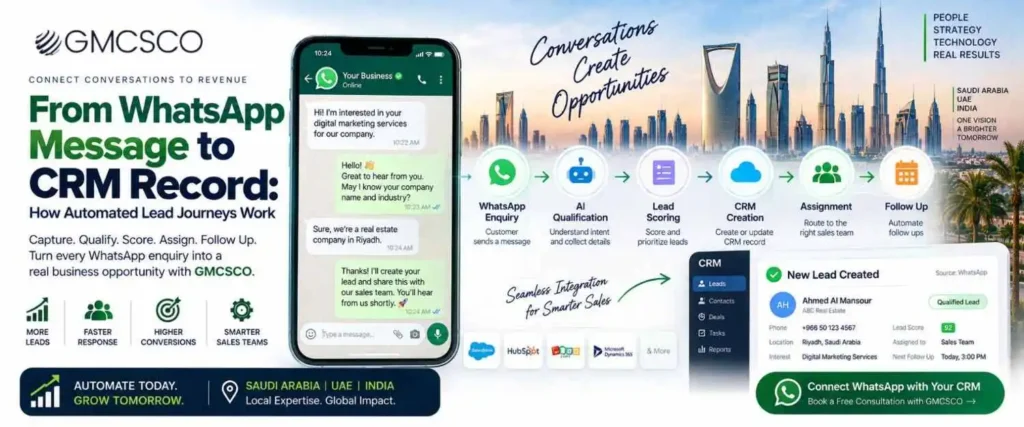
From WhatsApp Message to CRM Record: How Automated Lead Journeys Work

📇 WhatsApp CRM Automation — 2026 From a WhatsApp Enquiry to a Sales-Ready CRM Lead: The Complete Automation Guide What happens after “Hi, I want to know more about your service” determines whether it becomes revenue or disappears into a busy inbox. 92.7%WhatsApp usage in Saudi Arabia 14 StepsFrom first message to revenue 8 PhasesTo build the system Quick Answer WhatsApp CRM lead automation is a system that automatically captures customer enquiries from WhatsApp, collects relevant information, qualifies the lead, creates or updates a CRM record, and triggers the next sales or marketing action. Instead of Customer → WhatsApp → Employee → Manual CRM entry, the automated model becomes Customer → WhatsApp → Automation → CRM → Sales, with an AI layer making it even more intelligent: Customer → WhatsApp → AI qualification → Lead score → CRM → Assignment → Follow up. The objective isn’t to remove humans from the sales process — it’s to eliminate repetitive administrative work so sales teams can spend more time on qualified opportunities. Saudi Arabia’s 2025 Internet Report recorded 99.6% internet penetration, 92.7% WhatsApp usage, and 61.3% of users spending seven or more hours online daily. Why WhatsApp and CRM Integration Matters in 2026 A potential customer may discover a business through Google Search, visit the website, click WhatsApp, then ask a question. If that conversation stays only inside WhatsApp, the business has limited visibility into what happens next. CRM integration creates the missing connection — the business can know who contacted them, what they requested, where they came from, whether they’re qualified, which salesperson owns the lead, what stage the opportunity is in, and whether the lead eventually became a customer. That’s where WhatsApp becomes part of a measurable revenue process. The Complete Automated Lead Journey 1. Discover → 2. WhatsApp Chat → 3. Enquiry Received → 4. AI Understands Intent → 5. Qualifying Questions → 6. Info Collected → 7. Lead Scored 8. CRM Record → 9. Lead Assigned → 10. Sales Notified → 11. Auto Follow-Up → 12. Sales Conversation → 13. Becomes Customer → 14. Outcome Recorded Step 1: Customer Sends a WhatsApp Enquiry The source could be a website WhatsApp button, Google Ads, Meta Ads, a QR code, Google Business Profile, or referral. A customer searching for an IT company in Riyadh clicks “Chat with us on WhatsApp” and writes “I need WhatsApp Business API for my company” — this initial message already contains useful intent information, so instead of sending them to a generic form, the system begins qualification directly inside WhatsApp. Step 2: Identify the Customer The system captures WhatsApp number, name, message, timestamp, campaign source, and existing customer status. If the person already exists in the CRM, the system identifies the existing record; if new, it begins creating a lead profile — avoiding one of the most common sales problems: the same customer treated as a brand-new enquiry every time they contact the company. Step 3: Understand the Customer’s Intent A traditional chatbot uses buttons (1. Website Development 2. SEO 3. WhatsApp Marketing). An AI-powered system understands natural language — “We are a real estate company in Riyadh and need a WhatsApp bot that can answer property questions and send leads to our CRM” gets extracted into Industry: Real estate, Location: Riyadh, Requirement: WhatsApp AI chatbot, Integration: CRM — far more useful than simply storing “WhatsApp enquiry.” Step 4: Ask Qualification Questions Questions shouldn’t feel like a long form — they should follow the conversation naturally: “Are you currently using a CRM?” → “Yes, Salesforce.” → “Approximately how many leads do you receive through WhatsApp each month?” → “Around 500.” → “Would you like the system to automatically qualify and assign those leads?” → “Yes.” The system now has meaningful sales information without a traditional form. What Should a WhatsApp Lead Capture? Field Example Name Ahmed Company ABC Properties Industry Real Estate Location Riyadh Requirement WhatsApp AI Agent CRM Salesforce Lead volume 500/month Timeline 30 days Intent High An ecommerce business would instead capture product interest, order number, and delivery location. The automation should collect only information that’s useful for the next business decision. Step 5: Qualify the Lead Information Request The customer is researching. Marketing Qualified Matches the target profile and shows interest. Sales Qualified Defined need, ready for sales engagement. High Intent Ready to discuss pricing or purchase. Step 6: Lead Scoring Lead Attribute Score Target industry +20 Saudi Arabia +10 Clear requirement +20 Budget provided +20 Timeline under 30 days +15 Decision maker +15 Classification: 80–100 High priority, 50–79 Medium priority, below 50 Nurture. The exact model should be customized for the business — scoring should reflect actual sales probability, not arbitrary numbers. Step 7: Create the CRM Record Automatically Instead of a salesperson manually entering name, phone, company, and notes, the automation sends information directly through an integration: WhatsApp → Automation → CRM API → Lead Record. A useful CRM record includes: Contact Info Name, phone, email. Company Info Name, industry, size, location. Lead Info Requirement, estimated value. Marketing Info Campaign, source, keyword. Conversation Info Key WhatsApp details. Qualification Lead score, stage, intent. Sales Ownership Assigned salesperson or team. Next Action Call, meeting, quotation. Step 8: Assign the Lead to the Right Salesperson Assignment can be based on location, industry, product, language, or lead score — a Riyadh real estate lead routes to the Saudi real estate team, a Dubai ecommerce lead routes to the UAE ecommerce team, an enterprise AI project routes to the enterprise solutions team. This prevents leads from simply sitting in a shared WhatsApp inbox. Step 9: Notify the Sales Team 🔔 New High Priority Lead Company: ABC Properties · Location: Riyadh · Requirement: WhatsApp AI Agent · CRM: Salesforce · Lead Score: 92 · Timeline: 30 days · Source: Google Ads The salesperson can immediately continue the conversation — creating a much shorter path between customer intent and sales response. The longer a qualified lead waits, the greater the risk they move to another provider.

From WhatsApp Message to CRM Record: How Automated Lead Journeys Work Read More »
WhatsApp AI Agent vs Chatbot 2026 Guide GMCSCO

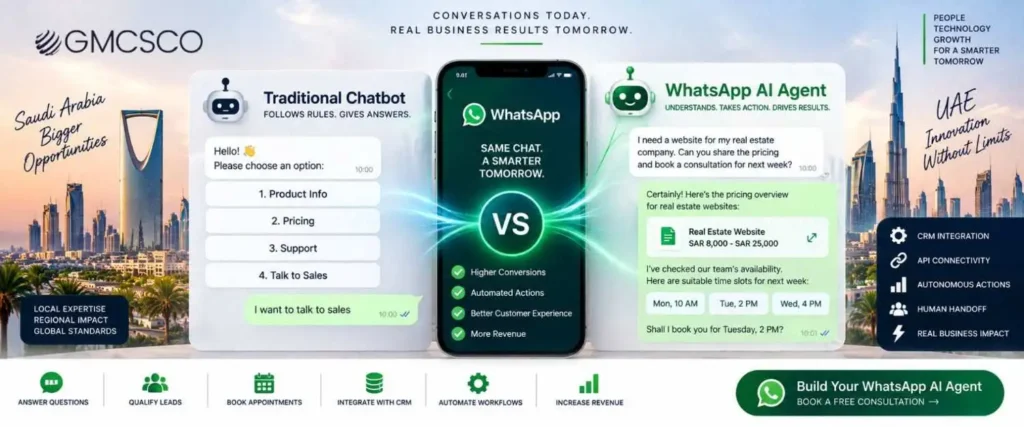
WhatsApp AI Agents vs Traditional Chatbots: What Businesses Need in 2026

🤖 WhatsApp Automation — 2026 WhatsApp AI Agent vs Chatbot: What Is the Difference? Chatbot = responds. AI chatbot = understands and responds. AI agent = understands, decides, and acts. 92.7%WhatsApp usage in Saudi Arabia 45.2%Saudi AI tool adoption (2025) 3 LevelsChatbot → AI Chatbot → AI Agent Quick Answer A traditional WhatsApp chatbot generally follows predefined conversation logic. An AI chatbot can understand natural language and generate more flexible responses. A WhatsApp AI agent goes a step further by combining reasoning, business rules, tools, APIs, and actions to complete a task — Customer asks → AI understands intent → AI checks information → AI decides next step → AI calls an API → AI performs action → AI confirms result. For businesses in Saudi Arabia and the UAE, this distinction matters because WhatsApp is already deeply integrated into customer communication — Saudi Arabia’s 2025 Internet Report recorded WhatsApp usage at 92.7% among internet users, while AI tool adoption reached 45.2%. The question for 2026 isn’t “do we need a WhatsApp chatbot?” — it’s “do we need a chatbot that answers questions, or an AI agent that can actually help complete business processes?” The Comparison at a Glance Capability Traditional Chatbot AI Chatbot WhatsApp AI Agent Natural language understanding Limited Strong Strong Handles unexpected questions Limited Better Advanced Maintains context Limited Yes Yes Connects with CRM Possible Yes Yes Uses APIs Limited Possible Core capability Makes decisions Rule based AI assisted Goal and rule based Takes actions Limited Some Advanced Lead qualification Basic Strong Advanced Multi-step workflows Limited Moderate Advanced Autonomous task execution No Limited Yes, within defined permissions Best for FAQs and simple automation Conversations Complex business processes That distinction should guide your technology investment. What Is a Traditional WhatsApp Chatbot? An automated conversation system using predefined rules, menus, buttons, keywords, or workflow logic. A customer sends “Hello,” the bot responds “Welcome to ABC Company. Please select an option: 1. Product Information 2. Pricing 3. Book Appointment 4. Talk to Sales.” Traditional chatbots are predictable, easy to control, and relatively straightforward to test — they work especially well when conversations follow a known sequence: FAQ automation, order status, appointment requests, basic lead forms, and department routing. WhatsApp Business Platform provides APIs and interactive messaging capabilities for building these experiences, with a Cloud API supporting programmatic messaging and webhooks for receiving events. What Is an AI Chatbot? An AI chatbot uses artificial intelligence to understand natural language instead of depending entirely on predefined paths. A customer asking “I need a website for my real estate company. How much does it cost and how long will it take?” gets understood as Service: Website development, Industry: Real estate, Intent: Pricing and timeline — the AI then responds naturally and asks relevant follow-up questions. However, an AI chatbot doesn’t automatically become an AI agent — that distinction is critical. What Is a WhatsApp AI Agent? An AI-powered conversational system designed not only to communicate but also to perform defined business tasks using tools, APIs, databases, CRM systems, and workflows. Instead of stopping at Customer asks → AI answers, the workflow becomes Customer asks → AI understands intent → AI checks information → AI decides next step → AI calls an API → AI performs action → AI confirms result. A customer asking “Can you check whether tomorrow’s 4 PM appointment is available?” could have the agent understand the request, connect with the appointment system, check availability, reserve the slot if permitted, and send confirmation — this is the fundamental difference between conversational automation and agentic automation. The Three Levels of WhatsApp Automation Level 1: Traditional Chatbot Customer → predefined flow → predefined response. Best for: FAQs, menus, basic lead forms, simple routing. Level 2: AI Chatbot Customer → AI understands → response. Best for: natural conversations, product questions, lead qualification. Level 3: AI Agent Customer → AI understands → reasons → uses tools → takes action → confirms result. Best for: CRM operations, appointment booking, order workflows, sales automation. Why WhatsApp AI Agents Matter in 2026 In June 2026, Meta announced Meta Business Agent, describing it as an AI system that can answer business-specific questions, recommend products, book appointments, qualify leads, allow human intervention, and close sales — alongside a Business Agent Platform designed to connect agents with business systems and tools. This signals a major shift from “Automate replies” toward “Automate customer processes.” The Core Difference: Action Capability 📋 Traditional Chatbot “Where is my order?” → “Please enter your order number.” → “Your order is being shipped.” Useful but limited. 🤖 AI Agent “Where is my order and can I change the delivery address?” — identifies the order, checks if modification is permitted, calls the system, updates it if allowed, confirms the change, or escalates. What Makes an AI Agent Different? Natural Language Understanding Understands what the customer wants to accomplish. Context Uses conversation and, where permitted, CRM information. Knowledge Product catalogs, pricing, policies, documentation. Tools & APIs CRM, calendar, ERP, payment, shipping, booking systems. How WhatsApp AI Agents Work Customer → WhatsApp → WhatsApp Business Platform ↓ AI Agent Layer → Intent Detection → Business Knowledge ↓ Decision Logic → Tools and APIs ↓ CRM / ERP / Booking / Ecommerce ↓ Response to Customer This lets WhatsApp become an interface through which customers interact directly with business systems. The 8-Layer AI Agent Architecture 1. WhatsApp Layer Handles customer communication. 2. AI Layer Understands language and context. 3. Knowledge Layer Trusted business information. 4. Decision Layer Determines what happens next. 5. Tool Layer Access to approved actions. 6. Integration Layer Connects APIs, CRM, software. 7. Safety Layer Controls what AI can/cannot do. 8. Human Handoff Layer Transfers to employees when required. CRM Integration: Where AI Agents Become More Valuable A customer sends “I need a quotation for 20 employees” — the agent collects name, company, industry, requirement, budget, and timeline, then creates or updates a CRM record: WhatsApp → AI qualification → CRM record → Lead score → Sales notification

WhatsApp AI Agents vs Traditional Chatbots: What Businesses Need in 2026 Read More »

WhatsApp Chatbot for E Commerce

WhatsApp Chatbot for E commerce: Driving Sales via Chat

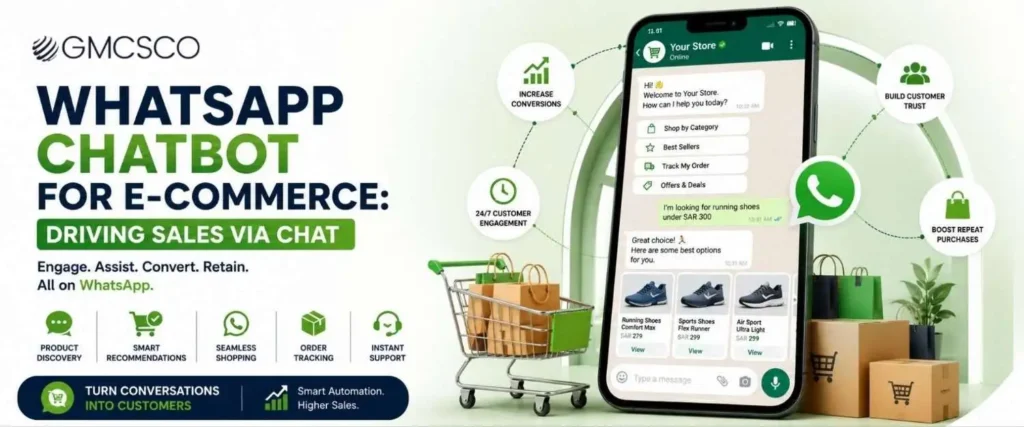
🛍️ Conversational Commerce — 2026 WhatsApp Chatbot for E-Commerce: The Complete Guide for Saudi Arabia & UAE 20 ways to turn product questions on WhatsApp into structured sales opportunities — from discovery through delivery and repeat purchase. 85%Saudi retail payments made electronically (2025) 34.5MEstimated Saudi ecommerce users by 2025 20 Use CasesDiscovery to retention Quick Answer A WhatsApp chatbot for e-commerce helps online businesses turn customer conversations into structured sales opportunities by automating product enquiries, recommendations, lead qualification, order support, follow-ups, and customer communication through WhatsApp. Instead of asking customers to leave WhatsApp and navigate multiple pages, a well-designed chatbot helps them: Discover products → Ask questions → Get recommendations → Receive relevant information → Add to cart or checkout → Receive order updates → Get support → Return for future purchases. For businesses in Saudi Arabia and the UAE, this matters because digital commerce and electronic payments continue to expand — electronic payments represented 85% of total retail payments in Saudi Arabia in 2025, up from 79% in 2024, according to the Saudi Central Bank. The opportunity isn’t simply to put a chatbot on WhatsApp — it’s to make WhatsApp part of the complete ecommerce customer journey. The 11:30 PM Question That Stops a Sale A customer finds a product they like, then has a question: “Is this available in my size?” “Can you deliver to Riyadh?” “Which product is better for sensitive skin?” “Do you accept mada?” “Where is my order?” If they have to wait until the next morning for an answer, the purchase journey often stops — they open another website, compare another product, ask another seller, or simply forget about the purchase. This is one of the biggest opportunities for conversational commerce: a WhatsApp chatbot can provide immediate assistance for common questions, guide shoppers toward suitable products, and connect qualified customers with human sales or support teams. What Is a WhatsApp Chatbot for E-Commerce? An automated conversational system interacting with customers through WhatsApp — depending on configuration, it can help with product discovery, recommendations, pricing enquiries, stock questions, order status, delivery information, customer support, lead qualification, promotions, appointment booking, cart recovery workflows, and human agent handover. An advanced chatbot can also connect with ecommerce platforms, CRM systems, inventory systems, and payment infrastructure — making WhatsApp more than a communication channel, a sales and customer experience layer connected to the rest of the business. Why WhatsApp Matters for E-Commerce Online shopping removed geographical limitations but increased competition — customers compare price, reviews, delivery, product features, offers, customer service, and brand reputation within minutes. The buying experience can influence conversion just as much as the product itself. WhatsApp reduces friction because customers can ask questions through a familiar conversational interface rather than searching through multiple pages — combining Conversation + Product Discovery + Sales + Support in one journey. Saudi Arabia: A Strong Market for Conversational Commerce A Monsha’at ecommerce report estimates 34.5 million ecommerce users by 2025 and highlights continued development of ecommerce, payment, and logistics infrastructure. According to the Saudi Central Bank, electronic payments represented 85% of total retail payment transactions in 2025, with 14.6 billion electronic transactions recorded during the year. SAMA has also continued developing ecommerce payments infrastructure, including improvements around mada integration and payment security — creating an environment where Conversation → Product → Checkout → Payment → Delivery can increasingly happen through connected digital systems. UAE: Why WhatsApp Ecommerce Automation Matters The UAE government states that ecommerce is regulated under Federal Decree by Law No. 14 of 2023 on Modern Technology Based Trade, covering online transactions through websites, mobile applications, social platforms, and digital marketplaces. For ecommerce companies operating in the UAE, conversational commerce should be designed as part of a broader digital commerce strategy rather than treated as an isolated marketing channel. How a WhatsApp Ecommerce Chatbot Works Ad Click → WhatsApp → Discovery → Recommendation → Purchase → Retention 20 Ways a WhatsApp Chatbot Drives Ecommerce Growth 1. Product Discovery Through WhatsApp “I need a laptop for business use under AED 4,000” — instead of requiring the customer to enter search filters, the chatbot asks what they’ll mainly use it for, storage needs, and OS preference, then presents relevant options, turning discovery into a conversation. 2. AI Product Recommendations “I need a skincare product for dry skin” — an AI chatbot asks appropriate follow-up questions and recommends products based on category, preferences, budget, previous purchases, and availability from the store’s approved knowledge base. Recommendations should be based on reliable product data, not unsupported AI assumptions. 3. Answer Product Questions Instantly Is this available? What sizes? What’s the warranty? How long does delivery take? A chatbot connected to approved product information answers common questions quickly, transferring complex or sensitive ones to a human. 4. Generate Sales From Conversations Rather than just answering questions, the chatbot guides customers toward an action: “Would you like to view the product, speak with a specialist, or continue shopping?” — View Product, Buy Now, Get Recommendation, Speak to Sales, Track Order — turning the conversation into part of the sales funnel. 5. Recover Abandoned Shopping Journeys Product viewed → Question asked → Added to cart → Purchase not completed. A suitable follow-up workflow can remind the customer about the product, but businesses must design these carefully and follow applicable WhatsApp and privacy requirements — the purpose is to help complete a genuine shopping journey, not overwhelm with messages. 💬 Turn WhatsApp Conversations Into Sales Opportunities GMCSCO can help ecommerce businesses in Saudi Arabia and the UAE connect WhatsApp, AI chatbots, CRM, and ecommerce workflows into a structured customer journey. 💬 Chat on WhatsApp: +91 95133 51353 6. WhatsApp Order Tracking Confirmed → Processing → Shipped → Out for Delivery → Delivered A connected WhatsApp system provides appropriate order-related updates from the ecommerce or logistics system — reducing repetitive support enquiries. 7. Customer Support Through WhatsApp “How can I return my order?” gets the approved return process instantly; “My order arrived damaged” transfers to a

WhatsApp Chatbot for E commerce: Driving Sales via Chat Read More »

Scale Business With AI Automation

Scale Business with AI Automation: Efficiency at Scale

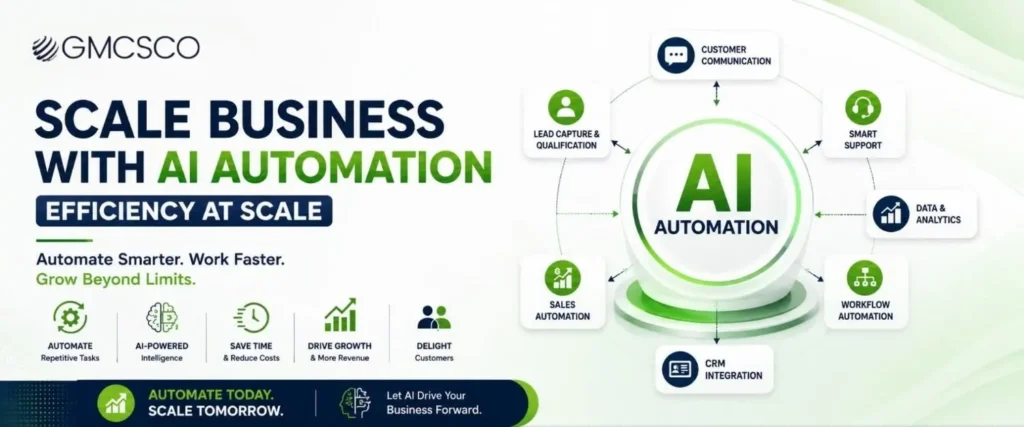
⚙️ AI Business Automation — 2026 How AI Automation Helps Scale a Business: The Complete Guide for Saudi Arabia & UAE 17 ways to build a human + AI operating model — automating repetitive work while keeping people focused on strategy, relationships, and judgment. 17 Use CasesSales, support, HR, finance & more Human + AIA model, not a replacement 6 PhasesDiscover → Pilot → Scale Quick Answer AI automation helps businesses scale by automating repetitive work, improving response times, processing information faster, and allowing employees to focus on higher-value activities. Instead of scaling only by hiring more people, businesses can use AI across Lead capture → Customer communication → Qualification → Sales follow-up → CRM updates → Marketing → Support → Reporting → Internal workflows. The objective isn’t to replace every human task — it’s to create a human + AI operating model where AI handles repetitive, data-intensive work while people focus on strategy, relationships, creativity, complex decisions, and revenue-generating activities. For businesses in Saudi Arabia and the UAE, this aligns with the region’s broader focus on AI adoption and digital transformation. Growth Creates More Work, Not Just More Revenue Business growth sounds simple: more customers, more sales, more revenue. But operationally, growth creates another problem — more work. More leads mean more follow-ups. More customers mean more support requests. More sales mean more CRM updates. More campaigns mean more marketing operations. More transactions mean more reporting. Eventually, businesses reach a point where adding more employees becomes the default answer to increasing workload — but hiring alone doesn’t always solve the underlying problem. If a process is inefficient with 10 employees, adding 20 more may simply make the inefficient process more expensive. Instead of asking “how many more people do we need?”, businesses can ask: “which parts of our operation can be intelligently automated?” What Is AI Business Automation? Traditional automation follows predefined rules — “if a customer submits a form → send an email.” AI automation adds a layer of intelligence: “Customer submits enquiry → AI understands the enquiry → identifies intent → classifies the lead → provides an appropriate response → updates CRM → routes qualified lead to sales.” 📋 Traditional Automation Rule → Action. 🤖 AI Automation Data → Understanding → Decision support → Action. The best business systems can combine both. Why AI Automation Matters for Growth Scaling a business creates four common challenges: more work, more complexity, more data, and more customer expectations. AI automation can address parts of all four — an AI chatbot handles routine questions, CRM automation updates records, AI lead qualification prioritizes prospects, automated reporting summarizes performance, AI content workflows accelerate marketing production, and workflow automation moves information between systems. The result can be greater operational capacity without increasing manual workload at the same rate. AI Automation vs Traditional Automation Traditional Automation AI Automation Rule-based Context-aware Predictable inputs Can handle variable inputs Fixed workflows Can adapt within defined boundaries “If X, do Y” Understand → decide → act Limited interpretation Natural-language understanding Best for repetitive rules Useful for complex information-heavy tasks AI is not automatically better for every process. “Invoice amount > SAR 50,000 → require approval” doesn’t necessarily require AI. The strongest strategy uses AI where intelligence is useful and traditional automation where rules are sufficient. 17 Ways AI Automation Helps Scale a Business 1. Automate Repetitive Tasks Copying data between systems, updating CRM records, sending routine follow-ups, categorizing enquiries, generating standard reports, scheduling meetings, answering repetitive questions, creating internal notifications, sorting incoming requests — AI automation can reduce the manual work involved without necessarily eliminating the role, allowing employees to spend less time on repetitive administration. 2. Automate Lead Capture A growing business receives leads from Google Ads, SEO, social media, website forms, WhatsApp, landing pages, chatbots, and referral campaigns — without automation, these leads end up scattered. AI can connect these channels into one workflow: Website enquiry → AI identifies requirement → Lead added to CRM → Lead categorized → Lead score assigned → WhatsApp/email follow-up → Sales notification. 3. Automate Lead Qualification Not every lead deserves the same sales response. AI can identify signals such as service requirement, company size, budget range, location, buying timeline, business problem, and intent — “we need WhatsApp automation for 50 sales agents and want implementation next month” represents stronger intent than “what is WhatsApp API?” 4. Accelerate Customer Response A prospect may contact multiple providers simultaneously — the faster company often has the advantage. AI chatbots can respond immediately: “Do you provide CRM integration?” → “Yes. We can help integrate CRM workflows with WhatsApp, lead capture and customer communication. Would you like to discuss your current CRM setup?” — then collect information and route the conversation. 5. Scale Customer Support Pricing, service availability, account information, order status, appointment details, documentation, basic troubleshooting — AI handles suitable routine questions while complex issues transfer to human agents, creating a hybrid model: AI handles routine requests, humans handle complex cases. 6. Automate WhatsApp Communication Particularly valuable for businesses targeting Saudi Arabia and the UAE: Lead clicks advertisement → WhatsApp conversation → AI qualification → Service recommendation → CRM update → Sales handover → Automated follow-up, connecting communication, qualification, and sales into one workflow. 7. Automate Sales Follow-Up “I’ll get back to you next week” often gets lost when the salesperson gets busy. AI and workflow automation create structured reminders: Meeting completed → CRM updated → Follow-up reminder → Relevant information sent → Sales notification → Opportunity updated — making follow-up systematic rather than memory-dependent. 8. Automate CRM Management A CRM is only valuable when its data is accurate. AI automation can assist with contact creation, lead categorization, conversation summaries, activity logging, lead scoring, task creation, sales-stage updates, and follow-up reminders — Conversation → Summary → CRM record → Next action, reducing administrative work. 9. Automate Marketing Operations Content research, content briefs, email workflows, lead segmentation, campaign reporting, audience analysis, social media workflows, personalization, and lead scoring — but AI-generated marketing content should still

Scale Business with AI Automation: Efficiency at Scale Read More »

Lead Nurturing Automation Software

Lead Nurturing Automation: From Prospect to Loyal Client

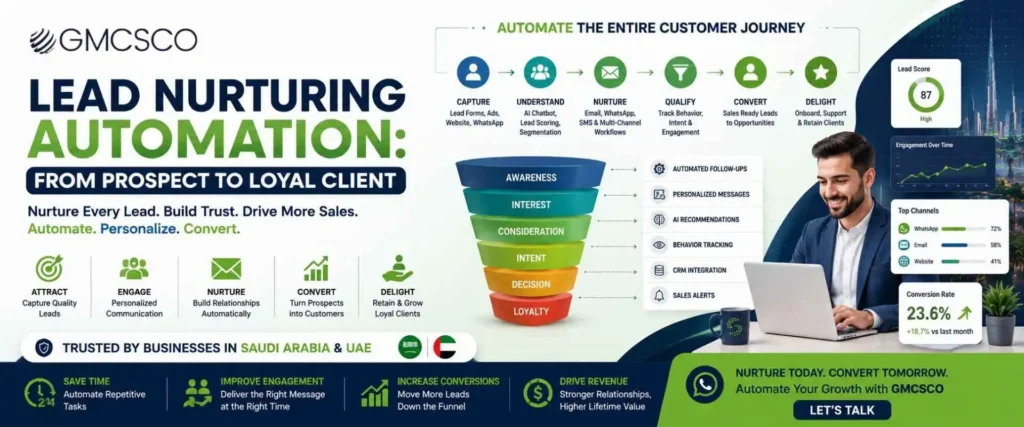
🌱 Lead Nurturing Automation — 2026 Lead Nurturing Automation: The Complete 2026 Guide for Saudi Arabia & UAE 25 ways to keep interested prospects engaged until they’re ready to buy — without forcing every enquiry into a sales call. 25 TacticsAcross scoring, WhatsApp & AI 92.7%WhatsApp usage in Saudi Arabia 45.2%Saudi AI tool adoption (2025) Quick Answer Lead nurturing automation is the use of software, CRM systems, AI, and automated communication workflows to build relationships with prospects who are not yet ready to buy: capture the lead → understand → segment → send relevant communication → follow up → identify intent → alert sales → convert → continue post-sale engagement. It can use WhatsApp, email, SMS, CRM workflows, and AI chatbots to deliver timely communication based on a prospect’s behaviour and stage in the buying journey. For businesses in Saudi Arabia and the UAE, the goal isn’t more automated messages — it’s more relevant conversations that move qualified prospects toward a decision. Not Every Prospect Buys on Day One Someone may download a guide today, request pricing next week, compare providers next month, and become a customer months later — especially common in B2B where decisions involve multiple stakeholders and longer approval processes. Many businesses treat every lead as either “buy now → sales” or “not buying now → forget the lead,” creating a significant gap. Saudi Arabia’s latest Internet Report shows 99.6% internet penetration, 45.2% AI tool adoption, 61.3% of users online seven or more hours daily, and 92.7% WhatsApp usage. The UAE’s official AI strategy similarly focuses on improving performance and creating economic value from AI investment. Lead nurturing is moving beyond occasional email follow-ups into a connected, multi-channel customer journey. What Is Lead Nurturing Automation Software? Technology that combines CRM, email, WhatsApp, AI, lead scoring, website tracking, and chatbots to trigger actions based on events: a lead downloads an ebook → send an educational email; visits the pricing page → increase lead score; starts a WhatsApp conversation → trigger a sales workflow; becomes inactive → start re-engagement. Far more powerful than sending the same newsletter to everyone. Lead Nurturing vs Lead Generation 📥 Lead Generation Brings prospects into your business — SEO, Google Ads, LinkedIn, social media, content, WhatsApp. 🌱 Lead Nurturing Develops the relationship — email, WhatsApp, AI, content, follow-up, remarketing, sales outreach. A business can generate thousands of leads and still struggle to grow if its nurturing process is weak. The Modern Lead Nurturing Funnel 1 Awareness The prospect discovers your brand. 2 Interest They consume your content or enquire. 3 Consideration They compare solutions. 4 Intent They request pricing, a demo, or consultation. 5 Decision They speak with sales and evaluate the proposal. 6 Customer They purchase. 7 Loyalty They receive onboarding, support, and relevant communication. Nurturing doesn’t necessarily end when the sale happens — post-sale automation can turn customers into repeat buyers and advocates. 25 Ways to Automate Lead Nurturing 1. Start With Lead Segmentation A SaaS company and a real estate company have different buying journeys. Segment by industry, location, company size, service interest, budget, buying stage, and lead source — for Saudi/UAE campaigns, include Riyadh, Jeddah, Dubai, and Abu Dhabi where geography genuinely affects the offer. 2. Define Your Ideal Customer Profile Market, industry, decision maker, requirement, company size, and buying timeline — automation can then prioritize prospects matching this profile instead of spending equal resources on every lead. 3. Build Different Nurturing Journeys New Leads get educational information, High-Intent Leads move toward sales, Pricing Leads get commercial information, Unresponsive Leads start re-engagement, and Enterprise Leads route to specialized sales — a more personalized journey for each situation. 4. Use Lead Scoring Behaviour Example Interpretation Reads blog Low/medium intent Downloads guide Medium intent Visits pricing Higher intent Requests proposal High intent Books meeting Very high intent 5. Automate Email Nurturing Day 0 welcome + resource, Day 2 educational article, Day 5 industry insight, Day 9 case study, Day 21 consultation CTA — but behaviour should override the schedule. If the prospect books a meeting on Day 4, they shouldn’t keep receiving generic prospecting emails. 6. Use WhatsApp for Faster Conversations With 92.7% usage in Saudi Arabia: Lead submits enquiry → WhatsApp confirmation → useful resource → follow-up → AI qualification → sales handover, making WhatsApp more than a support channel — part of the nurturing and conversion process. 💬 Turn More Enquiries Into Sales Opportunities GMCSCO can design automated lead nurturing workflows using CRM, AI, WhatsApp, and other channels to keep qualified prospects engaged until they’re ready to talk to sales. 💬 Chat on WhatsApp: +91 95133 51353 7. Combine AI With Lead Nurturing Instead of everyone getting Email A → B → C, AI-assisted automation uses intent, conversation history, and content consumed to determine the next interaction — “how much does WhatsApp API cost for 50 agents?” signals far stronger intent than “what is WhatsApp API?” 8. Use AI Chatbots During the Nurturing Journey “I contacted you last week about CRM integration” → “Welcome back — are you looking for CRM integration with WhatsApp, your website, or both?” Continuity reduces friction and makes the experience feel connected rather than starting from zero. 9. Use Behaviour-Based Automation Reading one blog triggers no action; visiting the pricing page increases lead score; starting a WhatsApp conversation triggers qualification; booking a meeting stops generic nurturing — reacting to behaviour beats sending identical messages to every lead. 10. Automate Follow-Up After Sales Conversations Meeting completed → CRM updated → follow-up workflow triggered → relevant information sent → reminder created → salesperson notified — reducing how many promising conversations simply disappear. 11. Automate Proposal Follow-Up Day 1 proposal confirmation, Day 3 answer common questions, Day 7 relevant case study, Day 12 offer consultation — communication that adds value instead of repeatedly asking “any update?” 12. Create Industry-Specific Nurturing Healthcare gets patient communication and appointment automation content; Real Estate gets lead response and property enquiry automation; B2B Technology gets CRM integration and AI automation — a

Lead Nurturing Automation: From Prospect to Loyal Client Read More »

AI Chatbot for Lead Qualification

Qualifying Leads Automatically with AI Chatbot Solutions

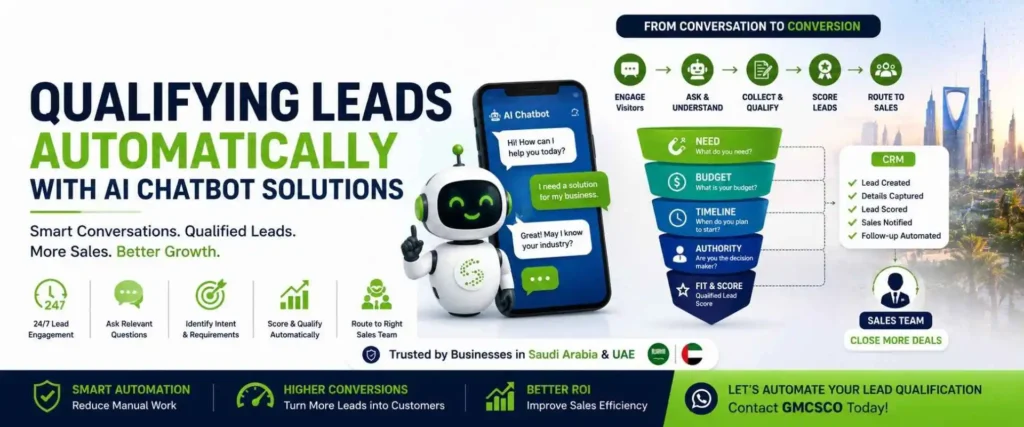
✅ AI Lead Qualification — 2026 AI Chatbot for Lead Qualification: The Complete 2026 Guide for Saudi Arabia & UAE 20 ways an AI chatbot turns raw enquiries into scored, routed, sales-ready opportunities. 45.2%Saudi AI tool adoption (2025) 92.7%WhatsApp usage in Saudi Arabia 20 Use CasesAcross qualification & routing Quick Answer An AI chatbot for lead qualification uses artificial intelligence to communicate with prospects, understand their requirements, collect relevant information, identify buying intent, and route suitable prospects to a sales team or CRM. Instead of treating every enquiry equally, it asks questions like service needed, location, industry, timeline, and consultation interest — then categorizes the enquiry against predefined business criteria. For businesses in Saudi Arabia and the UAE, this reduces manual lead screening, improves response speed, and lets sales teams focus on potentially valuable opportunities. Generating Leads Is Only Half the Challenge Imagine 200 enquiries a month — some ready to buy, some comparing providers, some just researching, some outside the target market. If sales manually reviews every one, time gets spent sorting instead of selling. An AI chatbot can have an initial conversation, understand what the prospect wants, collect qualifying information, and determine the next workflow — not simply more conversations, but better organized conversations → better prioritization → faster sales response. Saudi Arabia’s 2025 Internet Report shows 45.2% AI tool adoption alongside 99.6% internet penetration and 92.7% WhatsApp usage. The UAE has made AI a strategic national priority through its own AI strategy. The question is moving from “should we use AI?” to “where can AI create measurable business value?” Lead qualification is one of the most practical answers. What Is AI Lead Qualification? Lead Starts Chat → AI Asks Questions → Intent Identified → Lead Scored → CRM Updated → Sales Notified This doesn’t mean AI makes every final sales decision — it acts as the first qualification layer. AI Chatbot vs Traditional Lead Form 📋 Traditional Form Name, Email, Phone, Message — useful, but limited context before a salesperson gets involved. 🤖 AI Conversation “I need WhatsApp automation for my real estate company” → AI asks which market, monthly lead volume, and specific need — far more context before sales steps in. Why Automated Qualification Matters Without Automation 100 enquiries → sales manually reviews all 100 → low-quality leads consume time → high-value leads may wait. With AI Qualification 100 enquiries → AI collects information → categorized → high-priority leads routed immediately → sales focuses on qualified opportunities. 20 Ways AI Chatbots Qualify Leads 1. Qualify Leads 24/7 Early morning, late evening, weekends, holidays — an AI chatbot starts the qualification process the moment a prospect arrives, giving an immediate response instead of “we’ll contact you during business hours,” especially valuable when campaigns generate enquiries throughout the day. 2. Ask the Right Qualification Questions A good chatbot doesn’t ask every visitor the same 15 questions — “I need SEO services” → “Which market are you targeting?” → “Saudi Arabia” → “Local SEO, ecommerce SEO, or enterprise SEO?” Each question depends on the previous answer, creating a natural qualification journey. 3. Identify Customer Intent “What is SEO?” is low intent. “How much does SEO cost?” is commercial investigation. “I need an SEO agency for my Riyadh business” is high commercial intent. Classifying conversations into Information, Comparison, Commercial, and High Intent helps route them appropriately. 4. Capture Important Lead Information Company, industry, country, city, service required, number of employees, budget range, timeline, and business objective — customized around the company’s Ideal Customer Profile, capturing what traditional forms often miss. 5. Automatically Categorize Leads Hot Lead (strong intent + suitable company + immediate requirement), Qualified Lead (matches profile, needs discussion), Nurture Lead (relevant but not ready), Low Priority, or Support Request — each category triggers a different workflow. 6. Connect AI Lead Qualification With CRM The AI captures Company: ABC Technology, Location: Riyadh, Requirement: WhatsApp Business API, Team Size: 25, Timeline: This month, Intent: High — automatically creating or updating the CRM record so the salesperson can open with “I understand you’re looking for WhatsApp Business API integration for your 25-person team” instead of “so, what are you looking for?” 7. Automate Lead Scoring Lead Signal Potential Weight Service enquiry Medium Pricing request High Demo request High Enterprise requirement Very High Immediate timeline High Outside target market Low Generic information request Low The exact model should be customized to the business — treat scores as decision support, not unquestionable judgments. 8. Reduce Response Time Welcome the visitor → answer basic questions → collect requirements → qualify → offer a meeting → notify sales, all immediately — shrinking the gap between Interest → Conversation → Sales Action before a competitor responds first. 9. Automatically Book Meetings With Qualified Leads “Based on your requirements, a consultation would be useful — would you like to schedule a meeting?” removes unnecessary back-and-forth when connected to an appropriate scheduling system. 10. Use WhatsApp for AI Lead Qualification With WhatsApp at 92.7% usage in Saudi Arabia: Google/Social/Website → WhatsApp → AI Chatbot → Qualification Questions → Lead Score → CRM → Sales Representative — significantly easier than a lengthy form. 11. AI Lead Qualification for B2B Businesses Company size, industry, decision-maker role, technology requirement, budget, timeline, and number of users — collected during the initial conversation, particularly useful for SaaS, IT, digital agencies, enterprise technology, and business consulting. 12. AI Lead Qualification for Saudi Arabia 99.6% internet penetration, 45.2% AI adoption, 99.6% mobile internet access, and 92.7% WhatsApp usage mean qualification journeys should be mobile-first: Mobile Ad → Landing Page → WhatsApp → Arabic/English AI conversation → Qualification → CRM → Sales. A localized approach beats copying a global chatbot workflow. 13. AI Lead Qualification for the UAE The UAE’s national AI strategy and Dubai’s Universal Blueprint for AI focus on accelerating adoption across strategic sectors. Workflows can be customized by industry, company size, location (Dubai, Abu Dhabi, Sharjah), buyer role, budget, and timeline — particularly useful for a diverse international customer base. 14.

Qualifying Leads Automatically with AI Chatbot Solutions Read More »

Scroll to Top