
🛍️ Conversational Commerce — 2026
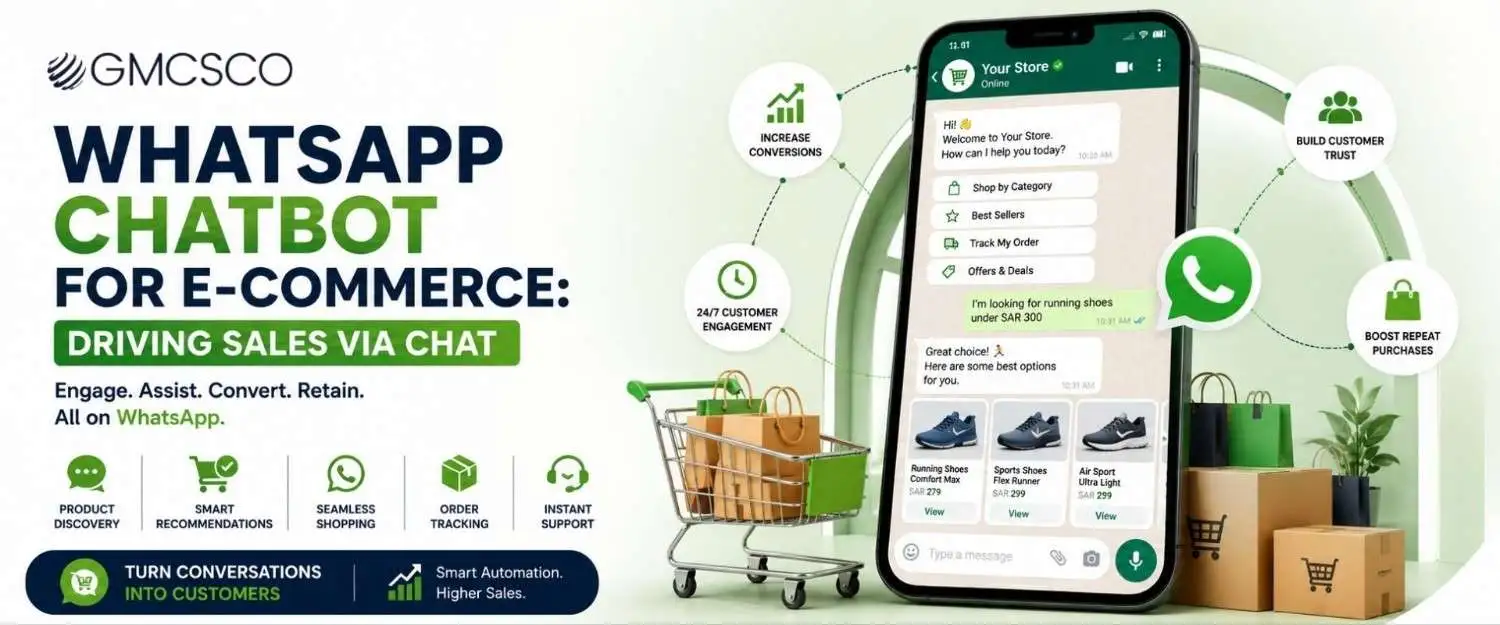
WhatsApp Chatbot for E-Commerce: The Complete Guide for Saudi Arabia & UAE
20 ways to turn product questions on WhatsApp into structured sales opportunities — from discovery through delivery and repeat purchase.
Quick Answer
A WhatsApp chatbot for e-commerce helps online businesses turn customer conversations into structured sales opportunities by automating product enquiries, recommendations, lead qualification, order support, follow-ups, and customer communication through WhatsApp. Instead of asking customers to leave WhatsApp and navigate multiple pages, a well-designed chatbot helps them: Discover products → Ask questions → Get recommendations → Receive relevant information → Add to cart or checkout → Receive order updates → Get support → Return for future purchases. For businesses in Saudi Arabia and the UAE, this matters because digital commerce and electronic payments continue to expand — electronic payments represented 85% of total retail payments in Saudi Arabia in 2025, up from 79% in 2024, according to the Saudi Central Bank. The opportunity isn’t simply to put a chatbot on WhatsApp — it’s to make WhatsApp part of the complete ecommerce customer journey.
The 11:30 PM Question That Stops a Sale
A customer finds a product they like, then has a question: “Is this available in my size?” “Can you deliver to Riyadh?” “Which product is better for sensitive skin?” “Do you accept mada?” “Where is my order?” If they have to wait until the next morning for an answer, the purchase journey often stops — they open another website, compare another product, ask another seller, or simply forget about the purchase. This is one of the biggest opportunities for conversational commerce: a WhatsApp chatbot can provide immediate assistance for common questions, guide shoppers toward suitable products, and connect qualified customers with human sales or support teams.
What Is a WhatsApp Chatbot for E-Commerce?
An automated conversational system interacting with customers through WhatsApp — depending on configuration, it can help with product discovery, recommendations, pricing enquiries, stock questions, order status, delivery information, customer support, lead qualification, promotions, appointment booking, cart recovery workflows, and human agent handover. An advanced chatbot can also connect with ecommerce platforms, CRM systems, inventory systems, and payment infrastructure — making WhatsApp more than a communication channel, a sales and customer experience layer connected to the rest of the business.
Why WhatsApp Matters for E-Commerce
Online shopping removed geographical limitations but increased competition — customers compare price, reviews, delivery, product features, offers, customer service, and brand reputation within minutes. The buying experience can influence conversion just as much as the product itself. WhatsApp reduces friction because customers can ask questions through a familiar conversational interface rather than searching through multiple pages — combining Conversation + Product Discovery + Sales + Support in one journey.
Saudi Arabia: A Strong Market for Conversational Commerce
A Monsha’at ecommerce report estimates 34.5 million ecommerce users by 2025 and highlights continued development of ecommerce, payment, and logistics infrastructure. According to the Saudi Central Bank, electronic payments represented 85% of total retail payment transactions in 2025, with 14.6 billion electronic transactions recorded during the year. SAMA has also continued developing ecommerce payments infrastructure, including improvements around mada integration and payment security — creating an environment where Conversation → Product → Checkout → Payment → Delivery can increasingly happen through connected digital systems.
UAE: Why WhatsApp Ecommerce Automation Matters
The UAE government states that ecommerce is regulated under Federal Decree by Law No. 14 of 2023 on Modern Technology Based Trade, covering online transactions through websites, mobile applications, social platforms, and digital marketplaces. For ecommerce companies operating in the UAE, conversational commerce should be designed as part of a broader digital commerce strategy rather than treated as an isolated marketing channel.
How a WhatsApp Ecommerce Chatbot Works
Ad Click
Discovery
Recommendation
Purchase
Retention
20 Ways a WhatsApp Chatbot Drives Ecommerce Growth
1. Product Discovery Through WhatsApp
“I need a laptop for business use under AED 4,000” — instead of requiring the customer to enter search filters, the chatbot asks what they’ll mainly use it for, storage needs, and OS preference, then presents relevant options, turning discovery into a conversation.
2. AI Product Recommendations
“I need a skincare product for dry skin” — an AI chatbot asks appropriate follow-up questions and recommends products based on category, preferences, budget, previous purchases, and availability from the store’s approved knowledge base. Recommendations should be based on reliable product data, not unsupported AI assumptions.
3. Answer Product Questions Instantly
Is this available? What sizes? What’s the warranty? How long does delivery take? A chatbot connected to approved product information answers common questions quickly, transferring complex or sensitive ones to a human.
4. Generate Sales From Conversations
Rather than just answering questions, the chatbot guides customers toward an action: “Would you like to view the product, speak with a specialist, or continue shopping?” — View Product, Buy Now, Get Recommendation, Speak to Sales, Track Order — turning the conversation into part of the sales funnel.
5. Recover Abandoned Shopping Journeys
Product viewed → Question asked → Added to cart → Purchase not completed. A suitable follow-up workflow can remind the customer about the product, but businesses must design these carefully and follow applicable WhatsApp and privacy requirements — the purpose is to help complete a genuine shopping journey, not overwhelm with messages.
💬 Turn WhatsApp Conversations Into Sales Opportunities
GMCSCO can help ecommerce businesses in Saudi Arabia and the UAE connect WhatsApp, AI chatbots, CRM, and ecommerce workflows into a structured customer journey.
6. WhatsApp Order Tracking
Confirmed
Processing
Shipped
Out for Delivery
Delivered
A connected WhatsApp system provides appropriate order-related updates from the ecommerce or logistics system — reducing repetitive support enquiries.
7. Customer Support Through WhatsApp
“How can I return my order?” gets the approved return process instantly; “My order arrived damaged” transfers to a human support agent — AI handles repetitive questions, humans handle exceptions and complex issues.
8. WhatsApp for Cross-Selling
Camera purchase → relevant accessories; skincare purchase → compatible products. Cross-selling should be based on genuine relevance — sending unrelated promotions can damage customer trust.
9. WhatsApp for Repeat Purchases
Beauty products, supplements where legally appropriate, pet supplies, household products, food products, and other consumables lend themselves to reordering — “Would you like to reorder your previous purchase?” simplifies repeat purchasing.
10. Build Customer Segments
A CRM connected with WhatsApp can segment by new customer, returning customer, high value customer, product category, purchase frequency, location, interests, and lifecycle stage — for Saudi and UAE businesses, this can also support region-specific communication.
11. Arabic and English Customer Experiences
A chatbot can be designed to support Arabic, English, or additional languages depending on the audience — the important point isn’t simply translation, the conversation should feel natural and culturally appropriate. Arabic support is particularly valuable for Saudi customers; multilingual support is useful for the UAE’s highly international customer base.
12. WhatsApp Lead Generation for Ecommerce
“Can you send me the catalogue?” or “I want to buy for my company” signals commercial intent — the chatbot can identify this and capture name, company, requirement, quantity, location, budget, and preferred product before adding the lead to the CRM, particularly useful for businesses selling both B2C and B2B.
13. B2B Ecommerce Through WhatsApp
Bulk orders, wholesale pricing, custom products, delivery schedules, invoices, payment terms, and specifications — an AI chatbot can collect initial requirements and route qualified enquiries to the appropriate sales team, significantly reducing repetitive qualification work.
14. Connect WhatsApp With Your Ecommerce Store
Store
AI Chatbot
CRM
Inventory
Support
This allows information to move between systems instead of forcing employees to manually copy information.
15. Connect WhatsApp With CRM
Without Integration
WhatsApp conversation → employee manually records information.
With Integration
WhatsApp → Customer identified → CRM updated → Lead stage updated → Follow-up triggered → Sales notified.
16. Use AI for Lead Qualification
With hundreds of WhatsApp enquiries, sales can’t give every conversation equal attention. AI can identify product interest, purchase intent, budget, quantity, timeline, and location — “I want 100 units for my company and need delivery next month” should be treated differently from “how much is this?”
17. WhatsApp Chatbot for Ecommerce Promotions
New product launch, seasonal offer, limited availability, loyalty benefit, back-in-stock, relevant category promotion — promotional messaging should be permission-based and compliant with applicable WhatsApp requirements and local privacy/marketing rules. The strategy should prioritize relevance over message volume.
18. Back-in-Stock Notifications
Customer wants product → Unavailable → Requests notification → Becomes available → Appropriate notification → Customer returns to product — converting previously lost demand into future sales opportunities.
19. Customer Reviews Through WhatsApp
“How was your shopping experience?” after delivery, directing customers to the appropriate review or feedback mechanism — helping businesses collect insights and identify service problems. Review requests should be designed around genuine customer experiences rather than incentivizing misleading reviews.
20. WhatsApp for Customer Retention
Acquiring a customer is only one part of ecommerce growth — long-term growth depends on repeat purchases, satisfaction, retention, loyalty, and customer lifetime value. The objective: First purchase → Better experience → Repeat purchase → Long-term customer.
WhatsApp Chatbot vs WhatsApp Marketing
📢 WhatsApp Marketing
Focuses on sending approved promotional or customer communication messages. E.g. “Our new collection is now available.”
💬 WhatsApp Chatbot
Focuses on interactive conversations. E.g. “What type of product are you looking for? What’s your budget?”
The strongest ecommerce strategy can combine both.
WhatsApp Chatbot vs Website Chatbot
🌐 Website Chatbot
Useful for website visitors, product enquiries, on-site support.
💬 WhatsApp Chatbot
Useful for conversational sales, follow-up, support, order updates, lead qualification, repeat communication.
Businesses can use both rather than choosing only one.
How AI Makes WhatsApp Ecommerce Chatbots Better
Traditional chatbot: Menu → Option → Menu → Option. AI chatbot: Customer explains requirement naturally → AI understands intent → retrieves approved information → responds → continues conversation. “I’m looking for a birthday gift for my wife under SAR 500 — can you suggest something?” gets understood and narrowed into relevant products, feeling more like shopping assistance than menu navigation.
Important: AI Should Not Invent Product Information
An AI chatbot should never invent prices, stock, discounts, delivery dates, warranty terms, or specifications. It should retrieve information from trusted business systems or an approved knowledge base — if information is unavailable, it should say so and offer a human handover. Accuracy is more important than sounding intelligent.
A Complete WhatsApp Ecommerce Sales Funnel
Customer sees Google or social advertisement.
Customer clicks WhatsApp.
Chatbot asks what the customer needs.
AI identifies the product category.
Customer receives suitable products.
Customer asks questions.
Chatbot provides approved product information.
Customer clicks to purchase.
Order information is confirmed.
Customer receives appropriate updates.
Customer receives support.
Customer enters the retention journey.
This turns WhatsApp into a complete conversational commerce channel.
📅 Build Your WhatsApp Ecommerce Sales Journey
Receiving product enquiries on WhatsApp but still handling everything manually? GMCSCO can connect your WhatsApp Business Platform, AI chatbot, ecommerce store, and CRM into an automated sales workflow.
How to Implement a WhatsApp Chatbot for Ecommerce
Define the Business Objective
Not “we need a chatbot” — “what problem are we solving?” (enquiries, conversion, support workload, cart recovery, order updates, qualification).
Map the Customer Journey
Advertisement → WhatsApp → Discovery → Qualification → Purchase → Delivery → Support → Retention.
Prepare Product Data
Products, categories, prices, stock, specifications, delivery, returns, FAQs.
Define Human Handover Rules
Customer requests human, complaint, complex issue, refund exception, high-value customer, technical problem, uncertain answer.
Connect CRM and Ecommerce Systems
Shopify, WooCommerce, custom platform, CRM, inventory, ERP, payments, support platform.
Build and Test
Test real customer scenarios — accuracy, human access, CRM updates, message timing, workflow stops after purchase.
Measure Results
Conversations, qualified conversations, enquiries, CTR, conversion rate, sales generated, automation rate, repeat purchases.
How GMCSCO Can Help
GMCSCO can help ecommerce businesses in Saudi Arabia and the UAE build WhatsApp-based customer journeys around their sales and support requirements — connecting:
The exact workflow should be designed around the company’s products, sales cycle, customer data, and technology infrastructure. For businesses in Saudi Arabia and the UAE, the strategy can also be localized around market, language, customer journey, and business requirements.
Measuring WhatsApp Chatbot ROI
Sales
WhatsApp-generated sales, conversion rate, AOV, revenue per conversation.
Leads
Qualified leads, lead-to-customer conversion, response time, handover rate.
Support
Automated resolution rate, escalation rate, resolution time.
Customer
Repeat purchase rate, satisfaction, retention, lifetime value.
The key question isn’t “how many conversations did the chatbot handle?” — it’s “how much business value did the chatbot create?”
Common Mistakes When Using WhatsApp Chatbots for Ecommerce
Too Complicated
Customers should reach useful information quickly.
Too Many Menu Options
Keep the first interaction simple.
Incorrect Product Info
Connect the chatbot to reliable data.
No Human Handover
Customers should have an easy path to a person.
Too Many Promos
Automation should improve the customer experience.
Not Connecting CRM
A standalone chatbot creates disconnected customer data.
Ignoring Post-Purchase
The customer journey continues after payment.
AI as Strategy Replacement
A chatbot can’t fix poor products, pricing, or logistics.
Frequently Asked Questions
What is a WhatsApp chatbot for ecommerce?
A WhatsApp chatbot for ecommerce is an automated conversational system that helps online stores communicate with customers, answer questions, recommend products, qualify enquiries, provide support, and assist with the buying journey.
Can a WhatsApp chatbot increase ecommerce sales?
It can help reduce friction, improve response times, assist product discovery, and move customers toward relevant purchasing actions. Actual results depend on the product, offer, customer journey, implementation, and traffic quality.
Can a WhatsApp chatbot recommend products?
Yes. AI-powered chatbots can recommend products when connected to reliable product information and suitable recommendation logic.
Can WhatsApp chatbot track ecommerce orders?
Yes, when the chatbot is appropriately integrated with the ecommerce or order management system, it can provide relevant order status information.
Can WhatsApp chatbot recover abandoned carts?
It can support appropriate abandoned cart or incomplete purchase workflows, subject to platform rules, customer permissions, and applicable regulations.
Can WhatsApp chatbot integrate with Shopify or WooCommerce?
Integration can be possible through APIs, connectors, or custom development depending on the platform configuration and required workflow.
Can WhatsApp chatbot work in Arabic?
Yes. A chatbot can be designed to support Arabic, English, and other languages depending on the business requirements and implementation.
Is WhatsApp chatbot useful for Saudi ecommerce businesses?
Yes. Saudi Arabia’s rapidly expanding digital payment and ecommerce ecosystem creates opportunities for conversational customer experiences. Electronic payments represented 85% of retail payments in 2025 according to SAMA.
Is WhatsApp chatbot useful for UAE ecommerce businesses?
Yes. UAE ecommerce businesses can use conversational automation for product discovery, sales, customer service, and post-purchase communication while operating within the applicable UAE ecommerce and consumer protection framework.
Should an ecommerce chatbot replace human support?
No. A hybrid model is usually more practical. AI can handle routine conversations while humans handle complex, sensitive, or high-value cases.
What is the difference between a WhatsApp chatbot and WhatsApp Business API?
The WhatsApp Business Platform provides the business messaging infrastructure and capabilities, while a chatbot is the conversational software or logic built on top of that infrastructure to automate interactions.
How much does a WhatsApp ecommerce chatbot cost?
There is no universal price. Cost depends on chatbot complexity, AI requirements, WhatsApp setup, integrations, CRM, ecommerce platform, automation workflows, and ongoing messaging or infrastructure requirements.
Final Thoughts
Ecommerce customers don’t always want to fill out another form or search another FAQ page — sometimes they simply want to ask “which product should I buy?”, “is this available?”, “when will it arrive?”, “can I return it?” A WhatsApp chatbot for ecommerce can turn these questions into useful conversations. The real opportunity is bigger than automated replies — it’s connecting Customer Conversation → AI → Product Discovery → Sales → Payment → Delivery → Support → Retention. For Saudi Arabia, this is supported by rapid ecommerce and digital payment development; for UAE businesses, ecommerce operates within an increasingly established digital commerce ecosystem covering websites, apps, social platforms, and marketplaces. The winning strategy isn’t “put a chatbot on WhatsApp” — it’s “build a conversational ecommerce journey that helps customers discover, decide, purchase, and return.”
Ready to Drive More Ecommerce Sales Through WhatsApp?
GMCSCO helps ecommerce businesses in Saudi Arabia and the UAE build AI-powered WhatsApp chatbot solutions connected with ecommerce stores, CRM systems, and customer communication workflows.