
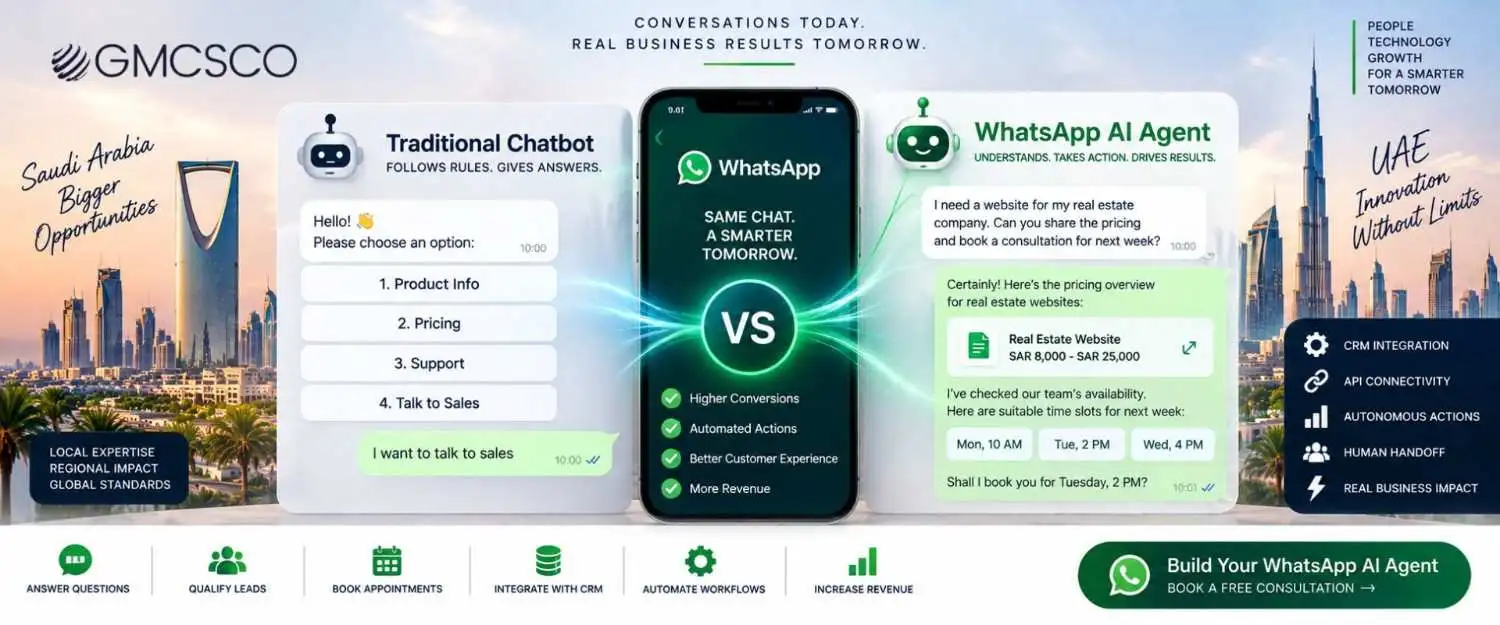
🤖 WhatsApp Automation — 2026
WhatsApp AI Agent vs Chatbot: What Is the Difference?
Chatbot = responds. AI chatbot = understands and responds. AI agent = understands, decides, and acts.
Quick Answer
A traditional WhatsApp chatbot generally follows predefined conversation logic. An AI chatbot can understand natural language and generate more flexible responses. A WhatsApp AI agent goes a step further by combining reasoning, business rules, tools, APIs, and actions to complete a task — Customer asks → AI understands intent → AI checks information → AI decides next step → AI calls an API → AI performs action → AI confirms result. For businesses in Saudi Arabia and the UAE, this distinction matters because WhatsApp is already deeply integrated into customer communication — Saudi Arabia’s 2025 Internet Report recorded WhatsApp usage at 92.7% among internet users, while AI tool adoption reached 45.2%. The question for 2026 isn’t “do we need a WhatsApp chatbot?” — it’s “do we need a chatbot that answers questions, or an AI agent that can actually help complete business processes?”
The Comparison at a Glance
| Capability | Traditional Chatbot | AI Chatbot | WhatsApp AI Agent |
|---|---|---|---|
| Natural language understanding | Limited | Strong | Strong |
| Handles unexpected questions | Limited | Better | Advanced |
| Maintains context | Limited | Yes | Yes |
| Connects with CRM | Possible | Yes | Yes |
| Uses APIs | Limited | Possible | Core capability |
| Makes decisions | Rule based | AI assisted | Goal and rule based |
| Takes actions | Limited | Some | Advanced |
| Lead qualification | Basic | Strong | Advanced |
| Multi-step workflows | Limited | Moderate | Advanced |
| Autonomous task execution | No | Limited | Yes, within defined permissions |
| Best for | FAQs and simple automation | Conversations | Complex business processes |
That distinction should guide your technology investment.
What Is a Traditional WhatsApp Chatbot?
An automated conversation system using predefined rules, menus, buttons, keywords, or workflow logic. A customer sends “Hello,” the bot responds “Welcome to ABC Company. Please select an option: 1. Product Information 2. Pricing 3. Book Appointment 4. Talk to Sales.” Traditional chatbots are predictable, easy to control, and relatively straightforward to test — they work especially well when conversations follow a known sequence: FAQ automation, order status, appointment requests, basic lead forms, and department routing. WhatsApp Business Platform provides APIs and interactive messaging capabilities for building these experiences, with a Cloud API supporting programmatic messaging and webhooks for receiving events.
What Is an AI Chatbot?
An AI chatbot uses artificial intelligence to understand natural language instead of depending entirely on predefined paths. A customer asking “I need a website for my real estate company. How much does it cost and how long will it take?” gets understood as Service: Website development, Industry: Real estate, Intent: Pricing and timeline — the AI then responds naturally and asks relevant follow-up questions. However, an AI chatbot doesn’t automatically become an AI agent — that distinction is critical.
What Is a WhatsApp AI Agent?
An AI-powered conversational system designed not only to communicate but also to perform defined business tasks using tools, APIs, databases, CRM systems, and workflows. Instead of stopping at Customer asks → AI answers, the workflow becomes Customer asks → AI understands intent → AI checks information → AI decides next step → AI calls an API → AI performs action → AI confirms result. A customer asking “Can you check whether tomorrow’s 4 PM appointment is available?” could have the agent understand the request, connect with the appointment system, check availability, reserve the slot if permitted, and send confirmation — this is the fundamental difference between conversational automation and agentic automation.
The Three Levels of WhatsApp Automation
Level 1: Traditional Chatbot
Customer → predefined flow → predefined response.
Best for: FAQs, menus, basic lead forms, simple routing.
Level 2: AI Chatbot
Customer → AI understands → response.
Best for: natural conversations, product questions, lead qualification.
Level 3: AI Agent
Customer → AI understands → reasons → uses tools → takes action → confirms result.
Best for: CRM operations, appointment booking, order workflows, sales automation.
Why WhatsApp AI Agents Matter in 2026
In June 2026, Meta announced Meta Business Agent, describing it as an AI system that can answer business-specific questions, recommend products, book appointments, qualify leads, allow human intervention, and close sales — alongside a Business Agent Platform designed to connect agents with business systems and tools. This signals a major shift from “Automate replies” toward “Automate customer processes.”
The Core Difference: Action Capability
📋 Traditional Chatbot
“Where is my order?” → “Please enter your order number.” → “Your order is being shipped.” Useful but limited.
🤖 AI Agent
“Where is my order and can I change the delivery address?” — identifies the order, checks if modification is permitted, calls the system, updates it if allowed, confirms the change, or escalates.
What Makes an AI Agent Different?
Natural Language Understanding
Understands what the customer wants to accomplish.
Context
Uses conversation and, where permitted, CRM information.
Knowledge
Product catalogs, pricing, policies, documentation.
Tools & APIs
CRM, calendar, ERP, payment, shipping, booking systems.
How WhatsApp AI Agents Work
Customer → WhatsApp → WhatsApp Business Platform
↓
AI Agent Layer → Intent Detection → Business Knowledge
↓
Decision Logic → Tools and APIs
↓
CRM / ERP / Booking / Ecommerce
↓
Response to Customer
This lets WhatsApp become an interface through which customers interact directly with business systems.
The 8-Layer AI Agent Architecture
1. WhatsApp Layer
Handles customer communication.
2. AI Layer
Understands language and context.
3. Knowledge Layer
Trusted business information.
4. Decision Layer
Determines what happens next.
5. Tool Layer
Access to approved actions.
6. Integration Layer
Connects APIs, CRM, software.
7. Safety Layer
Controls what AI can/cannot do.
8. Human Handoff Layer
Transfers to employees when required.
CRM Integration: Where AI Agents Become More Valuable
A customer sends “I need a quotation for 20 employees” — the agent collects name, company, industry, requirement, budget, and timeline, then creates or updates a CRM record: WhatsApp → AI qualification → CRM record → Lead score → Sales notification → Follow up. This eliminates the need for sales teams to manually copy information from WhatsApp into CRM — significantly improving lead management for B2B companies in Saudi Arabia and the UAE.
💬 Ready to Build a WhatsApp AI Agent?
GMCSCO can design a WhatsApp AI agent connected with your CRM, APIs, lead qualification workflows, and human support process.
WhatsApp AI Agent Use Cases by Industry
Lead Qualification
Instead of a sales rep manually responding to every enquiry, the agent asks structured questions — service needed, industry, location, timeline, team size — then classifies the lead as High Intent (ready for sales), Medium Intent (needs more information), or Low Intent (early research) and routes accordingly.
Appointment Booking
“I want to speak with your sales team tomorrow afternoon” — a properly integrated agent can understand the date and time preference, check the calendar, present available slots, book the selection, store it, send confirmation, and trigger reminders. The key word is integrated — an AI model alone doesn’t automatically have access to a company’s calendar; the agent needs appropriate tools, APIs, and permissions.
Ecommerce
“I need a black running shoe under AED 500” gets understood as Category: Running shoes, Color: Black, Budget: AED 500 — the agent queries an approved catalog and returns relevant products, potentially continuing through Product discovery → Recommendation → Cart → Checkout → Order confirmation → Delivery updates, depending on available APIs.
Real Estate
“I am looking for a 3 bedroom apartment in Riyadh under SAR 1.5 million” gets extracted into location, property type, bedrooms, and budget, then searched against an approved property database — the key is connecting the agent to reliable property data rather than allowing it to invent listings.
Healthcare
Suitable for appointment requests, clinic information, doctor availability, and reminders — but businesses should be careful about using AI to provide medical diagnosis or treatment decisions. The agent should have clearly defined boundaries and transfer sensitive or clinical situations to qualified professionals.
Travel, Logistics & More
Travel companies can collect travel dates, travelers, interests, and budget to recommend approved packages. Logistics companies can answer “Where is shipment 45892?” by querying the tracking system directly — far more useful than “please contact customer support.”
Human Handoff Is Still Essential
AI agents shouldn’t be designed around the idea that humans are no longer needed. A strong AI system knows when to stop — handoff can be triggered by customer request, high-value customer, complaint, sensitive information, payment issue, low confidence, or technical failure: AI handles routine work → AI identifies exceptions → Human handles exceptions. Meta’s 2026 Business Agent announcement specifically describes human intervention as part of its business agent experience.
What Does “Autonomous” Actually Mean?
An AI agent shouldn’t have unlimited freedom to make decisions inside a business. Businesses should define what the agent can see, decide, change, and access, and when human approval is required. For example, an ecommerce AI agent may be allowed to check inventory, recommend products, and create a cart — but a refund of AED 10,000 should require human approval. This is much safer than unrestricted access to business systems.
An AI model can generate language — it cannot magically update your CRM, check your inventory, or book your calendar. Those actions require integrations: AI Agent → CRM API → Customer Record, or AI Agent → Calendar API → Available Slots. This is why AI agent development is partly an AI problem and partly an integration architecture problem, and the architecture should follow the principle of least privilege — giving the agent access only to what its specific job requires.
Arabic and English AI Agents
A Saudi customer may write in English, Arabic, Arabizi, or a mixture of both — for example “أبغى موعد بكرة الساعة 4” — the system needs to understand intent rather than simply translate the sentence. Considerations include local terminology, Saudi dialect, currency and date formats, and city references. UAE businesses have a highly international customer base communicating in English, Arabic, Hindi, Urdu, and other languages — but language support should always be combined with strong business knowledge; a multilingual agent that gives incorrect information is still a poor experience.
What to Consider Before Implementing an AI Agent
Business Process
What task should the AI actually perform?
Data
What information does the AI need?
Integration
Which systems need to be connected?
Governance
What can the AI do without approval?
Measurement
How will success be measured?
Starting with the technology and searching for a problem afterward is usually the wrong approach. Saudi Arabia’s PDPL implementing regulations include specific requirements for direct marketing consent and opt-out mechanisms; the UAE’s Personal Data Protection Law similarly establishes requirements around processing, consent, and security. This article isn’t legal advice — verify specific compliance obligations with qualified legal or privacy professionals.
A Practical Decision Framework
Do customers mostly ask repetitive questions?
Yes → A traditional chatbot may be enough.
Do customers ask questions in many different ways?
Yes → An AI chatbot may be better.
Does the system need to access business data?
Yes → Integration is required.
Does the system need to perform actions?
Yes → Consider an AI agent.
Does the action involve sensitive or high value decisions?
Yes → Add human approval and strict controls.
📅 Not Sure Which Level You Need?
Schedule an AI Agent Consultation with GMCSCO to map your process, integrations, and the right level of automation for your business.
How to Measure WhatsApp AI Agent ROI
10,000 Conversations
7,500 Resolved
1,500 Qualified
400 Opportunities
100 Customers
SAR 1.5M Revenue
This gives management a much better picture than simply reporting “the AI handled 10,000 conversations.”
Total Cost of Ownership
| Cost Area | Traditional Chatbot | AI Chatbot | AI Agent |
|---|---|---|---|
| Initial setup | Lower | Medium | Higher |
| Integrations | Low | Medium | High |
| API development | Limited | Moderate | Significant |
| Governance | Basic | Important | Critical |
| Maintenance | Low | Medium | Medium to high |
The cheapest technology isn’t always the cheapest business solution — the correct comparison is technology cost vs business value, not technology cost vs technology cost.
Common Mistakes When Building WhatsApp AI Agents
Giving Too Much Access
Never grant unrestricted CRM, payment, or financial access.
No Human Handoff
Customers need a clear escalation path.
No Knowledge Governance
Outdated pricing or policies frustrate customers.
No CRM Integration
Conversations end without recording useful context.
Building Before Defining Use Case
Start with the process, not the technology.
Measuring Conversations, Not Outcomes
More conversations ≠ more revenue.
The Future: Agentic Commerce
Messaging is evolving from a communication channel into an action interface. A customer may increasingly expect to find a product, compare products, book an appointment, track an order, and request a quotation without leaving WhatsApp. “I need a laptop for video editing under AED 5,000” could have the agent understand requirements, search approved products, compare options, add a selection to cart, and help with checkout — the conversation itself becomes the interface. Meta’s 2026 Business Agent direction describes exactly this broader shift toward completing customer journeys inside conversations.
How GMCSCO Can Help Build WhatsApp AI Agents
The objective isn’t simply to put AI inside WhatsApp — it’s to connect WhatsApp + AI + business systems + customer journey into one measurable workflow:
Frequently Asked Questions
What is the difference between a WhatsApp AI agent and a chatbot?
A traditional chatbot primarily follows predefined workflows and responds to known inputs. An AI chatbot can understand natural language and provide more flexible responses. A WhatsApp AI agent goes further by using approved tools, APIs, and business systems to perform tasks and complete workflows.
Is a WhatsApp AI agent better than a chatbot?
Not always. A traditional chatbot is better for simple, predictable workflows. An AI agent becomes more valuable when customers require natural conversations, personalization, CRM access, API integrations, and automated actions.
Can a WhatsApp AI agent integrate with CRM?
Yes. A properly designed AI agent can connect WhatsApp conversations with CRM systems through APIs or integration platforms, allowing businesses to create leads, update records, qualify prospects, and trigger sales workflows.
Can an AI agent book appointments through WhatsApp?
Yes, if it is connected to an appropriate calendar or booking system and has the necessary permissions. The agent can understand the request, check available slots, and complete the booking according to the configured workflow.
Can a WhatsApp AI agent take payments?
This depends on the business architecture, available WhatsApp capabilities, payment systems, and regional availability. Payment-related workflows should be designed with appropriate security, permissions, and compliance controls.
Can WhatsApp AI agents understand Arabic?
AI agents can be designed to support Arabic, English, and other languages. For Saudi Arabia, businesses should consider Arabic terminology, local expressions, and bilingual customer journeys rather than relying only on direct translation.
Can an AI agent replace customer service employees?
Usually, the better objective is to augment customer service rather than eliminate human involvement. AI can handle repetitive questions and workflows while employees handle complex, sensitive, or high-value conversations.
What is the difference between an AI chatbot and an AI agent?
An AI chatbot focuses primarily on understanding and generating conversational responses. An AI agent combines conversation with decision making, tool usage, and task execution within defined permissions.
Is WhatsApp AI available for businesses in Saudi Arabia?
WhatsApp and Meta continue to expand AI capabilities for businesses, but the availability of specific native Business AI or Business Agent features can vary by market, account type, and rollout stage. Businesses can also build custom AI experiences using the WhatsApp Business Platform and integrations.
How much does a WhatsApp AI agent cost?
There is no universal price. Cost depends on WhatsApp setup, AI model usage, conversation volume, CRM integration, API development, business logic, hosting, knowledge systems, and ongoing maintenance.
What industries can use WhatsApp AI agents?
Real estate, ecommerce, healthcare, travel, logistics, education, automotive, hospitality, professional services, and many B2B industries can use AI agents. The best use cases are processes that involve repetitive conversations and clearly defined actions.
Is a WhatsApp AI agent secure?
Security depends on how the system is designed. Businesses should use access controls, secure API authentication, data minimization, logging, permission boundaries, and human approval for sensitive actions.
Should a Saudi business use a chatbot or AI agent?
If the business only needs FAQs, menus, and simple lead collection, a chatbot may be sufficient. If it needs CRM integration, lead qualification, appointment booking, API actions, or complex customer journeys, an AI agent may provide greater value.
Final Verdict
A traditional chatbot automates conversations. An AI chatbot understands conversations. A WhatsApp AI agent can understand conversations and perform approved business actions. WhatsApp already has enormous relevance in Saudi Arabia, with 92.7% usage reported in the 2025 Saudi Internet Report, while AI adoption reached 45.2%. Meta’s 2026 product direction shows the messaging ecosystem moving toward AI-powered business agents capable of answering questions, recommending products, qualifying leads, booking appointments, and supporting sales. But businesses shouldn’t replace every chatbot with an AI agent — the right approach is to match the technology with the process: Simple questions → Traditional chatbot. Complex conversations → AI chatbot. Conversations + decisions + actions → AI agent. And for high-value or sensitive processes: AI agent + human approval.
Ready to Build a WhatsApp AI Agent?
If your business wants to move beyond basic WhatsApp chatbot automation, GMCSCO can help design a WhatsApp AI agent connected with your CRM, APIs, and human support process.