Task-Specific AI Bots WhatsApp Business API UAE: The Future of Smart Business Automation (2026)
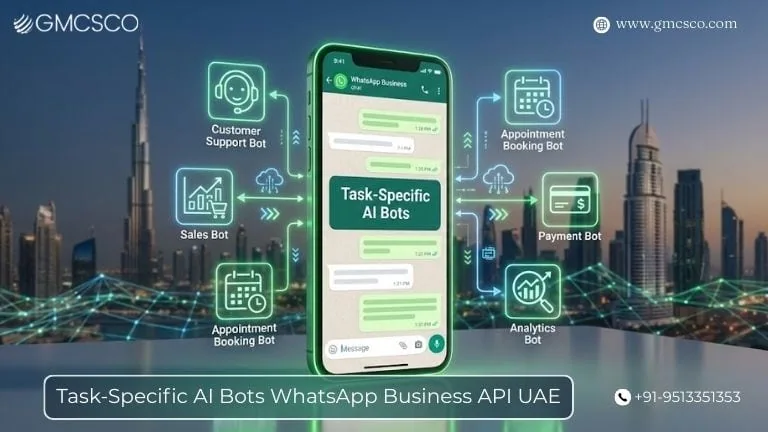
The UAE doesn’t wait for the future. It builds it. From AI strategy frameworks to smart government services, the country has positioned itself as a global innovation hub. Under the leadership of entities like the UAE Artificial Intelligence Office and initiatives driven by the Ministry of Artificial Intelligence, artificial intelligence is no longer experimental — it’s operational. Now in 2026, one technology is quietly transforming businesses across Dubai, Abu Dhabi, Sharjah, and beyond: Task-specific AI bots powered by the WhatsApp Business API. If your business operates in the UAE and you’re not using them, your competitors probably are. Let’s break it down clearly — what they are, why they matter, and how they’re reshaping customer engagement in the Emirates. What Are Task-Specific AI Bots on WhatsApp? Unlike generic chatbots that try to answer everything, task-specific AI bots are designed to complete one defined objective — extremely well. For example: Booking an appointment Processing a payment Tracking an order Collecting KYC documents Generating a quotation Registering event attendees These bots are connected through the official WhatsApp Business API, allowing businesses in the UAE to automate conversations at scale securely and compliantly. Instead of overwhelming users with menus, they guide customers through a focused workflow. The result? Higher completion rates. Lower drop-offs. Better user experience. Why the UAE Is Perfect for WhatsApp AI Automation The UAE stands out as one of the best markets for WhatsApp Automation for Business, mainly because people here are highly connected and comfortable with digital technology in their daily lives. The UAE offers: Over 90% smartphone penetration across the population One of the highest WhatsApp usage rates in the world A digitally savvy and tech-friendly audience A strong and forward-thinking regulatory environment supporting AI innovation Cities like Dubai and Abu Dhabi have become global business hubs, home to thousands of startups, fintech companies, real estate agencies, e-commerce brands, and luxury businesses — all competing to capture customer attention in a fast-moving market. Also Read About WhatsApp Business API at Scale in GCC Enterprises Customers in the UAE now expect: Instant responses without waiting Smooth multilingual communication in Arabic and English 24/7 customer support Fast, seamless digital experiences across every touchpoint This is exactly where WhatsApp Automation makes a real difference. Task-focused AI bots help businesses respond instantly, manage conversations efficiently, and deliver personalized customer experiences at scale something modern UAE customers increasingly demand. Why Generic Chatbots Fail (And Task-Specific Bots Win) Many businesses previously installed “smart chatbots” that tried to answer everything. What happened? Confused conversations High bounce rates Frustrated customers Low conversions Task-specific bots solve this by focusing on one outcome. For example: Instead of saying: “How can I help you today?” A task-specific bot says: “Let’s book your consultation in under 60 seconds.” Clear. Direct. Efficient. In a fast-paced UAE market, clarity converts. Real-World Use Cases in the UAE (2026) 1. Real Estate Viewing Booking Bot (Dubai) Dubai’s real estate market remains highly competitive. Agencies use task-specific WhatsApp bots to: Capture property preferences Verify budget Schedule viewing slots Send location pin Confirm via calendar The entire process happens in under two minutes. No calls. No delays. 2. Fintech KYC Automation Bot (Abu Dhabi) Fintech startups in Abu Dhabi deploy AI bots to: Collect Emirates ID Validate documents Perform instant KYC checks Approve onboarding This reduces manual review time by 60%. 3. Healthcare Appointment Bot Clinics automate: Appointment booking Insurance verification Reminder messages Rescheduling Patients now prefer booking and managing appointments through WhatsApp using automated healthcare chat solutions. 4. E-commerce Order Tracking Bot Retail brands integrate WhatsApp bots that: Track delivery Send shipment updates Handle returns Provide refund status Customer support tickets drop significantly. Why WhatsApp Business API Is Essential The WhatsApp Business App is limited. To scale automation in the UAE, companies need the official WhatsApp Business API. Benefits include: Automated workflows CRM integration Verified green tick accounts High-volume messaging Secure infrastructure It ensures compliance and performance. Arabic + English AI = Competitive Advantage The UAE is multicultural. Your AI bot must support: Arabic English Code-switching (mixed language) Advanced NLP models in 2026 handle: Voice messages Regional dialects Intent detection Context memory A bilingual AI bot increases engagement significantly. ROI: Why Task-Specific Bots Deliver Faster Returns Let’s look at a typical UAE SME: 5 customer support agents AED 6,000 average monthly salary AED 30,000 monthly support cost If a task-specific AI bot automates 60% of repetitive interactions: Operational cost drops Response time improves Lead conversion increases Many UAE businesses report ROI within 3–4 months. This isn’t just automation. It’s profitability engineering. Compliance & Data Protection in the UAE The UAE has introduced strong data protection laws under the Federal Decree-Law No. 45 of 2021 (PDPL). Businesses must ensure: Secure hosting Encrypted communication Consent management Data transparency Working with compliant AI providers is critical. Trust is everything in the Emirates. Also Read About WhatsApp Business API Services for UAE, KSA, USA & Beyond 2026 Trends in WhatsApp AI Bots UAE Micro-Task Bots Instead of one big chatbot, businesses deploy multiple small bots for specific functions. AI + Human Hybrid Model Bots handle simple tasks, humans manage high-value conversations. Voice-Based WhatsApp Automation Customers send voice notes — bots respond intelligently. In-Chat Payments Full checkout happens inside WhatsApp. AI Analytics Bots analyze conversation data to optimize marketing strategy. How to Choose the Right WhatsApp AI Bot Provider in UAE Ask these questions before investing: Are you an official WhatsApp Business API provider? Do you comply with UAE data protection laws? Can the bot integrate with our CRM? Does it support Arabic NLP? Can we customize workflows for specific tasks? Don’t just buy automation. Build a strategic automation ecosystem. Voice Search Optimized Answer What are task-specific AI bots on WhatsApp Business API in UAE? Task-specific AI bots are automated systems designed to complete one focused action such as booking appointments, processing orders, or verifying documents through WhatsApp using the official Business API. They improve efficiency, reduce costs, and increase customer satisfaction in the UAE market. Frequently Asked Questions Q: What