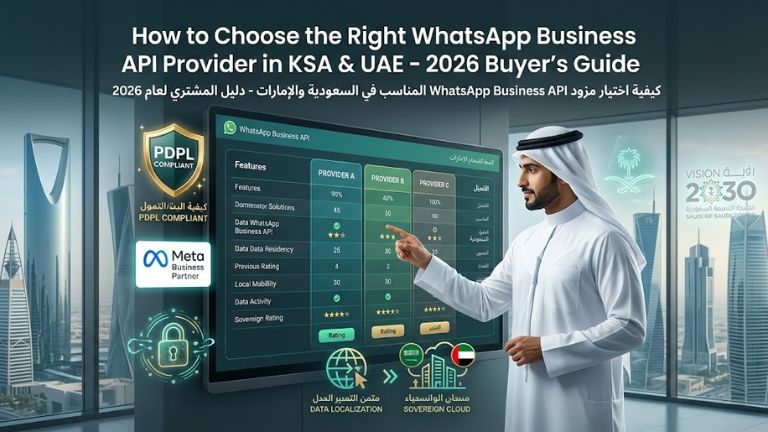
How to Choose the Right WhatsApp Business API Provider in KSA & UAE – 2026 Buyer’s Guide
Choosing the right WhatsApp Business API provider in 2026 is one of the most important decisions for large organizations in Saudi Arabia and the UAE. With increasing regulatory scrutiny, high message volumes, and the need for data sovereignty, selecting the wrong partner can lead to compliance risks, poor performance, and wasted investment. This comprehensive buyer’s guide is written for CIOs, Digital Transformation Heads, CXOs, and procurement teams who want to make an informed, future-proof decision. Why Choosing the Right Provider Matters in 2026? Meta’s strict policies, PDPL enforcement, and the growing demand for AI automation mean only a few providers can truly deliver secure, scalable, and compliant solutions for enterprise needs in the GCC. Avoid compliance risks and poor performance. Choose a WhatsApp API partner built for GCC enterprise requirements. 10 Critical Factors to Evaluate Before Choosing a Provider? Official Meta Business Partner Status Only verified Meta Partners have direct access and priority support. Always verify this. PDPL & Local Regulatory Expertise The provider must demonstrate deep knowledge of PDPL, NCA, SAMA (for banks), and other KSA/UAE regulations. Ask for specific compliance experience. Data Sovereignty & Client-Server Hosting For large enterprises and government-related projects, insist on client-server or sovereign hosting so sensitive data never leaves your approved environment. Structured AI & Automation Capabilities Confirm they build task-specific, rule-based AI Agents (Meta-compliant) and not general chatbots. Integration Experience Strong track record integrating with CRM (Salesforce, Zoho), ERP (SAP, Oracle), HRIS, and custom systems. Security & Compliance Standards Look for ISO 27001, regular third-party audits, end-to-end encryption, and full audit logging. Scalability & High-Volume Handling Can they reliably handle 1 Crore+ messages per month with consistent performance? Arabic Language & Local Support Full Arabic support, RTL formatting, and a team that understands GCC business culture. Transparent Pricing & No Hidden Costs Clear per-message pricing based on Meta rates + one-time onboarding fee. Avoid providers with heavy monthly/quarterly charges. Proven Track Record & References Ask for anonymous case studies from similar organizations in KSA/UAE and response times for support. Need help evaluating WhatsApp API providers? GMCSCO can guide you with a compliance-first provider assessment. Common Mistakes to Avoid Choosing the cheapest provider without checking compliance capabilities Ignoring data sovereignty requirements Accepting general-purpose AI chatbots (prohibited by Meta in 2026) Not verifying Meta Partner status Underestimating integration complexity Don’t let the wrong provider cost you time, money, and compliance confidence. Speak with GMCSCO before you decide. Our Recommendation Look for a partner that combines: Official Meta Partner status Deep PDPL & local regulatory expertise Sovereign/client-server architecture Strong integration capabilities Transparent pricing Proven GCC enterprise experience GMCSCO 💬 Chat on WhatsApp 📅 Schedule Consultation Now 📞 Call Now FAQs Q1: What is the most important factor when choosing a WhatsApp API provider in KSA? PDPL compliance and data sovereignty. Q2: Are all Meta Partners equal? No. Experience, local knowledge, and technical capabilities vary significantly. Q3: Should we prioritize local or international providers? A partner with strong GCC experience and local support is usually better. Q4: Is client-server hosting expensive? It is a worthwhile investment for large organizations handling sensitive data. Q5: How do we verify a provider is a real Meta Partner? Ask for their official Meta Partner ID or check directly with Meta. Q6: Can small providers handle high-volume enterprise deployments? Most cannot. Enterprise-grade infrastructure is required. Q7: What should we look for in AI capabilities? Structured, task-specific AI Agents, not general chatbots. Q8: How long does onboarding usually take? 7–21 days for standard setups, longer for complex integrations. Q9: Is Arabic support mandatory? Highly recommended for best user experience in the GCC. Q10: What is the typical cost structure? Meta per-message fees + one-time onboarding/setup fee. Q11: Can we switch providers later? Yes, but it is complex. Choose carefully from the beginning. Q12: How important is integration experience? Critical for large organizations with existing CRM/ERP systems. Q13: What security certifications should we look for? ISO 27001, regular penetration testing, and compliance with NCA standards. Q14: Should we ask for case studies? Yes, preferably anonymous ones from similar industries. Q15: How can GMCSCO help? As an Official Meta Partner with deep GCC experience, we offer end-to-end compliant solutions. Still unsure which WhatsApp Business API provider is right for your organization? Book a free consultation with GMCSCO today. Disclaimer: This content is for general informational purposes only. Information may be sourced from AI tools, search engines, and trusted references. Please verify all details with official sources before making any business or legal decisions. We are not responsible for actions taken based on this content.
How to Choose the Right WhatsApp Business API Provider in KSA & UAE – 2026 Buyer’s Guide Read More »