GMCSCO Media Group

Author name: Admin

AI-driven WhatsApp chatbot for daily employee notifications and HR alerts in KSA

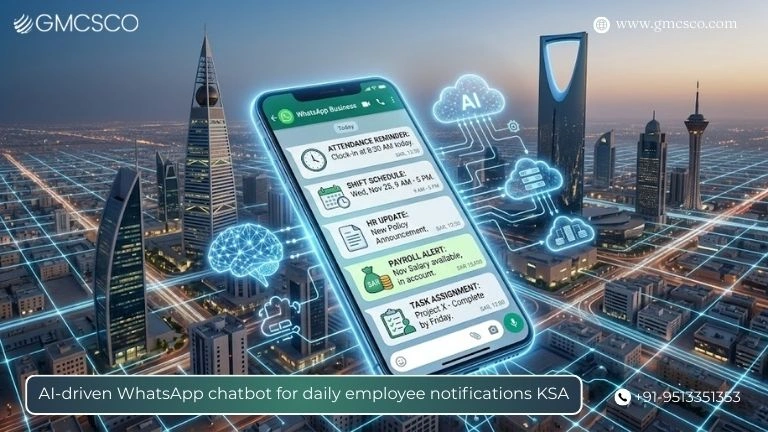
AI driven WhatsApp chatbot for daily employee notifications KSA

Introduction: The Silent Communication Crisis Inside Modern Businesses Every growing business eventually faces the same challenge. Information does not reach employees on time. Policies are updated but not read. Shift schedules change but someone misses the memo. HR sends reminders that get buried in email inboxes. Compliance announcements are ignored. Operational updates create confusion instead of clarity. In Saudi Arabia, where digital transformation is accelerating under Vision 2030, businesses cannot afford communication gaps. Whether you run a retail chain in Riyadh, a logistics firm in Jeddah, a healthcare group in Dammam, or a fast growing startup in NEOM, internal communication efficiency directly impacts productivity, compliance, and profitability. Now consider this fact. WhatsApp is one of the most widely used communication platforms in the Kingdom. Employees check it multiple times a day. It is immediate, familiar, and trusted. So the strategic question becomes simple. What if businesses could automate daily employee notifications through an AI driven WhatsApp chatbot for daily employee notifications KSA? Not just broadcast messages. But intelligent, automated, personalized communication that improves operations. This article will break down how it works, why it matters, and how forward thinking organizations in Saudi Arabia are implementing it to gain measurable competitive advantage. If your organization is exploring automation, this guide will help you make an informed decision. The Real Operational Challenges Businesses Face Today Let us address the ground reality. Most companies in KSA still rely on: Email for internal updates Manual WhatsApp groups Paper notices HR portals that employees rarely check Supervisors verbally relaying information This creates several problems. Also Read About WhatsApp Business API Compliance Saudi Arabia 2026 1. Low Message Visibility Email open rates for internal communication can be surprisingly low, especially among frontline staff who do not sit at desks all day. 2. Human Dependency Managers must manually remind teams. HR must resend notifications. Operations teams repeat instructions daily. 3. Inconsistent Communication Different departments receive information at different times. This leads to confusion and mistakes. 4. Compliance Risk In sectors like healthcare, finance, logistics, and manufacturing, missed notifications can result in regulatory penalties. 5. Employee Disengagement When communication feels chaotic, employees lose trust in systems. Saudi Arabia is rapidly digitizing government services, banking, and enterprise operations. Yet many companies still operate internal communication models from a decade ago. This is where AI powered employee engagement tools and enterprise WhatsApp automation Saudi Arabia become strategic assets. If your organization still relies heavily on manual reminders, it may be time to evaluate smarter automation options. Why This Matters in the Saudi and Global Digital Economy Saudi Arabia is not just adopting digital technology. It is leading regional transformation. With initiatives aligned to Vision 2030, companies are under pressure to: Improve operational efficiency Enhance workforce productivity Adopt smart automation systems Reduce administrative overhead Strengthen compliance frameworks At the same time, employees expect real time communication. Also Read About Enterprise WhatsApp automation Saudi Arabia Globally, enterprise messaging is moving toward conversational AI, automated notifications, and intelligent workflow integration. In KSA specifically: WhatsApp penetration is extremely high Mobile first communication dominates Distributed workforces are increasing Retail, logistics, construction, and hospitality rely on frontline staff An AI chatbot for internal communication bridges the gap between management systems and employees in the field. It creates a real time, automated communication channel that employees already use daily. For business owners and enterprise decision makers, this is not about technology hype. It is about operational reliability. If your competitors are improving internal response time through automation, standing still is not an option. What Is an AI Driven WhatsApp Chatbot for Daily Employee Notifications Let us simplify the concept. An AI driven WhatsApp chatbot for daily employee notifications KSA is a smart automation system integrated with your business software that sends structured, automated updates to employees via WhatsApp. It can: Send daily shift schedules Notify employees about attendance reminders Share policy updates Deliver HR announcements Provide training reminders Send payroll notifications Share compliance alerts Collect confirmations from employees The AI component enables: Personalization based on role or department Language customization such as Arabic and English Automated responses to employee queries Escalation logic if a message is not acknowledged Smart reporting and analytics Instead of managers manually sending updates, the system connects to HR software, ERP systems, CRM platforms, or attendance tools. When a trigger occurs, the chatbot automatically sends the right message to the right employee at the right time. This is not just messaging. It is intelligent business process automation KSA applied to internal communication. Also Read About AI Chatbot and Automation Practical Business Use Cases in Saudi Arabia Let us explore how real businesses apply this solution. Retail Chains Retail businesses often manage hundreds of staff across multiple branches. Use cases include: Daily shift assignments Inventory reminders Promotion briefing messages Sales target updates Store compliance checklists An automated HR notification chatbot solution ensures every staff member receives updates before the shift begins. Construction and Contracting Field workers may not check email regularly. Chatbot use cases include: Safety compliance alerts Project schedule changes Equipment inspection reminders Site meeting notifications Healthcare Organizations Hospitals and clinics can use WhatsApp automation for: Shift rotations Policy changes Training reminders Patient care protocol updates Logistics and Delivery Companies For drivers and warehouse teams: Route changes Delivery instructions Performance notifications Attendance tracking reminders Corporate Offices For enterprise teams: Townhall announcements IT maintenance alerts HR document reminders Performance review scheduling In each case, employee communication automation KSA reduces manual work and improves accountability. If you are unsure whether your industry can benefit, consider mapping your daily repetitive internal messages. Those are automation opportunities. How Companies Adopt an AI WhatsApp Notification System One of the most common concerns among decision makers is implementation complexity. Let us break it down into a practical step by step approach. Step 1: Identify Communication Gaps Audit your current internal communication system. Ask: Which notifications are sent daily Which reminders require manual follow up Where do delays occur What messages are frequently ignored Step 2: Define Use Cases

AI driven WhatsApp chatbot for daily employee notifications KSA Read More »
Predictive AI WhatsApp chatbot for automated customer updates and notifications in UAE

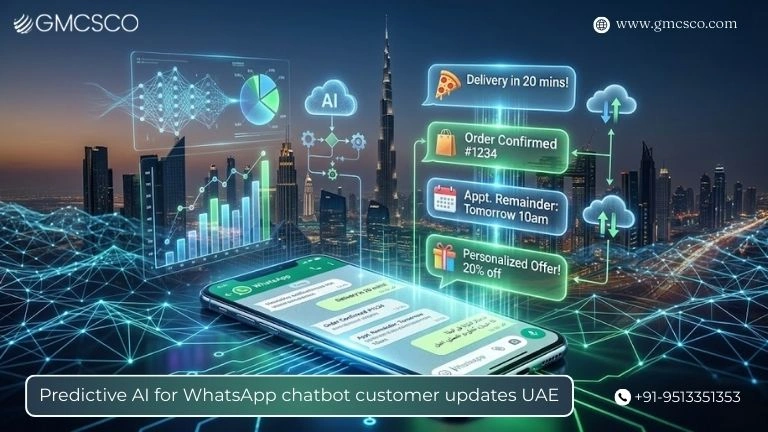
Predictive AI for WhatsApp Chatbot Customer Updates UAE

Introduction: Why Businesses in the UAE Are Struggling with Customer Updates Every business leader in the UAE knows the pressure. Customers expect instant updates. They want real time order confirmations. They want delivery notifications. They want appointment reminders. They want proactive communication before they even ask. At the same time, operational teams are overwhelmed. Customer support inboxes are full. Sales teams are chasing follow ups manually. Logistics teams are handling constant status requests. The result is predictable. Delayed responses. Frustrated customers. Rising support costs. Lost revenue. This is exactly where Predictive AI for WhatsApp chatbot customer updates UAE is transforming the way modern businesses operate. Instead of reacting to customer inquiries, companies are now predicting what customers need and sending updates automatically through WhatsApp. The platform customers already use every day. For business owners, marketing leaders, and enterprise decision makers, this shift is not just about convenience. It is about competitive survival. The Real Industry Problem: Reactive Communication Is Costly Let us address the core issue. Most companies still operate in reactive mode. A customer places an order. They do not receive an update. They contact support. The support team checks manually. They respond hours later. Multiply that by hundreds or thousands of customers daily. This creates: High customer support costs Slower response times Low customer satisfaction Poor customer retention Increased churn rates In fast moving markets like Dubai, Abu Dhabi, and the broader UAE, customers have choices. If communication feels slow, they switch brands. Industries most affected include: Ecommerce businesses Real estate developers Healthcare providers Logistics companies Financial services Hospitality groups Education institutions Without AI driven communication automation, scaling becomes chaotic. Also Read About AI Chatbot and Automation Trends Ready to Reduce Manual Support Load? If your team is spending hours answering repetitive update questions, it is time to explore AI automation solutions tailored for UAE businesses. GMCSCO helps companies move from reactive to predictive communication seamlessly. Why This Topic Matters in the UAE Business Environment The UAE is one of the most digitally advanced markets in the world. WhatsApp penetration is extremely high across residents and businesses. Customers in the UAE prefer messaging over email. Many prefer WhatsApp over phone calls. Add to this: Rapid ecommerce growth Smart city initiatives Government digital transformation High customer service expectations Strong competition in every sector Businesses cannot afford outdated communication systems. Predictive AI integrated with WhatsApp Business API allows companies to deliver proactive customer updates, automate workflows, and create personalized communication at scale. In the UAE market, speed and personalization are everything. Companies that adopt AI powered customer engagement platforms gain a serious advantage. What Is Predictive AI for WhatsApp Chatbot Customer Updates? Let us simplify the concept. Predictive AI is artificial intelligence that uses customer data, behavior patterns, and business logic to anticipate what a customer will need next. When integrated into a WhatsApp chatbot, it can: Predict when a customer expects a delivery update Trigger reminders before appointments Notify customers about payment due dates Send proactive restock alerts Provide real time order tracking updates Offer renewal reminders before subscription expiry Instead of waiting for customers to ask, the system sends updates automatically. This combines: Machine learning algorithms Customer behavior analytics CRM integration ERP system integration WhatsApp Business API Automated workflow engines The result is intelligent, proactive communication. For decision makers, this means fewer support tickets and higher customer satisfaction. Also Read About CRM Integration with WhatsApp Business API for UAE & KSA 2026 How Predictive AI Works in Business Terms Many executives hear the term predictive AI and assume it is complex or experimental. In reality, the process is structured and practical. Step 1: Data Collection The system gathers historical customer data such as purchase behavior, inquiry patterns, and service timelines. Step 2: Pattern Analysis Machine learning models identify trends and recurring customer actions. Step 3: Trigger Identification The system determines when a customer is likely to request an update. Step 4: Automated WhatsApp Communication The chatbot sends a proactive message at the right time. Step 5: Two Way Interaction Customers can reply instantly and receive further automated responses or escalation to human agents. This is AI customer support automation in action. Real World Use Cases in the UAE Ecommerce Businesses in Dubai An online retailer integrates predictive AI with WhatsApp. When a customer places an order: Order confirmation is sent immediately Shipping notification is triggered automatically Delivery update is sent on dispatch If delivery is delayed, a proactive explanation is sent After delivery, feedback is requested Customer support tickets drop by 40 percent. Real Estate Developers in Abu Dhabi Property developers use WhatsApp chatbot automation UAE to: Send construction progress updates Notify buyers about milestone payments Schedule handover appointments Send documentation reminders Buyers feel informed without repeatedly contacting sales teams. Healthcare Clinics Clinics use predictive analytics for customer communication to: Send appointment reminders Share test results notifications Provide follow up care instructions Alert patients for prescription refills Missed appointments decrease significantly. Also Read About WhatsApp Chatbot TDRA Regulations UAE 2026 Want Similar Results in Your Business? GMCSCO specializes in implementing enterprise chatbot solutions UAE that integrate with your existing CRM and operational systems to deliver measurable ROI. Step by Step Implementation for Businesses If you are considering Predictive AI for WhatsApp chatbot customer updates UAE, here is how implementation typically works. Step 1: Business Process Mapping Identify high volume customer update scenarios such as: Order tracking Payment confirmations Appointment reminders Service status updates Renewal notifications Step 2: System Integration Connect: CRM systems ERP platforms Ecommerce platforms Booking systems Payment gateways Seamless integration ensures accurate real time customer updates via WhatsApp. Step 3: AI Model Configuration Define predictive triggers such as: Time based triggers Behavior based triggers Transaction based triggers Step 4: WhatsApp Business API Setup Ensure compliance with WhatsApp policies and template approval processes. Step 5: Testing and Optimization Monitor performance metrics such as: Response rate Engagement rate Reduction in support queries Customer satisfaction scores Step 6: Continuous Improvement Use analytics dashboards to refine predictive models. Key

Predictive AI for WhatsApp Chatbot Customer Updates UAE Read More »

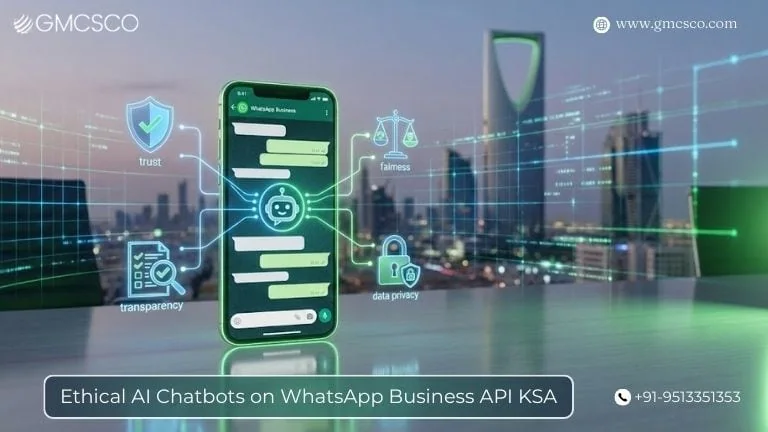
Ethical AI chatbots on WhatsApp Business API KSA focused on trust, transparency and data privacy compliance

Ethical AI Chatbots on WhatsApp Business API KSA: Your Complete 2026 Guide to Compliant, Trust-Building Customer Engagement

Picture this: It’s 10 PM in Riyadh. A young mother needs to reschedule her child’s dental appointment. She opens WhatsApp, the app she checks 30+ times a day, messages her clinic, and within seconds gets a clear, polite response in perfect Saudi Arabic. No endless hold music. No data privacy worries. Just helpful, reliable service that feels respectful and human. That seamless experience? It’s powered by an ethical AI chatbot on WhatsApp Business API built the right way for KSA. In 2026, Saudi businesses that get this right aren’t just saving time — they’re building unbreakable customer loyalty while staying 100% compliant with Meta’s strict new rules, PDPL, and SDAIA’s AI Ethics Principles. Those who cut corners? They risk blocked numbers, fines, and lost trust in a market where WhatsApp drives real commerce. I’ve helped dozens of KSA enterprises — from family-run retailers in Jeddah to national banks in the Capital — launch these systems. This guide shares exactly what works in 2026, with fresh data, real implementation steps, and the exact framework that keeps you on the right side of every regulation. Ready to turn WhatsApp into your most ethical, profitable channel? Let’s dive in. What Exactly Are Ethical AI Chatbots on WhatsApp Business API in KSA? Ethical AI chatbots on WhatsApp Business API KSA are task-specific, purpose-built conversational tools that automate customer interactions while strictly following Saudi regulations and global best practices. Unlike the old “anything-goes” chatbots, Meta banned general-purpose AI on the Business API effective 15 January 2026. Only narrow, business-focused automation is allowed — order tracking, appointment booking, FAQ answers, payment reminders, shipment updates, and similar defined workflows. The “ethical” part comes from full alignment with: Saudi Data and Artificial Intelligence Authority (SDAIA) AI Ethics Principles Personal Data Protection Law (PDPL) Meta’s Commerce and Business Policies National Cybersecurity Authority (NCA) standards These bots use secure WhatsApp Business API integration (via approved Business Solution Providers), local Arabic NLP models tuned for Saudi dialects, and built-in human handover triggers for sensitive topics. Result? 98% open rates, 70%+ response rates, and customers who feel respected — not tracked or manipulated. Why Ethical AI Chatbots Matter More Than Ever in Saudi Arabia Right Now Saudi Arabia has over 33 million active WhatsApp users in 2026 — that’s roughly 83% of internet users and one of the highest penetration rates globally. Saudis open the app dozens of times daily, and 76% of consumers in the Middle East prefer buying from brands that communicate via WhatsApp. Vision 2030 is pushing hard for digital transformation. The National Strategy for Data and AI (NSDAI) positions ethical AI as a competitive advantage, not a checkbox. Businesses that demonstrate SDAIA compliance win government tenders, earn trust badges, and future-proof against stricter enforcement. At the same time, customers are more privacy-aware than ever. One data mishandling story spreads like wildfire on X or Snapchat. Ethical design protects your reputation while unlocking higher engagement. Real talk from the trenches: A national retail chain I worked with saw manual query volume drop 87% after launching a properly ethical chatbot. Customer satisfaction jumped 41%, and their WhatsApp quality rating stayed in the top tier — letting them scale to 200K+ monthly messages without a single block. Also Read About WhatsApp Business API Compliance Saudi Arabia 2026 Key Regulations Every KSA Business Must Follow in 2026 1. Meta’s January 2026 AI Restrictions Only task-specific bots allowed. No open-ended “ask me anything” assistants. All outbound messages outside the 24-hour customer-initiated window must use pre-approved templates. Portfolio-level limits now apply across all numbers under one Business Account. 2. PDPL (Personal Data Protection Law) Explicit consent required for every data collection. Data minimization is mandatory — collect only what you need. Users have rights to access, correct, and delete their data (including one-tap unsubscribe). Sensitive data (health, financial, biometric) demands extra safeguards and preferably stays inside KSA borders. Fines can reach SAR 5 million for serious breaches. 3. SDAIA’s 7 AI Ethics Principles These are non-negotiable for any AI system in the Kingdom. Here’s how they translate directly to WhatsApp chatbots: Fairness Train on diverse Saudi datasets covering all regions, ages, genders, and dialects (Hijazi, Najdi, Southern). Run quarterly bias audits. Example: A chatbot in Al Khobar must respond equally well to Eastern Province slang as one in Abha. Privacy & Security End-to-end encryption is already built into WhatsApp (Signal protocol). Add consent logging, data minimization, and secure local storage. Never store full conversation history longer than necessary. Humanity Design to empower, never manipulate. Align with Saudi cultural values — respectful language, family-first framing, no deceptive urgency. Always offer an easy human handover: “Reply HUMAN to speak with our team.” Social & Environmental Benefits Promote sustainable choices (e.g., “Choose eco-friendly delivery?”). Use energy-efficient hosting. Support national initiatives like Saudization or green economy goals. Reliability & Safety Test against edge cases (power outages, dialect variations, high-load events like Ramadan sales). Human oversight mandatory for any irreversible action (refunds, medical advice routing). Transparency & Explain ability Disclose AI usage clearly in the very first message: “Hi, I’m the clinic’s AI assistant here to help with appointments. Reply HUMAN anytime for our team.” Log decisions for audit. Accountability & Responsibility Assign clear ownership inside your organization. Keep detailed logs for SDAIA or NCA if requested. Have escalation protocols ready. Pro tip: Print these seven principles and pin them above every developer’s desk. I’ve seen teams that treat them as living checklists achieve zero compliance issues in their first year. Also Read About WhatsApp Chatbot Best Practices & SDAIA Ethics Step-by-Step: How to Launch an Ethical AI Chatbot on WhatsApp Business API in KSA Get Verified & Choose a Compliant BSP Work only with Meta-approved Business Solution Providers registered in KSA. They handle verification, template approvals, and local compliance support. Design Consent-First Flows Every new conversation starts with clear opt-in and AI disclosure. Store proof of consent with timestamps. Build Task-Specific Flows Map every possible user goal (book appointment → confirm → remind). Use decision trees +

Ethical AI Chatbots on WhatsApp Business API KSA: Your Complete 2026 Guide to Compliant, Trust-Building Customer Engagement Read More »

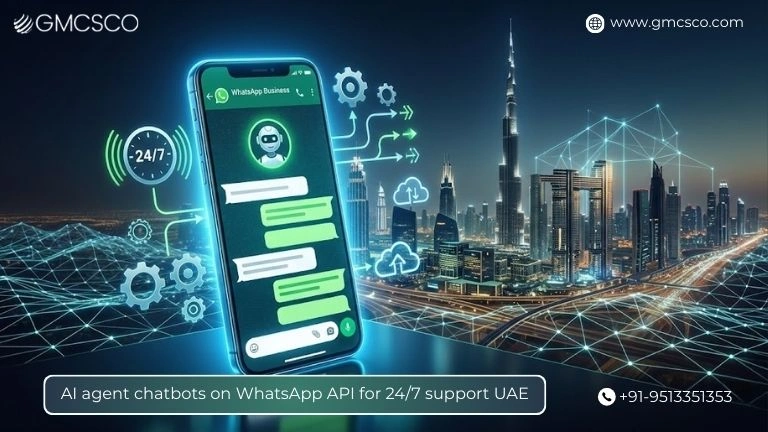
AI agent chatbots on WhatsApp API for 24/7 customer support in UAE businesses

AI Agent Chatbots on WhatsApp API for 24/7 Support in UAE

Why UAE Businesses Are Rethinking Customer Support Customer expectations across the UAE have changed dramatically in recent years. Today’s customers expect instant answers, personalized communication, and service availability at any hour of the day. Whether someone is booking real estate consultations in Dubai, tracking an e-commerce order in Abu Dhabi, or requesting banking information late at night, waiting for office hours is no longer acceptable. At the same time, businesses face increasing operational pressure. Support teams struggle with rising inquiry volumes. Marketing teams lose qualified leads outside working hours. Sales teams spend valuable time answering repetitive questions instead of closing deals. This is where AI agent chatbots on WhatsApp API for 24/7 support in UAE are transforming how companies operate. Instead of expanding large support teams, forward thinking organizations are deploying intelligent AI agents directly inside WhatsApp, the most widely used communication platform in the region. The result is continuous engagement, faster response time, and measurable business growth. The Growing Customer Support Challenges Businesses Face Most organizations recognize customer communication as critical, yet many still rely on outdated systems. Here are the most common operational problems seen across UAE companies. Limited Support Availability Human teams operate within business hours. Customers interact whenever they want. Missed conversations often mean lost revenue opportunities. High Operational Costs Scaling support traditionally requires hiring, training, and managing larger teams. For fast growing startups and enterprises alike, this becomes expensive quickly. Slow Response Time Customers contacting businesses through social media or messaging platforms expect immediate replies. Even a delay of a few minutes can reduce conversion rates. Also Read About Best WhatsApp Chatbot Providers UAE 2026 Fragmented Communication Channels Businesses manage emails, calls, website chats, and messaging apps separately, creating inconsistent customer experiences. Lead Leakage Marketing campaigns generate inquiries around the clock, but many businesses fail to capture or qualify those leads instantly. AI automation directly addresses these challenges without increasing workforce complexity. Advisory Insight: Many UAE companies begin exploring AI automation after realizing that response speed directly impacts revenue performance. Why This Topic Matters in the UAE Business Environment The UAE is one of the most digitally advanced markets globally. Several regional factors make WhatsApp based AI agents particularly powerful. WhatsApp Dominates Business Communication In the UAE, WhatsApp is often the first communication choice for customers interacting with brands. Consumers prefer messaging over calls or long email conversations. Multinational Customer Base Businesses serve residents and customers speaking Arabic, English, Hindi, Urdu, and other languages. AI chatbots enable multilingual conversations instantly. Always On Economy Tourism, real estate, finance, healthcare, logistics, and retail industries operate beyond traditional working hours. 24/7 automated support aligns perfectly with this environment. Government Led Digital Transformation UAE initiatives encouraging smart services and automation push enterprises toward AI powered customer engagement. Companies adopting conversational AI early gain a competitive advantage. Also Read About CRM Integration with WhatsApp Business API for UAE & KSA 2026 What Are AI Agent Chatbots on WhatsApp API? In simple terms, an AI agent chatbot connected to the WhatsApp API acts as an intelligent digital employee that communicates with customers automatically. Unlike traditional rule based bots that follow fixed scripts, modern AI agents understand intent, context, and conversation flow. They can: Answer questions naturally Guide customers through services Book appointments Qualify leads Process support requests Recommend products Escalate complex issues to humans All within WhatsApp conversations. How WhatsApp API Enables Business Automation The WhatsApp Business API allows companies to integrate advanced systems such as: CRM platforms Customer databases Payment systems Booking engines Marketing automation tools Support ticket platforms AI becomes the brain behind these integrations, turning messaging into a fully automated business workflow. How AI WhatsApp Agents Actually Work Understanding the workflow helps decision makers evaluate adoption more confidently. Step 1 Customer Initiates Conversation A user sends a message through WhatsApp after seeing an advertisement, website link, or QR code. Step 2 AI Understands Intent Natural language processing analyzes the message instantly. Example intents include: Product inquiry Pricing request Complaint submission Appointment booking Step 3 Intelligent Response Generation The AI provides contextual answers based on business knowledge and customer history. Step 4 Automated Action The system may: Create a support ticket Capture lead data Schedule meetings Send payment links Provide documents Also Read About WhatsApp Chatbot TDRA Regulations UAE 2026 Step 5 Human Escalation When Needed Complex conversations transfer seamlessly to human agents. This hybrid model ensures efficiency without sacrificing customer experience. Practical Tip: Businesses achieve the best results when AI handles repetitive communication while humans manage relationship driven interactions. Real Business Use Cases Across UAE Industries AI agent chatbots on WhatsApp API are not limited to customer support. They influence revenue, operations, and marketing performance. Real Estate Companies Property inquiries arrive day and night. AI agents can:  Share property listings Schedule viewings Pre qualify buyers Send brochures instantly Healthcare Providers Clinics automate appointment booking, reminders, and patient inquiries while reducing call center load. E Commerce Businesses AI agents manage: Order tracking Returns processing Product recommendations Cart recovery conversations Banking and Financial Services Secure automated responses help customers access information quickly while maintaining compliance. Hospitality and Tourism Hotels provide instant booking assistance, travel updates, and concierge services through WhatsApp. Soft CTA: Organizations exploring conversational automation often start with one department such as sales inquiries before scaling across the entire customer journey. Step by Step Guide to Implement AI WhatsApp Support Adopting AI automation becomes easier when approached strategically. Step 1 Define Business Objectives Identify whether the goal is to support efficiency, lead generation, or sales automation. Clear outcomes drive successful implementation. Step 2 Map Customer Conversations Analyze frequent customer questions and interaction patterns. These become the foundation of AI training. Step 3 Integrate WhatsApp Business API This enables secure enterprise messaging capabilities. Step 4 Train the AI Agent Upload knowledge bases, FAQs, product information, and workflows. Modern AI continuously improves through interaction data. Step 5 Connect Business Systems Integrate CRM, helpdesk software, and marketing tools. Automation becomes powerful when systems communicate together. Step 6 Launch and Optimize Monitor

AI Agent Chatbots on WhatsApp API for 24/7 Support in UAE Read More »

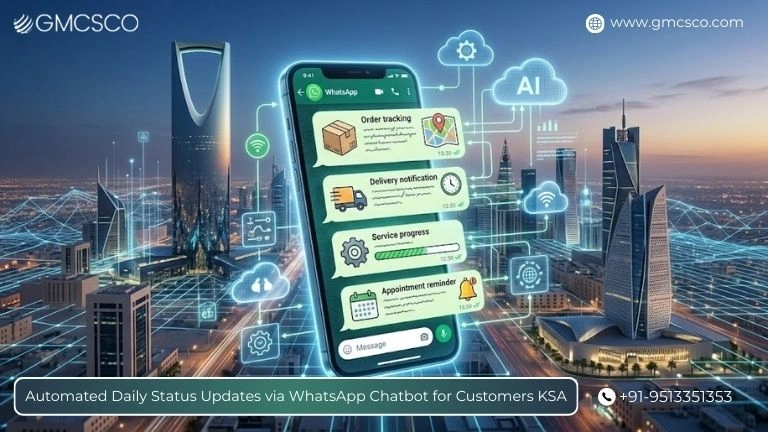
Automated daily status updates via WhatsApp chatbot for customers in KSA showing order tracking and delivery alerts

Automated Daily Status Updates via WhatsApp Chatbot for Customers in KSA

As a business owner or marketing leader in today’s fast paced world, you know how crucial it is to keep your customers informed. Imagine a scenario where your team spends hours each day manually sending status updates on orders, projects, or services. It drains resources, leads to errors, and frustrates customers who expect instant information. Now, picture flipping that script with automated daily status updates delivered straight through a WhatsApp chatbot. This approach not only saves time but also boosts customer satisfaction in the competitive Kingdom of Saudi Arabia market. In this article, we will explore how this technology can transform your operations. Drawing from over 15 years of experience in SEO content strategy and AI search optimization for B2B SaaS companies, I have seen firsthand how such solutions drive real results. We will cover the challenges, benefits, and practical steps to get started, all tailored to businesses in KSA and beyond. What Are the Main Industry Problems with Customer Communication? Businesses across sectors face ongoing struggles with customer communication. Manual updates often involve emails or phone calls that get lost in the shuffle. For instance, in e-commerce, customers constantly check on order statuses, leading to a flood of inquiries that overwhelm support teams. Operational challenges compound this issue. Teams juggle multiple tools, from CRM systems to spreadsheets, resulting in inconsistent messaging. In KSA, where the economy is booming with Vision 2030 initiatives, companies cannot afford delays. A single missed update can erode trust and push customers to competitors. Moreover, scalability becomes a nightmare as your business grows. Hiring more staff to handle updates is costly and inefficient. These problems highlight the need for smarter automation to streamline processes and maintain strong customer relationships. Why Do Automated Status Updates Matter in KSA and the Global Business Landscape? In KSA, digital transformation is accelerating under Vision 2030, with a focus on technology driven efficiency. Businesses here are adopting AI and automation to stay ahead in a market projected to reach billions in digital services by 2030. Globally, similar trends show that companies using messaging apps like WhatsApp see higher engagement rates, as customers prefer familiar platforms over traditional channels. This matters because customer expectations have evolved. People want real time information without effort. In the UAE and neighboring regions, where mobile penetration is over 100 percent, WhatsApp is a daily staple. Failing to leverage it means missing out on opportunities to build loyalty in a hyper connected world. For startups and enterprises alike, this technology aligns with broader goals of cost reduction and innovation. It positions your business as forward thinking, especially in competitive sectors like retail, logistics, and finance. If you are exploring ways to enhance customer engagement, consider consulting experts in AI automation. They can help assess your needs and outline a path forward without overwhelming your team. Also Read About High-Volume Messaging Strategies on WhatsApp API for KSA Enterprises How Does a WhatsApp Chatbot for Automated Daily Status Updates Work? At its core, a WhatsApp chatbot is an AI powered tool that interacts with users via the WhatsApp platform. For daily status updates, it integrates with your backend systems to pull data automatically and send personalized messages. Think of it as a virtual assistant. It connects to your database or CRM, retrieves updates like order progress or project milestones, and delivers them at scheduled times. No human intervention needed beyond initial setup. The technology relies on the WhatsApp Business API, which allows secure, scalable messaging. AI elements, such as natural language processing, enable the bot to handle queries if customers respond, turning one way updates into interactive conversations. In simple terms, it automates routine communication, freeing your team for higher value tasks while keeping customers informed effortlessly. What Are Some Practical Business Examples and Use Cases? Let us look at real world applications. In e-commerce, a KSA based online retailer uses a WhatsApp chatbot to send daily order status updates. Customers receive notifications like “Your package is out for delivery today,” reducing support tickets by 40 percent. For logistics firms, tracking shipments becomes seamless. A chatbot pulls data from GPS systems and alerts customers about delays or arrivals, improving transparency in supply chains across the Kingdom. In finance, banks send daily account summaries or loan status updates. This builds trust and encourages timely payments. Startups in the service industry, like consulting firms, use it for project progress reports, keeping clients engaged without constant emails. Enterprises in healthcare might automate appointment reminders or test result updates, ensuring compliance with privacy regulations while enhancing patient experience. These use cases show versatility across industries, making it a go to for customer centric businesses. Also Read About AI Chatbot and Automation Trends on WhatsApp Business API for Gulf Markets How Can Businesses Implement This Step by Step? Getting started is straightforward if approached methodically. First, assess your needs. Identify what status updates your customers value most, such as order tracking or service progress. Next, choose a platform. Opt for the WhatsApp Business API, which requires approval from Meta. This step ensures compliance with local regulations in KSA. Then, integrate with your systems. Use APIs to connect the chatbot to your CRM or database. Tools like no code platforms can simplify this for non technical teams. Develop the chatbot logic. Define triggers for daily sends, personalize messages based on user data, and add response handling for queries. Test thoroughly. Run pilots with a small customer group to refine messaging and fix issues. Finally, launch and monitor. Track metrics like open rates and feedback to optimize over time. This process typically takes a few weeks, depending on your tech stack, but the payoff is immediate efficiency gains. To ensure a smooth rollout, think about partnering with specialists in WhatsApp integrations. They can guide you through pitfalls and accelerate implementation. What Business Benefits Come from Efficiency and ROI? The advantages are compelling. Efficiency skyrockets as automation handles repetitive tasks, allowing teams to focus on strategy and growth. In KSA, where labor costs are rising,

Automated Daily Status Updates via WhatsApp Chatbot for Customers in KSA Read More »

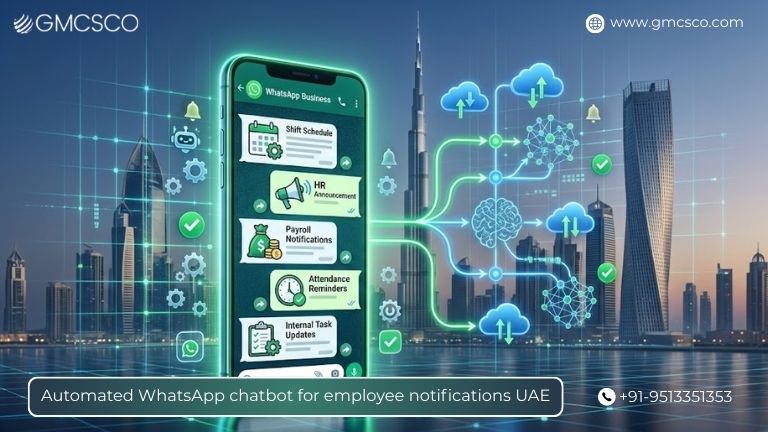
Automated WhatsApp chatbot for employee notifications and alerts in the UAE

Automated WhatsApp Chatbot for Employee Notifications in the UAE

As a business leader in the UAE, you know how fast paced the market can be. With teams spread across Dubai, Abu Dhabi, and beyond, keeping everyone informed feels like a constant battle. Missed emails, delayed updates, and communication silos can lead to costly errors and frustrated employees. What if there was a way to streamline all that through a tool your team already uses every day? Enter the automated WhatsApp chatbot for employee notifications. This technology is transforming how companies handle internal communications, making sure critical information reaches the right people instantly. In this article, we will explore how these chatbots solve real world problems, why they are essential in today’s business landscape, and how you can implement one effectively. Whether you are a startup founder juggling growth or an enterprise decision maker optimizing operations, understanding this solution could be a game changer for your organization. The Challenges of Employee Communication in Modern Businesses Effective communication is the backbone of any successful company, but it is easier said than done. In the UAE, where businesses often manage multicultural teams and remote workers, traditional methods like emails and intranet portals fall short. Employees might overlook important announcements buried in their inboxes, especially during off hours or high pressure periods. Operational challenges compound this issue. HR departments struggle with sending timely updates on policy changes, shift schedules, or emergency alerts. Without a reliable system, misunderstandings arise, leading to decreased productivity and higher turnover rates. For instance, in industries like retail or logistics, where quick coordination is key, delayed notifications can disrupt entire supply chains. These problems are not just annoyances. They translate into tangible losses. Research shows that poor internal communication costs businesses millions annually in errors and inefficiencies. In the UAE’s competitive environment, where companies vie for top talent, addressing these gaps is crucial for maintaining a motivated workforce. Also Read About Predictive AI for WhatsApp Chatbot Why Automated Employee Notifications Matter in the UAE and Globally The UAE is a hub for innovation, with its Vision 2031 emphasizing digital transformation across sectors. Businesses here are adopting AI driven tools to stay ahead, and automated notifications fit perfectly into this narrative. Globally, the shift to hybrid work models post pandemic has amplified the need for instant, accessible communication channels. In the UAE specifically, regulations around data privacy and labor laws require secure, compliant ways to share information. WhatsApp, with its end to end encryption, aligns well with these standards, making it a preferred platform for employee interactions. As companies expand internationally, tools that work seamlessly across borders become indispensable. This topic matters because it directly impacts business agility. In a world where markets change overnight, the ability to notify employees about updates in real time can mean the difference between seizing opportunities and falling behind. For UAE firms eyeing global growth, integrating such technology ensures they remain competitive and compliant. If you are considering ways to enhance your team’s connectivity, exploring AI automation options could provide the edge you need. Think about consulting experts who specialize in these integrations to see how they fit your operations. Understanding Automated WhatsApp Chatbots in Simple Terms At its core, an automated WhatsApp chatbot is a software program that uses AI to handle conversations on WhatsApp. For employee notifications, it acts as a virtual assistant, sending out alerts, reminders, and updates without human intervention. Imagine it as a smart messenger. You set up rules or triggers, like a new policy approval or payroll processing, and the chatbot delivers personalized messages to the relevant employees. It can handle queries too, such as “What’s my leave balance?” by pulling data from your HR system. The beauty lies in its simplicity. Built on WhatsApp Business API, it integrates with existing tools like CRM or ERP systems. No need for new apps, employees interact via the familiar WhatsApp interface, boosting adoption rates instantly. This concept demystifies AI for businesses. It is not about replacing people but augmenting them, ensuring routine communications are handled efficiently while freeing up time for strategic work. Real World Examples and Use Cases for Businesses Consider a retail chain in Dubai. During peak seasons like Ramadan, they use a WhatsApp chatbot to notify staff about inventory restocks or promotional changes. Employees receive instant alerts on their phones, reducing the chaos of manual calls. In the construction sector, common in the UAE, safety notifications are critical. A chatbot can send weather related warnings or site updates to field workers, ensuring compliance and reducing accident risks. For startups in free zones like Dubai Silicon Oasis, chatbots handle onboarding. New hires get automated welcome messages, document requests, and training schedules, streamlining the process without overwhelming HR. Enterprise firms benefit too. A multinational bank might use it for compliance training reminders, tracking completions automatically. These examples show how versatile the technology is, adapting to various industries from hospitality to finance. Also Read About CRM integration with WhatsApp API for automation Step by Step Guide to Implementing a WhatsApp Chatbot for Notifications Getting started does not have to be complicated. First, assess your needs. Identify key notification types, like HR updates, project alerts, or emergency broadcasts. Map out who receives what to ensure targeted delivery. Next, choose a platform. opt for WhatsApp Business API, which supports automation. You will need approval from WhatsApp, a process that typically takes a few weeks. Partner with a verified provider to handle this smoothly. Integrate with your systems. Connect the chatbot to your HR software or database using APIs. Tools like Zapier can simplify this for non technical teams, but for complex setups, custom development might be necessary. Design the chatbot flows. Create templates for messages, incorporating personalization like employee names. Test for accuracy and user friendliness, perhaps with a small pilot group. Launch and monitor. Roll it out company wide, train users if needed, and track metrics like open rates. Adjust based on feedback to optimize performance. This structured approach minimizes risks and ensures a smooth transition. To make informed decisions

Automated WhatsApp Chatbot for Employee Notifications in the UAE Read More »

Scroll to Top