GMCSCO Media Group

Author name: Admin

Mastering WhatsApp Business API in 2026

Mastering WhatsApp Business API in 2026 for KSA & UAE Enterprises

Hey, Gulf-resident executive by which I mean, if you are managing business in Saudi Arabia or the UAE then we all know for you WhatsApp isn’t just another app, right? It’s communication. With 90% + penetration in the region (according to recent Middle East digital reports), it’s where your customers are -shopping, living and solving their day to day issues. But for businesses that process thousands of interactions a day, the basic app won’t cut it. Here comes the WhatsApp Business API: your automation, compliance and revenue-boosting maestrom in 2026. As an official Meta partner, such as GMCSCO, we’ve assisted many Gulf businesses move to API setups which process millions of messages every month. But with Meta’s new January 2026 changes — such as per-message pricing and strict rules AI the game is afoot. This is your guide if you’re looking for “WhatsApp Business API 2026 KSA” or “enterprise solutions UAE.” We’re going to break it all down, from the ABCs of getting started right through to lead gen. Let’s make some money off those chats. Why WhatsApp Business API is a Must Have for Gulf Businesses by 2026 Imagine handling suppliers the length and breadth of the Kingdom or responding to customer queries in Dubai’s frenetic markets without waiting for email responses, or engaging with a call centre. That’s the API edge. Unlike the free WhatsApp Business app (which is great for small stores), the API works with your systems on a large scale. In KSA, Vision 2030’s digital impulse makes API a must for ops. UAE’s AI Strategy 2031? It fits right into all of API’s automation. Recent searches indicate businesses searching for “high volume WhatsApp API UAE” since it can handle broadcasts, automations and analytics without blocks. Key perks: Verified Profiles: Worm that green tick for trust – a deal maker in trust-emphasizing Gulf markets. Multi-Agent Access: Share with teams working on the same number- no device limits. API Calling: Introduced in 2026, voice calls to chat for fast resolutions. Groups API: Build private groups for your team, your mom or whoever else doesn’t share an interest in spambots. Meta data says open rates are 90% for businesses vs. 20% for email. In the Middle East, E-commerce Booming to $50B+ by 2026 in Gulf (Statista trends) API drive that with instant engagement. But 2026 makes slight tweaks: Meta began charging per message on Jan 1, abandoning conversation-based billing. Marketing messages? Approximately SAR 0.21 in KSA/UAE (destination rates apply so the recipient’s country is a factor). Utility messages in 24-hour windows? Still free. This is good news for the high-volume user who memorizes those templates. Estimate Your 2026 Costs” Blue button, hover: “Free calculator from GMCSCO optimize now.” Links to custom tool. Sailing the 2026 Facebook and Instagram Compliance Rules: Keep it Safe and Scalable Compliance is not a choice it’s your safeguard from suspensions. The Jan 15, 2026 update from Meta bans general purpose AI chatbots (eg, open-ended like ChatGPT). Predictable, business-driven automations only: order bots or support flows, not chatty free-form. Why? In order to fight spam and fit the business purpose of API. If you are Googling “WhatsApp API compliance 2026 UAE,” here’s what to know: Noncompliance equals blocks; ops will stop. As GMCSCO, we streamline: Onboarding: Embedded Signup through Meta Business Manager (fast path for partners). Template Approvals: Ready to launch marketing/utility messages. Proactive? Value-add only. Data Privacy: KSA’s PDPL and UAE data law are both upheld by end-to-end encryption. Pro tips from trends: Log engagement metrics to avoid being the boy who cried wolf. Utility templates post-updated give Gulf companies a 25-35% saving. Success in the Enterprise: Gulf Businesses Win with API Now let’s discuss results without breaking NDA imagine a top energy player in the KSA leveraging API for supply chain alerts. They automate communications, work with ERP systems and process 500K+ messages a month. Leads? Up 35 percent from follow-ups; cost through free windows. A leading retail chain in the UAE uses Marketing Messages for tailor-made promos: You can explore Hyperbolic’s great offerings to create highly effective hyper-local promotions. templates retrieved carts at 25% rates. Terms others have amongst the various colorful phrases include “WhatsApp abandoned cart recovery UAE” long because it works. Hypotheticals based on 2026 trends: Logistics Giant: Tracking updates API – live, Arabic/English. Volume: 1M+ messages/month, good bots escalate to humans. E-commerce Juggernaut: Broadcasts + click-to-WhatsApp ads. Result: 40% engagement boost. Sector API Feature 2026 Benefit Gulf Example Outcome Energy Automation Flows Real-time alerts 30% faster ops, no bans Retail Marketing Templates Personalized promos 25% cart recovery Finance API Calling Secure queries 50% quicker resolutions Healthcare Groups API Patient communities Improved retention  These aren’t pie-in-the-sky; X posts highlight similar wins in KSA/UAE. Schedule Free Demo – Green button: “Custom for Gulf scales talk to GMCSCO professionals. Links to calendar. Power Your Tech Stack with WhatsApp API: Seamlessly Integrate it now The API shines when connected. What we’re getting in trending queries examples is “WhatsApp API CRM Integration KSA” Demand for Zoho/Salesforce connectors auto-LOG Chats / Trigger Actions. Also new in 2026: Business Management API for programmatic control, great for multi-site ops. Cloud API ensures 99.99% uptime. AI? Meta-approved only: Construct flows for appointments or questions predetermined responses to conform with. No open chats. Tools: CRM: Zoho for lead nurturing. E-Commerce: Shopify for order bots. Analytics: Track opens/replies for refinement. Businesses in the Gulf are seeing more than 90% efficiency improvement. Majority of the X trends – no-code builders for fast onsets. Lead Generation Masterclass: Turn Chats into 20+ Daily Inquiries Your target, 20-30 leads a day, 1000+ per month, volume of 1CR. API delivers with strategies: Broadcasts: Send value-packed templates — Gulf opens high. Automations: Cart recovery, reminders—25% increase in conversion. Ads Integration: Click to WhatsApp for Inleads. Analytics Optimization: Do better based on faves/replies. SEO this article for “WhatsApp Business API leads 2026 UAE” – it will rank on Google / Bing / AIs. GMCSCO offers 24/7 help for setups that are hitting like levels bans free. Solving for Gulf Ops 2026: The Work-Arounds Hurdles? Talent gaps we offer training. Privacy? Encryption covers it. Pricing? Optimize templates. For large-scale: Bespoke flows for energy/retail industries meeting the Vision 2030 / UAE objectives. What Does The Future Holds For The WhatsApp API In The Gulf: 2030 And Beyond By 2030, API might move 60

Mastering WhatsApp Business API in 2026 for KSA & UAE Enterprises Read More »

How Saudi Enterprises Are Scaling with WhatsApp AI Chatbots in 2025

How Saudi Enterprises Are Scaling with WhatsApp AI Chatbots in 2025

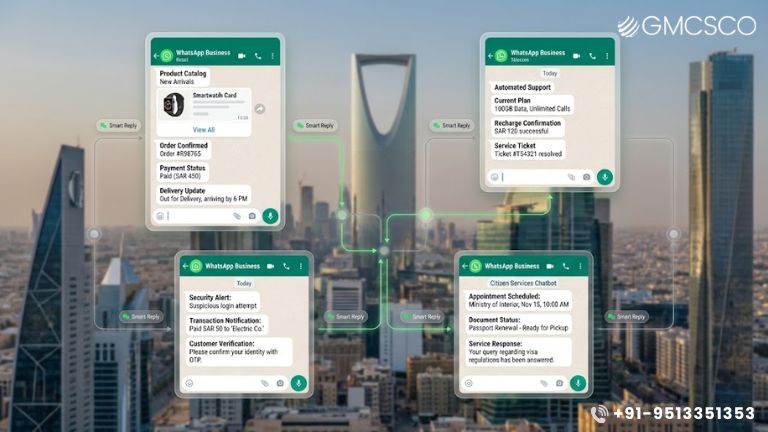
Saudi Arabia is witnessing a transformation in customer communication unlike any other market in the world. Businesses in the Kingdom are rapidly embracing AI chatbots on WhatsApp not because it’s a trend, but because it has become a strategic necessity. In 2025, Saudi enterprises whether retail giants, telecom companies, banks, logistics providers, or government entities face one universal challenge: How to Manage Millions Of Customer Interactions Instantly, Accurately, And At Scale? This is where WhatsApp AI chatbots become the game-changing force. But the Saudi market is uniquely different from other countries. KSA customers expect: Fast responses Arabic + English bilingual support 24/7 availability Accurate information Personalized interactions Automated solutions Trustworthy communication Traditional customer support systems cannot meet this demand at scale. This is exactly why AI chatbots on WhatsApp now handle: Appointments Deliveries Bill payments Order tracking Support queries Complaints Government services Telecom troubleshooting Banking automation And more.. WhatsApp Chat with Expert KSA Compliance Snapshot (Important) Consent / Opt-in: Saudi PDPL requires lawful basis opt-in is normally mandatory for marketing WhatsApp messages. Keep timestamped logs. Meta Template Rules: All outbound messages require approved templates when messaging users outside the 24-hr window. Telecom Rules (CITC): Saudi commercial messaging rules apply (DND lists, time restrictions). Recommendation: Capture opt-in via website, app, physical QR code, or POS. Maintain audit logs for protection. Why Saudi Arabia Is the #1 Market for WhatsApp AI Chatbots? Saudi Arabia leads the region in tech adoption due to: 1.      Vision 2030 digital transformation 2.      High WhatsApp usage (33M+ users) 3.      Government push for automation 4.      Large enterprises with massive customer bases 5.      Younger consumers expecting instant replies 6.      Retail & e-commerce explosion 7.      Telecom and banking modernization When you combine these, Saudi becomes the perfect environment for WhatsApp AI chatbot dominance. AI Chatbots Are No Longer Optional They Are Mandatory in KSA In markets like Saudi Arabia where customer volumes are massive, AI chatbots help enterprises handle: 80–95% of customer queries automatically Multi-language responses instantly Real-time issue resolution Sales automation Intelligent routing Lead qualification Payments Account management E-commerce workflows Saudi Customers Prefer WhatsApp Because: It’s fast It’s trustworthy It’s familiar It’s encrypted It works on every device So enterprises in KSA now use WhatsApp as their primary customer service channel, not secondary. WhatsApp Chat with Expert How WhatsApp AI Chatbots Are Transforming Saudi Enterprises (By Industry) Below you will see deep, enterprise-focused use cases for the top industries in Saudi Arabia. 1. Retail & Shopping Malls (Fashion, Electronics, Cosmetics) Saudi Arabia is one of the strongest retail markets in the world. Retail chains are using WhatsApp AI chatbots for: A. Product Discovery Customers browse: New arrivals Weekly offers Ramadan sales Eid collections B. Personalized Recommendations AI suggests products based on: Gender Location Past purchases Browsing history C. Store Navigation Customers simply type: “nearest branch” The chatbot sends location + Google Maps link + timings. D. Loyalty Program Automation AI manages: Points Rewards Tier upgrades Personalized discounts E. Customer Support AI answers: Return policies Size charts Availability queries Retail in KSA is now operating on auto-pilot via AI. 2. E-Commerce & Online Stores in KSA Saudi e-commerce is growing at 20–25% annually. AI chatbots help brands automate: A. Cart Recovery WhatsApp sends: Quick checkout link Discount code Prices Product images B. Order Updates Real-time: Confirmation Packing Shipped Out for delivery Delivered C. Return/Refund Journey AI handles: Eligibility check Pickup scheduling Refund tracking D. Customer Questions “Is this available?” “When will I get my order?” “How do I exchange?” AI handles it instantly. 3. Telecom Companies (STC, Mobily, Zain Type Use Cases) Telecom companies have millions of customers, making AI automation essential. AI chatbots manage: A. Bill Payment Automation Customers receive due amount + link. AI confirms payment. B. Technical Troubleshooting AI identifies issues like: Network outage Router reset Data usage SIM problems A. Plan Upgrades Customers browse: Data plans Roaming packs Postpaid upgrades B. eSIM Activation AI guides users step-by-step. 4. Banking & Fintech in Saudi Arabia The banking sector in KSA is adopting WhatsApp AI rapidly because customers expect instant answers. AI automates: A. KYC Document Collection Customers upload: ID License Proof of address B. Loan/Finance Status AI updates every stage (pre-approval → approval). C. Credit Card Offers AI sends: Cashback Dining offers Electronics deals D. Fraud Alerts Instant messages help customers react faster. E. Account Queries AI handles: Balance Statements Limits Charges Banks that adopt AI on WhatsApp see 40–60% lower call center load. 5. Government & Public Sector in Saudi Arabia Saudi Arabia’s government uses WhatsApp AI to support millions. AI helps: A. Citizen Services Complaints Queries Document submission Appointment booking B. License & Permit Updates AI notifies: Renewal Approval Rejection Missing documents C. Educational Institutions Schools/universities send: Exam schedules Fee reminders Result updates D. Public Announcements Ministries broadcast verified updates. WhatsApp Chat with Expert AI Workflows, Automation Architecture & Customer Journey Maps for Saudi Enterprises Saudi enterprises in 2025 have moved beyond basic WhatsApp automation. They now require advanced AI workflows capable of handling: Millions of monthly conversations Multi-language responses (Arabic + English) Smart lead qualification Dynamic workflows Deep CRM/ERP integration Real-time routing Automated decisions Fraud prevention Conversational commerce WhatsApp AI chatbots are becoming full customer experience engines, not just reply bots. Let’s break down the most advanced workflows and architectures used by top industries in KSA. Advanced WhatsApp AI Workflow Architecture (Saudi Enterprise Model) Every enterprise bot in KSA runs on a 4-layer automation stack: 1. Input Layer (Customer → WhatsApp) Customers message the business via: Click-to-chat on website In-store QR Social media ads Google search Retargeting campaigns Existing customer opt-in lists This triggers the WhatsApp flow. 2. AI Understanding Layer (NLP + LLM + Intent Detection) The AI identifies: Customer intent Language (Arabic, English, Saudi dialect) Urgency Sentiment Topic category Required flow path Examples of intents in KSA: “I want to pay my bill” “ويناقربفرع؟” (Where is the nearest branch?) “I need to renew my subscription” “I want today’s offers” The AI then selects the correct flow. WhatsApp Chat with Expert Platform Policy Note Third-Party AI on

How Saudi Enterprises Are Scaling with WhatsApp AI Chatbots in 2025 Read More »

SLM vs LLM for Marketing Teams

Why Your Marketing Team Needs a Specialist, Not a Generalist (SLM vs. LLM)

Marhaba, KSA trailblazers! In Saudi’s fast pace marketing environment, the more specialized AI (SLMs) wins out over generalist LLMs for accuracy and ROI. Jeddah agencies or Riyadh brands, SLMs nail’s the domain expertise back to topic on why you’ll need specialists in 2026. SLMs: Experts in <10B parameters, fine-tuned for things like Arabic SEO or ad copy. LLMs: Generalists with billions, great for ideation and poor for routines. Marketing needs: SLMs increase accuracy 40% in NLP tasks such as sentiment, run on premise for privacy. Hybrid: LLMs brainstorm, SLMs execute. The Heart of the Matter for Generalist AI in Marketing Large Language Models are amazing — but marketing is not a universal problem. LLMs are designed to: Answer anything Write about everything Support multiple industries This poses challenges for marketers: Generic messaging Inconsistent brand voice Poor local relevance High cost for repetitive tasks In the performance-obsessed marketing ecosystem of Saudi Arabia today, “good enough” AI is simply not good enough anymore. Also Read About SLM vs LLM for Business What Constitutes a SLM as an “Expert AI”? A Small Language Model is specifically trained to do one kind of work very well. Specialist Capabilities: Arabic SEO optimization Saudi dialect sentiment detection WhatsApp sales automation Ad copy refinement Lead qualification logic Instead of being a know-it-all, SLMs, they are the ones that “know” what your business need. Why Saudi Marketing Teams Need Specialists in 2026 1. Content Velocity Without Quality Loss Saudi brands publish: Daily reels Weekly blogs Always-on paid ads SLMs maintain speed + consistency without creative dilution. 2. Arabic-First Performance Most LLMs: Understand MSA poorly Struggle with Saudi slang Miss cultural nuance Custom SLMs trained on Najdi, Hijazi, and Gulf Arabic outperform by wide margins. Chat with us on WhatsApp Today Accuracy Matters More Than Creativity in Execution Creativity is important but execution drives ROI. Where SLMs Win: Keyword intent matching SEO metadata generation CTA optimization A/B testing logic Campaign personalization LLMs may inspire ideas, but SLMs deliver results. Cost & Efficiency: Specialists Always Win Factor SLM LLM Monthly Cost Low High Speed Fast Moderate Customization Full Limited Output Consistency High Variable Long-term ROI Excellent Average Saudi businesses using LLMs for routine tasks often overspend 3–5x unnecessarily. Privacy & PDPL Compliance Advantage SLMs can: Run on private Saudi servers Avoid third-party APIs Process data locally That makes them a lot safer for PDPL compliance than cloud-reliant LLMs. For regulated verticals (fintech, healthcare, government), generalists are a non-starter. Also Read About AI Agent Development Agency Hybrid Model: Where Generalists Are Still in Demand This isn’t an “either/or decision. Best Practice Architecture: LLMs → Ideation, research, brainstorming SLMs → Execution, automation, optimization This hybrid model delivers: Faster campaigns Lower costs Better targeting Higher conversions Real-World Saudi Marketing Use Cases Digital Agencies (Jeddah, Riyadh) SLMs for Arabic ad copy LLMs for pitch ideation E-commerce Brands SLMs for product descriptions SLMs for WhatsApp automation Real Estate Developers SLMs for lead qualification SLMs for regional messaging Enterprise Marketing Teams SLMs for reporting & analytics SLMs for campaign optimization Why ‘One AI’ May Be a Far Too Simplistic Approach The use of a single generalist model results in: Vendor lock-in High variable costs Poor scalability Inconsistent performance Creating modular, controllable, future-proof systems with specialist AI. How GMCSCO Develops Specialty AI for Marketing Departments GMCSCO is bringing domain specific intelligence to replace generic AI for businesses in Saudi. What We Deliver: Custom SLMs for marketing workflows Arabic SEO & content optimization templates WhatsApp marketing AI Hybrid SLM + LLM architecture PDPL-compliant deployment CRM, ads & analytics blended in It’s a simple drive for precision, performance and profit. How to Transition from Generalist to Specialist AI Step 1: Identify High-Volume Tasks SEO, ads, social, WhatsApp, reporting Stage 2: Converting LLM Execution to SLMs Keep LLMs only for ideation Step 3: Train on Your Data Brand voice, campaigns, audience behavior Step 4: Measure Performance Gains Track accuracy, cost, conversion uplift What Will Marketing AI Look Like (2026–2030) Specialist AI becomes standard Generalist AI becomes strategic only Marketing stacks become modular AI governance becomes critical Precision > scale The Saudi marketing Big Man will win by cobbling together a team of leaders who specialize in AI, not one oversized brain.  Also Read About WhatsApp API Access Requirements Frequently Asked Questions (FAQs) Q: What is the differential of SLM and LLM? SLMs are model-specific models, while LLMs are domain-agnostic models. Q: Why SLMs are best for marketing operations? They are faster, they are cheaper, they are more accurate and they are more consistent. Q: Are SLMs appropriate to Saudi Arabic? Yes, when fine-tuned on Saudi dialect corpora. Q: Can SLMs replace LLMs completely? No, LLMs are for ideation, SLMs are for execution. Q: Are SLMs more cost-effective? Yes. They decrease costs for AI with up to 70%. Q: Is it possible to run the SLMs on private servers? Yes, suitable for PDPL compliance. Q: Does specialized AI serve agencies? Absolutely when looking for scale and consistency. Q: What marketing activities can require SLMs? SEO, ads, personalization, automation, analytics. Q: Are SLMs harder to maintain? No. They are also simpler and more linear. Q: Does hybrid AI outperform a single model? Yes, hybrids provide the best return on investment. Q: Which Saudi industries benefit most? E-commerce, real estate, fintech, health, agencies. How can GMCSCO help? We design and implement specialist AI models for marketing teams with GMCSCO. Stop relying on generic AI. Start winning with specialists. Receive free marketing AI model analysis for your business in Saudi. Disclaimer: This content is for general informational purposes only. Information may be sourced from AI tools, search engines, and trusted references. Please verify all details with official sources before making any business or legal decisions. We are not responsible for actions taken based on this content.

Why Your Marketing Team Needs a Specialist, Not a Generalist (SLM vs. LLM) Read More »

WhatsApp Business API Saudi Arabia (2026)

WhatsApp Business API Saudi Arabia (2026) – Pricing, AI Chatbots & Enterprise Guide

Introduction: The Saudi Digital Transformation Era (2025) Saudi Arabia is experiencing one of the fastest digital transformations in the world. Driven by Vision 2030, organizations across the Kingdom from enterprise giants to fast-growing mid-market businesses are adopting automation, AI, and omnichannel communication at unprecedented speed. And in this digital revolution, one channel dominates everything: WhatsApp With over 33 million active users in KSA, WhatsApp is not just a communication platform it is the central nervous system of Saudi customer interaction. People in Saudi use WhatsApp for everything: Shopping Customer service Bookings & reservations Banking updates Delivery notifications Retail offers Post-purchase support Government services If your business is not on WhatsApp in KSA, you don’t exist in the customer’s world. This is why WhatsApp Business API has become the #1 automation and communication tool for enterprises in 2025. WhatsApp Chat with Expert KSA Compliance Snapshot Consent / Opt-in: Saudi PDPL requires lawful basis — opt-in is the usual legal basis for marketing/notifications. Keep proof of consent and timestamped records. Template & Promotional Rules: Meta requires approved message templates for outreach; promotional templates may also need local review. Telecom rules: CITC regulates commercial messaging practices (time windows, DND lists). Follow local telecom guidelines for mass campaigns. Recommendation: Always capture opt-in (website/app/in-store/QR), keep audit logs, and perform legal/compliance review before any mass campaign. What Makes WhatsApp Business API So Powerful for Saudi Companies? Unlike the normal WhatsApp app or WhatsApp Business App, the WhatsApp Business API is built for: Large enterprises High-volume messaging Automation AI chatbots Integrations Omnichannel workflows 24/7 customer support With WhatsApp API, a brand can: Send bulk messaging (100K, 1M, even 10M+ messages/month) Automate customer journeys Integrate CRM, ERP, POS Enable AI chatbots Offer instant support Manage multiple agents Track analytics & performance Run promotional broadcasts (based on templates) Deliver OTPs & notifications This is not a “chat app.” This is a mission-critical enterprise communication engine. Why WhatsApp API Is Exploding in KSA (Saudi Arabia) Based on deep market research, the surge is driven by 6 core factors: High WhatsApp Penetration in Saudi Arabia Saudi users prefer WhatsApp over: Email SMS Website chat Mobile apps The average Saudi user opens WhatsApp 30+ times per day. If you want attention → you reach customers on WhatsApp. Strong Government Push for Digital-First Experiences Vision 2030 encourages: Digital identity Smart cities Seamless customer service AI adoption Cloud-first transformation WhatsApp API fits perfectly into this national agenda. Saudi Customers Expect Instant Replies In Saudi, customers expect support within 10–20 seconds. If you delay → the customer goes to your competitor. WhatsApp AI automation solves this problem. Retail & E-Commerce Growth in Saudi Is Explosive Saudi retail chains (fashion, electronics, supermarkets, pharmacies) heavily rely on WhatsApp for: Promotions Order confirmations Delivery updates Customer support Loyalty campaigns The result: WhatsApp API demand grows every month. Logistics, Delivery & Food Apps Depend on WhatsApp Saudi delivery apps use WhatsApp for: Real-time tracking Delivery updates OTP verification Driver support Customer issue resolution No other channel gives this instant engagement. WhatsApp Is Becoming the Default “Digital Branch” Banks, insurers, telecom operators in Saudi are shifting: KYC Onboarding Support Loan updates Policy details to WhatsApp because it is: Secure Encrypted Familiar Easy to use 24/7 WhatsApp API Is Now the New Customer Service Center Who Needs WhatsApp Business API in Saudi Arabia? (Enterprise Categories) From massive corporations to mid-size chains, the following industries in KSA have the highest demand for WhatsApp API & AI automation: Retail Chains (Fashion, Electronics, Cosmetics) Use WhatsApp for: Promotions Location-based offers New arrivals Cart recovery Customer support Pharmacies & Healthcare Chains Use WhatsApp for: Prescription reminders Appointment alerts Lab reports Patient queries Insurance documentation E-commerce & D2C Brands Use WhatsApp for: Order confirmation Delivery updates Refund/return workflows Cash on delivery reminders Logistics, Courier & Delivery Companies Use WhatsApp for: COD verification Tracking updates Driver communication Customer issue resolution Telecom Operators Use WhatsApp for: Bill reminders SIM activation eSIM support Plan upgrades Account authentication Banks & Financial Institutions Use WhatsApp for: Customer onboarding KYC Credit card updates Fraud alerts Loan notifications Hospitality, Hotels & Travel Agencies Use WhatsApp for: Bookings Check-in details Itinerary updates Offers Feedback collection Government & Public Sector (E-Gov Services) Use WhatsApp for: Appointment scheduling Document submission Citizen support Permit updates Public announcements Why WhatsApp API Outperforms SMS, Email & Apps in Saudi Arabia ❌ SMS is ignored Open rate ~11%. No interactivity. No AI. ❌ Email gets lost Open rate <20%. Saudi users prefer quick interactions, not email threads. ❌ Mobile apps are expensive & unused 80% of downloaded apps are never opened again. WhatsApp API wins because: 98% open rate 70% response rate Instant delivery Trusted channel Personalized Works with AI Can handle millions of messages Secure end-to-end This is why Saudi enterprises rely on WhatsApp API for primary business communication. AI Automation: The Game Changer for WhatsApp in KSA AI chatbots are the #1 driver of demand for WhatsApp API in Saudi Arabia. With an AI bot, companies can: Answer 80% of customer queries automatically Reduce call center costs by 60% Improve customer satisfaction Generate more leads Boost conversions AI automation helps businesses: Book appointments automatically Run loyalty programs Automate product recommendations Provide instant support Handle multi-language (Arabic + English) Collect reviews Run targeted promotions This is exactly what KSA enterprises want in 2025. Platform policy note third-party AI on WhatsApp: Meta updated policy (late 2025) restricting some third-party general-purpose LLM chatbots on WhatsApp and tightening allowed AI usage via the Business API. This may affect certain LLM deployment models. Recommendation: Use a hybrid architecture the AI processes queries in backend services, and WhatsApp only delivers compliant outputs. Confirm with your BSP before deploying LLM-based assistants. Saudi Arabia is home to some of the fastest-growing, most digitally advanced enterprises in the world. WhatsApp Business API has become a core customer engagement engine across multiple sectors. Here we go deep into enterprise-grade use cases the exact workflows that KSA companies use when they scale beyond 1M+ monthly WhatsApp interactions. This is where the real

WhatsApp Business API Saudi Arabia (2026) – Pricing, AI Chatbots & Enterprise Guide Read More »

WhatsApp API for Modern Banking

WhatsApp API for Modern Banking A Better Alternative to SMS

Banking in the last 10 years has changed more than it did in the last five decades. No longer do customers want to wait in lines, or on hold. They demand real-time information, crisp communication and a seamless digital experience that feels both personal and secure. For years, SMS was the default medium for banking alerts, transaction updates and one time passwords. It had worked, but was restrictive and costly and increasingly ignored by users. Banks and financial institutions need something faster, smarter and more engaging today. This is exactly where WhatsApp API for advanced Banking becomes a game-changer. It’s not just another messaging application. It’s a potent communication architecture that disrupts the way banks reach out to and interact with their customers while reducing operational costs, building trust. In this comprehensive guide we will look into why WhatsApp API is a better solution to SMS, see how it tightly address real banking challenges and why forward-thinking banks are transforming their customer communication now. This guide is specifically for decision makers, marketers and business leaders within the world of finance. The Communication Problem in Banking Today Trust is high, volume is high when it comes to bank. Every message matters. But a delayed alert or missed OTP can be frustrating, and at worst even prove to have security implications. Here are top issues banks have with traditional SMS based communication. Low engagement rates There are dozens of SMSes we receive in a day. The vast majority of them are ignored and/or deleted unread. There are important banking messages lost in this chaos. Rising operational costs SMS gets expensive fast when you hit volume. For banks that send millions of messages each month, this is a significant cost for little benefit. Limited message capabilities SMS only supports plain text. No buttons. No images. No quick replies. No conversational flow. This limits the support for directing customers or answering questions. Lack of two way communication SMS is mostly one directional. Customers can’t readily reply, inquire, or take action directly in the message. Security concerns SMS is also susceptible to phishing and spoofing. Customers are becoming suspicious and thinking twice before clicking on SMS links or follow the given directions. These are challenges that cause banks to have to reconsider what and how they communicate. Start Chat Today for WhatsApp API So, Why is This Important in Today’s Banking Environment? Digital banking is gaining momentum around the world. Consumers demand the same experience from banks as they receive through ecommerce and digital destinations. And here is why WhatsApp API for banking is becoming so indispensable today. Customers already live on WhatsApp WhatsApp is one of the widely used messaging services across the globe. People look at it multiple times a day. That makes it an obvious conduit for communication to banks. Trust and familiarity Messages that appear in WhatsApp are more trustworthy for customers than from unidentified senders through SMS. Confirmed business profiles bring that extra layer of trust. Regulatory pressure and transparency Banks are meant to keep pristine records of correspondence via and offer clear-cut customer service. With WhatsApp API you have structured and traceable conversations. Competition from fintech players There are already digital first banks and fintech companies using WhatsApp to provide better experiences. The banks that fail to convert risk being left behind. It’s not optional anymore, this WhatsApp API thing, if banks want to remain relevant in our digital economy. It is strategic. Contact us Today for WhatsApp API What is WhatsApp API and How it works for Banking WhatsApp API is for intermediate to large businesses looking for secure, scalable and automated ways of communicating with customers. The API connects directly with banking systems, CRMs and customer support apps in a way the regular WhatsApp application cannot. Key capabilities include Automated transactional messages Two way customer conversations Rich media messages Secure authentication flows Chatbots and live agent handover Detailed analytics and reporting Using the WhatsApp API, banks can push alerts, verify identities on-message and respond to queries (including even actioning service requests) all within one chat. Actual Banking Use Cases Replacing SMS Entirely Transaction alerts and account updates Instead of standard text SMS, banks can now update customers with richer transaction updates containing formatting for icons and actionable buttons. Example: A customer gets a WhatsApp message revealing the new amount, merchant name and balance. There is a button for them to instantly report an issue. One time passwords and authentication Scalable OTP Delivery over WhatsApp Using the WhatsApp API for secure, more visible and higher open rate-supported One Time Password delivery. An SMS, on the other hand, can take 14 minutes or longer before it is checked and opened by a customer. Customer support and service requests Customers can enquire about any service, check account profile/account details, obtain mini statement of accounts and block lost/stolen cards on WhatsApp. This decrease call center burden and increase responding time. Loan and credit card communication Application updates, document reminders, approval notifi- cations and repayment reminders can be transmitted via WhatsApp by the banks. This increases conversion rates and reduces abandonment. Marketing and cross selling If the customer grants them permission, banks can advertise loans, credit cards, insurance or investment plans but ideally in a tailored manner. It’s a message SMS has a hard time communicating clearly. If your bank is still using SMS as a main method of authentication, you need to re-evaluate. WhatsApp API can revolutionize your customer communications and save you money, increase engagement and save you time! Why Should You Use WhatsApp API Instead of SMS Higher open and engagement rates Open rates of WhatsApp messages are much higher than those of SMS. People do actually read and engage with them. Rich and interactive messaging Banks can employ images, PDFs, buttons and quick replies to steer their customers seamlessly. Two way conversations Customers are able to respond immediately, ask questions and take actions without changing channels. Stronger brand presence WhatsApp business profiles verification instill trust and recognition of your brand. Cost efficiency at scale WhatsApp API may have set-up and template costs, but it is often cheaper than SMS at scale because of higher engagement. Improved security perception And people seem to feel safer interacting on WhatsApp than clicking unknown SMS links. How WhatsApp API is Enhancing Customer Experience in Banking

WhatsApp API for Modern Banking A Better Alternative to SMS Read More »

Hyper-Personalization in AI Without Data Leaks for KSA Enterprises

Hyper-Personalization in AI Without Data Leaks: 2026 Strategies for KSA Enterprises

Salaam alaikum, Gulf leaders! At SAR 100B KSA data economy: hyper-personalization is 30% revenue lifts, but leaks cost millions 2026 needs secure AI personalization. In both Riyadh healthcare and UAE fintech organizations, on-device AI based approaches help to fight off breaches while still providing a customized experience. We will rather dwell onto tactics which are leak-proof, and adhere to the principles of PDPL. Core: Hyper-personalization – AI for real-time tailoring, e.g., dynamic pricing or wellness tips. Risks? Data exposure CES 2026 spotlights on-device processing as the fix, in an effort to keep info local. Strategies: Federated learning train models decentralized. Differential privacy add noise for anonymity. Synthetic data AI-generated mimics for testing. In KSA banking, it is AI without that central storage personalizing and so trust up 25%. Get Consultation Today What is Hyper-Personalization in Artificial Intelligence (And Beyond Basic Personalization)? Hyper-personalization is more than just segmentation or rule-based personalization. It uses: Real-time behavioral data Contextual signals (location, device, timing) Predictive AI models individual-level experiences, not group-level messaging. Examples in KSA Enterprises: Bank apps with personalized financial advice Healthcare platforms delivering wellness nudges Pricing or offer changes by retail apps in real time B2B personalizing dashboards by decision maker  In 2026, consumers demand personalization as long as their data is secure. Why Data Leaks Are the #1 Threat to AI Personalization The smarter AI systems get, the more dangerous they become when misconfigured. Common Risks: Data lakes in the crosshairs of centralizationедакDataContracting becoming a breach target. Third party AI APIs on sensitive data Over-collection of personal information Failure to adhere to the PDPL data residency restrictions A single data leak can cost: Millions in penalties Permanent brand trust damage Regulatory scrutiny This is why it is now crucial to personalize in a secure-by-design way.  Also Read About WhatsApp Business API PDPL & Data Privacy in Saudi Arabia (2026) The Personal Data Protection Law (PDPL) is currently being promulgated in Saudi Arabia that mandates: Explicit user consent Purpose limitation Data minimization Local data storage (where required) Auditability of AI decisions AI-driven personalization must prove: Where data is processed How decisions are made Who has access Seamless hyper-personalization can indeed fully compliant with PDPL if done properly. On-Device AI: The Secret Sauce for Leak-Proof Personalization On-device AI On-device AI uses data that is processed directly on the user’s device, without sending it to central servers. Why This Matters: No raw personal information gets out of the device Reduced attack surface Faster response times Higher user trust Use Cases: Mobile banking personalization Healthcare monitoring apps Retail recommendation engines Smart city citizen services CES 2026 reaffirmed that on-device AI is the gold standard for privacy-first personalization. Contact us Today Federated Learning: Collaborative Machine Learning without Centralized Training Data Federated learning provides the following capabilities for AI models: Train across multiple devices Learn patterns locally Model, not data should be shared Benefits for KSA Enterprises: No central customer data storage PDPL-friendly architecture Improved trust and transparency Scalable across millions of users That’s why banks, fintech, and the healthcare in KSA are quickly embracing federated AI. Also Read About AI Agent Development Services Differential Privacy: Protecting Identity Without Sacrificing Knowledge Differential privacy introduces a controlled amount of noise into datasets or results. What It Solves: Prevents re-identification of individuals Protects sensitive attributes Enables analytics without exposure Used correctly, it allows: Safe personalization Secure analytics Regulatory compliance It would be particularly useful for government, health and financial data. Book Your Consultation Today  Synthetic Data: The Fuel For AI Without User Data Synthetic data is artificial data that A.I. systems can use in place of real personal details but that are so statistically similar as to be essentially equivalent for the computer system at hand. Why Enterprises Use It: Safe AI training and testing No compliance risk Faster experimentation Reduced dependency on production data Synthetic data is ideal for: Model testing Edge AI training Scenario simulations Agentic AI + Secure Personalization Agentic AI brings autonomy to decision-making while embedding checks and governance. How It Works Securely: Agents personalize content locally Policy agents enforce privacy rules Audit agents log decisions Human approval for sensitive actions Example: One retail app leverages edge AI agents to: Analyze browsing behavior Recommend products on-device Never transmit personal data externally Outcome: High degree of personalization without data loss. KSA & UAE Real Life Use Cases Banking & Fintech Personalized financial insights Fraud detection without data exposure Secure in-app recommendations Healthcare Personalized treatment reminders On-device diagnostics Privacy-first patient engagement Retail & E-commerce In-app product recommendations Dynamic offers without tracking users Loyalty personalization Government & Smart Cities Citizen service personalization Secure digital identity experiences AI-driven public services How GMCSCO Implements Secure Hyper-Personalization GMCSCO supports businesses in implementing privacy-first AI personalization technologies. Our Approach: First-party data audits On-device & edge AI architecture Federated learning implementation Differential privacy integration PDPL compliance checks AI governance & monitoring We concentrate on trust, security and return on business measurable results. Tips For Secure Personalization: Getting Started (A Step-by-Step Guide) Step 1: Audit Your Data Figure out what data you take, where it goes and how it is used. Step 2: Minimize Data Usage Personalize with only what you need. Step 3: Choose Privacy-First AI On-device AI, federated learning, synthetic data. Step 4: Implement Governance This is not about ”approval workflow” or audit logs or access control. Step 5: Communicate Transparency Explain how AI personalizes securely. The Gulf Futures of Safe Selfhood (2026–2030) Most customization will be on device Centralized data lakes will decline Agentic AI with privacy walls will win out Trust will be a strategic differentiator AI that can be made compliant will beat faster models By 2030, secure personalization will be a given – not a differentiator.   Also Read About WhatsApp API UAE Frequently Asked Questions (FAQs): Q: What is hyper-personalization in AI? Hyper-personalization leverages AI to provide real-time, microtargeted experiences informed by behavior and context. Q: Why is data privacy important in AI personalization? Because personalization needs sensitive data, and leaks are very expensive. Q: What is Saudi Arabia PDPL compliant? PDPL governs the way personal data is collected, processed and shared. Q: How does AI on-device protect data leaks? Except personal information never leaves the device: Everything is processed locally. Q: What is federated learning? A decentralized AI training approach that keeps your data local. Q:

Hyper-Personalization in AI Without Data Leaks: 2026 Strategies for KSA Enterprises Read More »

Scroll to Top