
⚖️ Platform Risk — 2026
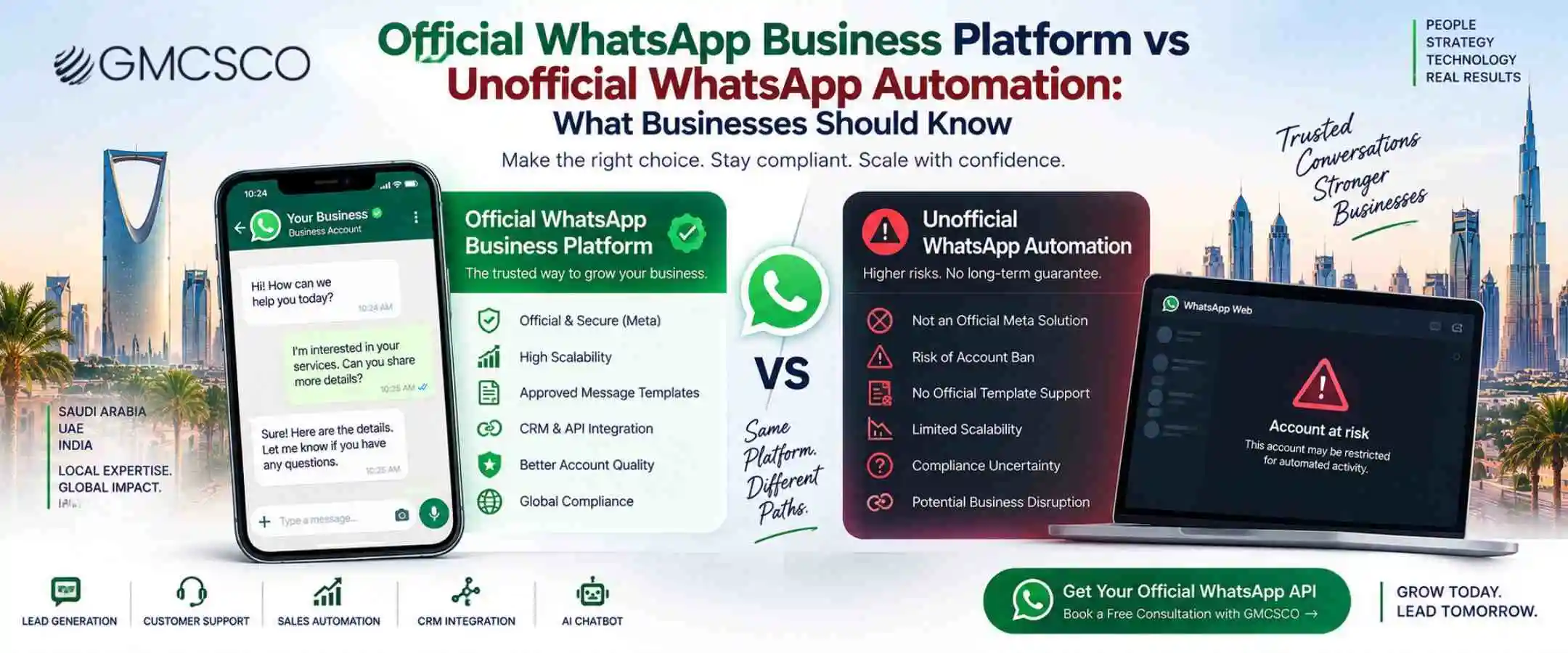
Official WhatsApp Business Platform vs Unofficial WhatsApp Automation
Automation itself isn’t the problem. How it connects to WhatsApp — and whether your business number is exposed to risk — is what actually matters.
Businesses increasingly use WhatsApp for lead generation, customer support, sales, notifications, appointment reminders, and marketing. As messaging volumes grow, many businesses start looking for ways to automate WhatsApp conversations and send messages at scale. This is where an important decision appears: should you use the official WhatsApp Business Platform or an unofficial WhatsApp automation solution? The difference is much bigger than simply choosing one software over another. An official WhatsApp API solution operates within the WhatsApp Business Platform ecosystem and provides a structured way to integrate WhatsApp with CRM systems, websites, chatbots, customer support platforms, and automation workflows. Unofficial automation generally refers to tools that automate WhatsApp through methods outside the official Business Platform API — browser automation, WhatsApp Web automation, modified clients, or other unsupported connection methods. For a business that depends on WhatsApp for leads, customers, transactions, or support, the choice affects account stability, scalability, compliance, automation capabilities, and long-term business continuity.
Quick Answer: Which WhatsApp API Should You Use?
If WhatsApp is an important customer acquisition, sales, support, or communication channel for your business, the official WhatsApp Business Platform is generally the appropriate architecture for long-term business messaging. It provides an official API environment, message templates, automation capabilities, business integrations, quality controls, and documented policies. Unofficial automation may appear attractive because it can sometimes offer quick setup or lower apparent costs — but businesses need to evaluate whether the method is supported, whether it complies with WhatsApp’s terms, how customer opt-ins are handled, and what happens if the account or connection is restricted. Automation itself is not the problem — WhatsApp officially supports automation. The key question is how the automation connects to WhatsApp and whether the business is operating within the official platform and applicable policies.
In Simple Terms
| Requirement | Official Platform | Unofficial Automation |
|---|---|---|
| Official Meta platform | Yes | Generally no |
| API based integration | Yes | Often uses alternative methods |
| CRM integration | Yes | Depends on tool |
| Business initiated messaging | Supported via approved templates | Method varies |
| Template system | Yes | Usually outside official workflow |
| Scalability | Designed for business scale | Depends on implementation |
| Compliance framework | Documented WhatsApp policies | May not have equivalent support |
| Account quality controls | Yes | Can vary significantly |
| Long term enterprise use | Designed for it | Requires careful risk assessment |
| Human handoff | Supported | Depends on system |
| AI chatbot integration | Yes | Depends on implementation |
| Business continuity | Structured platform approach | Depends on the automation method |
What Is the Official WhatsApp Business Platform?
Meta’s business messaging infrastructure for organizations communicating with customers through WhatsApp at scale — different from the standard WhatsApp Business App. The platform provides APIs and developer resources connecting WhatsApp to a business’s existing technology stack, supporting lead generation, conversational commerce, customer engagement, notifications, customer care, verification, and custom conversational experiences. Example workflows businesses build: Website enquiry → WhatsApp conversation → AI qualification → CRM → Sales representative; Order placed → WhatsApp notification → Delivery update → Customer support; Lead captured → Approved template → Customer response → Automated qualification → Human sales team.
What Is Unofficial WhatsApp Automation?
A broad term rather than one specific technology — it can include automation that interacts with WhatsApp outside the official Business Platform API, involving browser-based automation, WhatsApp Web automation, QR-based session automation, modified WhatsApp clients, third-party automation layers, scripts controlling a WhatsApp session, or unsupported connection methods. A tool saying “WhatsApp automation” doesn’t automatically mean it’s using the official Business Platform. Businesses should ask providers a simple technical question: “Are you connecting my business number through the official WhatsApp Business Platform API?” The provider should be able to clearly explain the architecture.
The Biggest Difference: Platform Relationship
With the official platform, the business operates within WhatsApp’s documented business messaging environment — Meta provides developer documentation, APIs, webhooks, policy enforcement documentation, rate limit information, and opt-in guidance. WhatsApp explicitly states businesses must comply with its Business Messaging Policy, and violations can result in access being limited or removed. With unofficial automation, the business needs to understand exactly how the tool interacts with WhatsApp and what risks or limitations may exist — making technical due diligence particularly important when selecting a provider.
Why Businesses Choose the Official Platform
The official platform is built around business messaging, not simply automating one WhatsApp session — that distinction matters more as a company grows. A small company might initially need only a simple inbox; a larger company may eventually need multiple sales users, CRM integration, lead assignment, AI chatbot, templates, customer segmentation, automated follow-ups, order notifications, appointment reminders, analytics, webhooks, API integrations, human agent escalation, and multiple workflows. Meta specifically supports CRM and marketing automation integrations as part of its Business Platform capabilities.
1. Scalability
A company receiving 20 enquiries per day may find a basic WhatsApp setup sufficient. Now imagine the company receives 2,000 leads per day — it may need to automatically capture the enquiry, identify the customer, ask qualification questions, determine product interest, create a CRM record, assign the lead, notify the sales representative, send a follow-up, track the conversation, and escalate to a human. This requires an API-driven communication architecture, not just automated messages. Meta’s onboarding guidance describes scaling through progressively higher messaging limits based on messaging quality.
2. WhatsApp Message Templates
When a business initiates a conversation outside the customer service window, WhatsApp requires an approved Message Template, which Meta can review, approve, pause, or reject. Templates support marketing communication, utility notifications, authentication, customer updates, appointment reminders, order and delivery notifications, and account-related communication. Meta’s current pricing structure distinguishes message categories including marketing, utility, authentication, and service.
3. WhatsApp API for Bulk Messaging
Bulk messaging shouldn’t mean uploading thousands of numbers and pressing “send.” A professional system considers customer opt-in, audience segmentation, message relevance, approved templates, quality signals, frequency, opt-out requests, delivery performance, customer responses, human support, and applicable privacy laws. WhatsApp’s Business Messaging Policy states businesses may contact people only where they have the person’s number and appropriate opt-in permission, and must respect requests to stop communications — particularly important when WhatsApp data connects to CRM and marketing databases in Saudi Arabia and the UAE.
4. Account Quality Matters
A common mistake is thinking success is determined only by message volume. Meta’s onboarding guidance emphasizes sending messages that are expected, timely, and relevant, and explains that poor messaging quality can affect messaging limits and contribute to account restrictions if unaddressed. Businesses should monitor message quality, delivery, read rates, blocks, complaints, template performance, opt-outs, and engagement — very different from simply buying a “bulk WhatsApp sender.”
5. CRM Integration
For many Saudi and UAE businesses, real value starts when WhatsApp connects to the CRM. A real estate customer sends “I want a 3 bedroom apartment in Riyadh” — instead of staying inside a WhatsApp inbox: WhatsApp → AI qualification → CRM record → Lead score → Sales assignment → Follow up, storing name, phone, requirement, location, budget, preference, source, sales owner, and status. The same architecture works for healthcare (appointment enquiry → qualification → booking → reminder), ecommerce (product enquiry → info → order → delivery update), education (course enquiry → qualification → counsellor → follow up), and travel (destination enquiry → requirements → package → sales follow up).
💬 Not Sure If Your Current Setup Is Official?
GMCSCO can review your current WhatsApp automation and confirm whether it’s connected through the official Business Platform.
Official WhatsApp API by Market
🇸🇦 Saudi Arabia
Real estate: ad → WhatsApp → AI qualification → CRM → agent. Ecommerce: order → notification → delivery update → support. Healthcare, logistics, and education follow similar structured flows.
🇦🇪 UAE
CRM integration, AI customer support, lead routing, marketing automation, order notifications, appointment reminders, sales follow-ups, and analytics as WhatsApp becomes part of the sales infrastructure.
WhatsApp API and Saudi PDPL Compliance
Compliance should be considered before launching a WhatsApp marketing campaign, not after receiving complaints. Saudi Arabia’s Personal Data Protection Law includes requirements relevant to direct marketing — Saudi regulatory material states consent is required for direct marketing in applicable circumstances, recipients must have a mechanism to stop receiving marketing material, and the sender’s identity must be clearly stated. A Saudi WhatsApp marketing workflow should consider how the number was collected, whether the customer opted in, what they agreed to receive, how consent is recorded, how opt-out is processed, how data is stored, who can access it, how CRM data is handled, and what happens when consent is withdrawn. WhatsApp platform compliance and local privacy compliance are separate considerations — meeting one does not automatically mean the business has satisfied the other.
WhatsApp API and UAE Data Protection
UAE businesses should similarly consider how personal information is collected, stored, processed, and shared across WhatsApp, CRM, customer support platforms, and automation tools. The UAE has a federal Personal Data Protection Law, while specific sectors and free zones may have additional requirements. Companies implementing WhatsApp automation should document: Data collection → Consent → WhatsApp communication → CRM storage → Automation → Retention → Deletion. The exact compliance requirements depend on the business, data, and applicable jurisdiction.
Risk Comparison: Official vs Unofficial
| Area | Official Platform | Unofficial Automation |
|---|---|---|
| Platform relationship | Official business platform | Depends on automation method |
| API | Official API | May use unsupported methods |
| Policy framework | Documented | Depends on tool |
| Templates | Official approval workflow | May not use official system |
| Opt-in | Required | Business responsibility remains |
| Scaling | Designed for business messaging | Depends on implementation |
| CRM integration | Supported | Tool dependent |
| AI integration | Supported through APIs | Tool dependent |
| Account quality | Official quality mechanisms | May vary |
| Support | Meta/partner ecosystem | Vendor dependent |
| Long term planning | Structured | Higher technical uncertainty |
| Enterprise architecture | Suitable | Requires careful assessment |
The exact risk of an unofficial solution depends on the technology being used, so businesses should not assume every third-party tool has identical characteristics.
Is WhatsApp Automation Itself Against the Rules?
No. This is an important distinction. WhatsApp officially supports automation — its Business Messaging Policy specifically allows automation during the 24-hour customer service window, provided businesses also maintain appropriate escalation paths to human support. The question isn’t “is automation allowed?” — it’s “is the automation implemented through an appropriate WhatsApp Business Platform integration and operated according to WhatsApp’s policies?” That distinction can prevent businesses from choosing technology based only on price or the number of features shown in a demo.
10 Questions to Ask Before Buying a WhatsApp API Solution
1. Is this the official Business Platform?
Ask for a clear explanation of the integration architecture.
2. Who owns the WhatsApp Business Account?
Understand who controls the account and business assets.
3. Can the number be migrated?
An important business continuity question if you change providers.
4. How are templates managed?
Understand whether templates use the official approval process.
5. Can WhatsApp connect to my CRM?
Ask about API, webhooks, and integration capabilities.
6. Can I build AI automation?
Ask whether it supports chatbot or AI agent integrations.
7. How is opt-in handled?
This should be clearly documented.
8. How are quality signals monitored?
Ask what analytics and quality info you can access.
9. What if a template is rejected?
Understand the process for correcting and resubmitting.
10. What happens if I leave the provider?
This question is often overlooked.
What Does “Get WhatsApp API” Actually Mean?
Someone searching this may actually need Business Platform onboarding, API integration, CRM integration, a chatbot, an AI agent, bulk messaging, marketing, notifications, OTP, customer support, or automation — these aren’t exactly the same service. A good implementation starts by identifying the business requirement before selecting technology: Need notifications? → utility messaging. Need marketing? → an appropriate strategy and customer opt-in. Need customer support? → a shared inbox and agent routing. Need lead generation? → Click to WhatsApp, qualification, and CRM integration. Need AI automation? → WhatsApp API + AI model + CRM + business rules.
Can You “Buy” WhatsApp API?
Technically, what businesses usually purchase isn’t a standalone software license called “WhatsApp API” — they may be paying for Business Platform access, API implementation, provider services, a software platform, CRM integration, chatbot, AI automation, support, message costs, and additional features. Meta states that businesses accessing the platform directly do not pay an additional fee simply to access it, while partners may charge fees for value-added services or technology. Meta’s current platform pricing is based on delivered messages and varies by market and category — ask for a complete cost breakdown rather than comparing only a monthly software fee.
What Should Businesses Calculate?
Meta Messaging Charges
Depend on market and message category.
Platform/Provider Fee
Software, inbox, automation, or support.
Integration Cost
CRM, ERP, ecommerce, or custom API work.
Chatbot/AI Cost
Additional technology costs.
Support
Ongoing technical support for enterprise use.
Total WhatsApp Cost = Meta Messaging Charges + Platform Fees + Integration + Automation/AI + Support
A Professional Bulk Messaging Workflow
Customer Opt In → Audience Segmentation
↓
Approved Message Template → WhatsApp Delivery
↓
Customer Response → Automation/AI
↓
CRM Update → Sales/Support Team → Follow Up
This structure keeps the objective as customer communication and conversion, rather than simply maximizing message volume — Meta’s platform is designed around business messaging experiences including marketing, commerce, customer care, and notifications.
Official WhatsApp API for Lead Generation
Meta Ad
Click to WhatsApp
WhatsApp Conversation
AI Qualification
Lead Score
CRM
Sales Rep
This eliminates several manual steps — a lead doesn’t simply enter WhatsApp, it becomes a structured business record. For Saudi and UAE companies running Meta Ads, Google Ads, or other digital campaigns, this creates a connected journey between advertising, WhatsApp, and sales.
WhatsApp AI Chatbot With the Official API
An AI chatbot can understand natural language, answer FAQs, qualify leads, recommend products, collect requirements, check connected-system information, route customers, create CRM records, schedule appointments, and escalate conversations. The WhatsApp API becomes the communication layer, the AI becomes the intelligence layer, the CRM becomes the customer data layer, and your business logic connects everything.
The system captures Requirement: 500 units, Location: Riyadh, Timeline: Next month — transferred into the CRM for sales follow-up. This is fundamentally different from a simple auto-reply.
When Unofficial Automation May Appear Attractive
Unofficial tools can appear attractive because of fast setup, lower initial cost, simple dashboards, bulk messaging features, easy browser-based automation, and minimal technical requirements. But the correct evaluation should include the entire business lifecycle. Ask: What happens when the business grows? When customer volume increases? If the automation method stops working? If you need CRM integration? Multiple agents? If the provider shuts down? If the WhatsApp number becomes restricted? These questions are more important than the initial monthly price.
📅 Building a WhatsApp Architecture That Grows With You
GMCSCO can help evaluate your current provider or build a proper WhatsApp Business API + CRM + AI architecture from the start.
How to Choose a WhatsApp API Provider in Saudi Arabia or UAE
Official Connectivity
Confirm how it connects your business to WhatsApp.
Business Ownership
Who controls the Meta assets, WABA, and number.
Integration
CRM, ERP, website, ecommerce, helpdesk, AI, marketing.
Automation
Real workflows, not just autoresponders.
Templates
Creation, approval, categorization, management.
Analytics
Delivery, read, and quality information.
Support
Who handles technical issues and onboarding.
Scalability
How it behaves as volume and agent count grow.
Data Protection
How customer info is processed and stored.
Exit Strategy
How you migrate assets if you change providers.
WhatsApp Business Platform for Saudi Arabia, UAE and India
🇸🇦 Saudi Arabia
Saudi PDPL, customer consent, Arabic + English, CRM integration, lead qualification, marketing governance, local workflows.
🇦🇪 UAE
UAE data protection, consent, CRM/marketing integrations, Arabic + English, enterprise support, data governance.
🇮🇳 India
Consent, business messaging policies, CRM integration, marketing communication, regional language, support workflows.
The platform remains the technology layer, while the business needs to ensure its messaging practices comply with applicable laws and WhatsApp policies.
Which Is Right for Your Business?
If you only need basic personal communication, you may not need a full API implementation. If you need business automation, consider the WhatsApp Business Platform. If you need CRM integration, an API-based implementation becomes important. If you need AI chatbot automation, use an architecture capable of integrating WhatsApp with your AI and business systems. If you need large-scale communication, evaluate official platform capabilities, messaging limits, templates, quality, and compliance. If WhatsApp generates significant revenue for your company, treat it as business infrastructure rather than simply another messaging application.
Why Think Beyond “WhatsApp Bulk Messaging”
“WhatsApp Business API for bulk messaging” has strong commercial intent, but businesses should think beyond message volume. A mature strategy looks at Acquisition → Conversation → Qualification → Conversion → Support → Retention, with WhatsApp potentially participating at every stage:
Google Ads
AI Qualification
CRM
Sales
Order
Notification
Support
Retention
This is where a WhatsApp API implementation becomes part of the company’s broader digital infrastructure.
How GMCSCO Helps Businesses Implement WhatsApp API Solutions
For businesses in Saudi Arabia, UAE, and India, GMCSCO can help plan and implement WhatsApp-based business communication around the actual sales and customer service workflow — not treat WhatsApp API as simply a messaging panel:
What a Professional WhatsApp Implementation Looks Like
Customer → WhatsApp Business Platform → WhatsApp API
↓
Automation / AI Layer
↓
CRM / ERP / Business System
↓
Sales / Support Team → Analytics
This architecture allows WhatsApp to become part of the business ecosystem instead of remaining an isolated communication channel.
Official WhatsApp API Implementation Checklist
Business Setup
☐ Meta business assets configured
☐ WABA configured
☐ Phone number prepared
☐ Business profile completed
Compliance
☐ Opt-in process defined
☐ Privacy policy reviewed
☐ Marketing consent documented
☐ Opt-out process available
☐ Data processing reviewed
Messaging
☐ Templates prepared
☐ Categories understood
☐ Arabic/English reviewed
☐ Support workflow defined
Automation
☐ Chatbot requirements defined
☐ AI requirements defined
☐ Human escalation defined
☐ Lead routing configured
Integration
☐ CRM integration planned
☐ API/webhooks planned
☐ Website integration done
☐ Analytics configured
Growth
☐ Message quality monitored
☐ Campaign performance monitored
☐ Feedback monitored
☐ Volume reviewed
Frequently Asked Questions
Is the official WhatsApp API better than unofficial WhatsApp automation?
The two approaches are different technologies. The official WhatsApp Business Platform is Meta’s documented business messaging infrastructure and is designed for business communication at scale. Unofficial automation can use alternative connection methods and should therefore be evaluated carefully for technical, operational, and platform risks.
What is the official WhatsApp API?
The official WhatsApp API is part of the WhatsApp Business Platform and allows businesses to integrate WhatsApp with applications such as CRM systems, customer support software, automation platforms, and other business systems.
Can I use WhatsApp API for bulk messaging?
Yes, the WhatsApp Business Platform supports business-initiated messaging, but businesses must follow WhatsApp policies, obtain appropriate opt-ins, and use approved templates when initiating conversations outside the applicable customer service window.
Can WhatsApp API connect with a CRM?
Yes. WhatsApp Business Platform supports integrations with CRM and marketing automation systems.
Can I use AI with WhatsApp API?
Yes. WhatsApp can be integrated into AI chatbot and AI agent architectures. The AI layer can handle conversational logic while the WhatsApp Business Platform provides the messaging channel.
Do WhatsApp API messages require templates?
Business-initiated messages outside the 24-hour customer service window require approved Message Templates under WhatsApp’s Business Messaging Policy.
Is WhatsApp automation allowed?
WhatsApp supports automation for business messaging. During the 24-hour customer service window, automation can be used provided businesses maintain appropriate escalation paths to human support.
What is a WhatsApp Business API provider?
A WhatsApp API provider or integration partner can help businesses connect WhatsApp Business Platform capabilities with software such as inboxes, CRM systems, chatbots, automation platforms, and other business applications. Meta notes that businesses that need integration support may prefer working with partners.
Can businesses in Saudi Arabia use WhatsApp Business API?
Yes. Businesses in Saudi Arabia can use WhatsApp Business Platform capabilities, subject to Meta’s policies and applicable Saudi laws and regulations. Saudi businesses should pay particular attention to customer consent and direct marketing requirements under applicable personal data rules.
Can businesses in UAE use WhatsApp Business API?
Yes. UAE businesses can use WhatsApp Business Platform subject to Meta’s policies and applicable UAE requirements. Businesses should also evaluate personal data processing requirements under the applicable UAE data protection framework.
How much does WhatsApp API cost?
WhatsApp Business Platform pricing depends on the market, message category, and applicable pricing structure. Meta states that businesses are charged based on delivered messages and that rates vary by market and category. Providers may also charge for additional software, technology, or services.
Should I buy WhatsApp API from a third party?
A business can work directly with the WhatsApp Business Platform or with an integration partner depending on its technical requirements. Meta specifically notes that businesses with in-house developers may access the APIs directly, while businesses that need help connecting WhatsApp to their technology stack may prefer a partner.
Final Takeaway: Which WhatsApp API Should You Use?
If your business depends on WhatsApp for lead generation, sales, customer support, notifications, CRM automation, or AI-driven customer communication, evaluate the official WhatsApp Business Platform first. The important question isn’t “which WhatsApp tool is cheapest?” — it’s “which WhatsApp architecture can support my business safely and sustainably as my customers, messaging volume, and automation requirements grow?” The official platform provides the foundation for API-based business messaging, templates, automation, integrations, and scalable customer communication. For businesses in Saudi Arabia and UAE, the implementation should then be designed around customer consent, data protection, Arabic and English communication, CRM integration, AI automation, customer support, and measurable business outcomes. If WhatsApp is already generating leads for your business, moving from basic automation toward a structured WhatsApp Business API + CRM + automation architecture can be an important step in building a scalable customer communication system.
Ready to Implement WhatsApp Business API?
GMCSCO can help businesses plan WhatsApp Business API implementation, CRM integration, chatbot automation, AI agent workflows, and business messaging solutions for Saudi Arabia, UAE, and India.
Disclaimer: This article is for general informational purposes only. WhatsApp Business Platform features, policies, pricing and requirements may change over time. Businesses should verify the latest information with official WhatsApp/Meta documentation before implementing a WhatsApp API or automation solution.