
🎯 WhatsApp AI Lead Qualification — 2026
WhatsApp AI Agent for Lead Qualification: From Conversation to Qualified Opportunity
Generating a lead is only the beginning. What happens in the next five minutes decides whether it becomes revenue or disappears into an inbox.
For many businesses, generating a lead is only the beginning. A customer may click a Meta ad, visit a website, send a WhatsApp message, and ask a simple question — what happens next determines whether that enquiry becomes a sales opportunity or gets lost in an overloaded inbox. Sales teams often spend significant time asking the same qualification questions, checking requirements, assigning leads to the right salesperson, and following up with people who have already shown interest. A WhatsApp AI agent can automate much of this journey. Instead of simply responding with predefined chatbot messages, an AI-powered WhatsApp workflow can understand customer questions, collect relevant information, qualify prospects, assign leads, update CRM records, and trigger the next action. Meta itself has been expanding AI capabilities for business conversations — in June 2026, Meta introduced Meta Business Agent, describing capabilities including answering business questions, recommending products, booking appointments, qualifying incoming leads, and supporting sales conversations, alongside a Business Agent Platform designed to connect agents with business systems and provide enterprise controls and measurement. For businesses in Saudi Arabia and the UAE, this creates an opportunity to turn WhatsApp from a simple communication channel into an automated lead qualification and sales workflow.
The Basic Journey
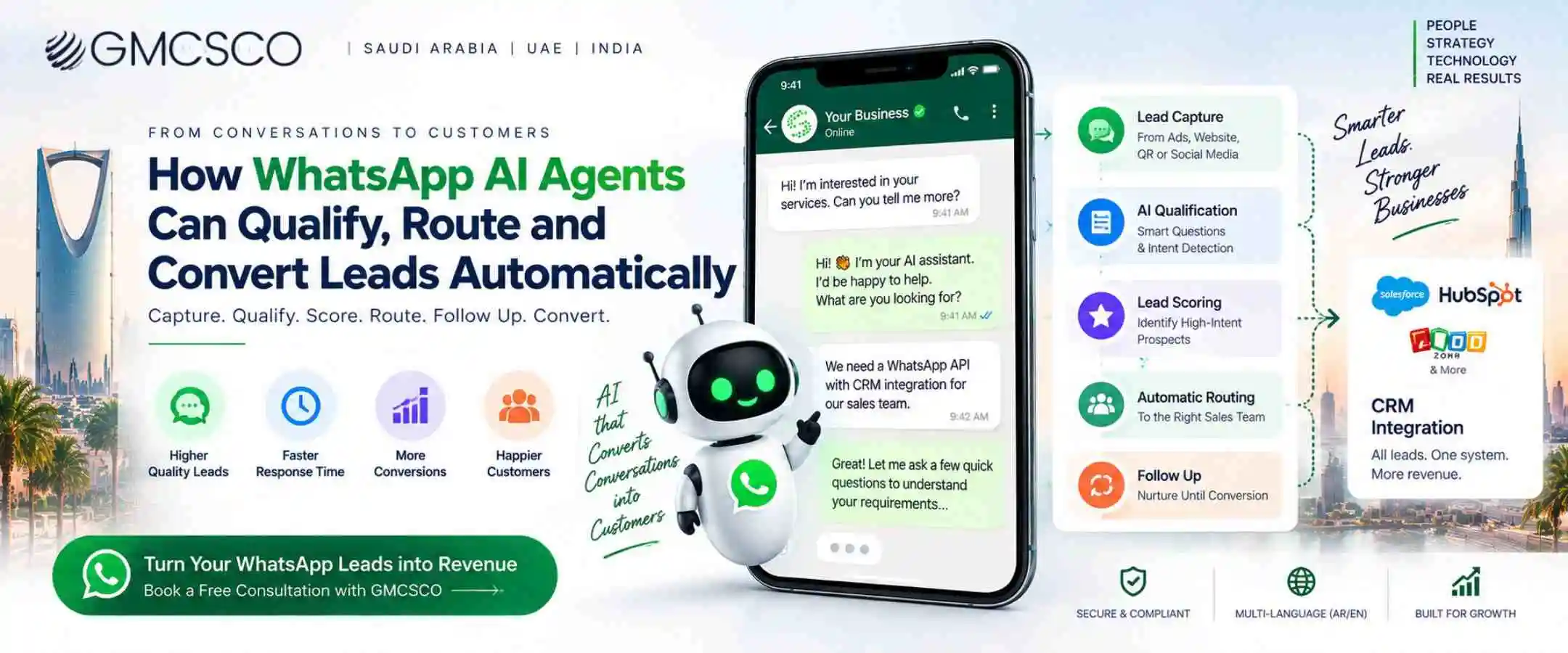
Ad or Website → WhatsApp → AI Conversation → Lead Qualification → Lead Score → CRM → Sales Assignment → Follow Up → Conversion. This article explains how that process works and what businesses should consider before implementing a WhatsApp AI lead qualification system.
What Is WhatsApp AI Lead Qualification?
The process of using an AI-powered WhatsApp system to communicate with potential customers, understand their requirements, and determine whether they’re suitable prospects for a company’s products or services. Traditional lead capture often collects only basic information — Name: Ahmed, Phone: +966 XXXXXXXX, Requirement: Interested in property. That’s useful, but it doesn’t tell the sales team whether Ahmed is ready to buy. An AI agent can continue the conversation naturally: “Are you looking for a residential property or an investment property?” → “Investment.” → “What approximate budget range are you considering?” → “Between SAR 1.5 million and SAR 2 million.” The system captures Lead Type: Investment, Budget: SAR 1.5M–2M, Location: Riyadh, Intent: High, Status: Sales Qualified Lead. The important difference: the WhatsApp conversation is producing structured sales information, not just messages.
Why WhatsApp Is Becoming Important for AI Lead Qualification
WhatsApp is particularly useful for conversational lead generation because customers can communicate through a channel they already understand. Saudi Arabia is an especially relevant market — the Saudi Internet Report 2025 from the Communications, Space and Technology Commission reported 99.6% internet penetration and 45.2% adoption of AI tools, with WhatsApp as the most used social application at 94.4% usage among male internet users and 90.4% among female internet users. Instead of sending a customer from an advertisement to a long form and waiting for a salesperson to respond, a company can start a conversation immediately: the customer asks questions, the AI responds, the AI qualifies the requirement, the CRM receives the information, and the sales team receives a structured lead. That’s the foundation of WhatsApp AI lead automation.
💬 See How This Would Work for Your Business
GMCSCO can walk through what a WhatsApp AI qualification workflow would look like for your specific product and sales process.
WhatsApp AI Chat vs Traditional WhatsApp Chatbot
A traditional chatbot generally works through predefined rules — “1. Product Information 2. Pricing 3. Book Appointment 4. Talk to Sales” — and the customer selects an option and moves through a predefined workflow. An AI agent works differently: it can interpret natural language and determine what the customer is trying to accomplish. “I need a WhatsApp API for around 50,000 messages every month and I also want CRM integration” would confuse a menu-based chatbot, but an AI agent identifies WhatsApp API, monthly messaging volume, CRM integration, and commercial intent, then continues the conversation around those requirements.
📋 Traditional Chatbot
Question → predefined answer → menu → next step.
🤖 AI Agent
Customer message → intent understanding → context → reasoning → action → next step.
How a WhatsApp AI Agent Qualifies Leads Automatically
Stage 1: Lead Capture
The journey starts when a potential customer enters WhatsApp — from Meta Ads, Google Ads, website, landing page, QR code, social media, an existing customer, referral, WhatsApp link, or an ecommerce website. Instead of asking the customer to complete a long form, the AI agent collects information conversationally: “Hi, welcome to GMCSCO. How can we help your business today?” → “I need WhatsApp API.” The AI determines the customer is interested in a WhatsApp Business solution.
Stage 2: AI Intent Detection
“I want to automate customer enquiries,” “We receive around 500 leads every month and our sales team cannot respond quickly,” and “Can your WhatsApp chatbot connect with Salesforce?” are all discussing WhatsApp automation, but their requirements differ. The AI classifies conversations into intents such as WhatsApp API, WhatsApp chatbot, AI agent, CRM integration, lead generation, customer support, marketing automation, ecommerce automation, appointment booking, and technical integration — letting the workflow change depending on what the customer actually needs.
Stage 3: Asking Qualification Questions
The key is not to ask every customer the same 15 questions — questions should depend on the customer’s requirement. A real estate company asks property type, location, budget, investment vs. personal use, and timeline. A healthcare business asks service, location, appointment timing, and new vs. follow-up. A B2B technology company asks solution needed, number of users, current CRM, monthly lead volume, and API integration needs. This makes the conversation more relevant.
Stage 4: Lead Scoring
Collecting information is useful, but sales teams also need to know which leads deserve immediate attention.
| Qualification Factor | Example |
|---|---|
| Requirement | Strong match |
| Budget | Within target |
| Location | Target market |
| Purchase timeline | Within 30 days |
| Decision maker | Yes |
| Engagement | High |
| Product interest | Specific |
A scoring model: 80–100 High priority, 50–79 Medium priority, below 50 Nurture. The exact system should be designed around the company’s sales process rather than using a universal formula — the result is sales representatives don’t treat every enquiry equally.
Stage 5: Automatic CRM Creation
Instead of leaving information inside WhatsApp, the system creates or updates a CRM record: Lead Name: Ahmed, Country: Saudi Arabia, City: Riyadh, Requirement: WhatsApp Business API, Monthly Volume: 50,000 messages, CRM: Salesforce, Lead Score: 87, Source: Meta Ads, Status: Qualified, Assigned To: Enterprise Sales. This is where WhatsApp CRM automation becomes much more valuable than a basic chatbot.
📅 Ready to Connect WhatsApp, AI and Your CRM?
GMCSCO can design the qualification questions, scoring model, and CRM integration around your actual sales process.
Stage 6: Automatic Lead Routing
Not every lead should go to the same salesperson — routing rules can use country, city, product, lead score, industry, language, budget, business size, customer type, and working hours. For example: Saudi Arabia + Enterprise + High Score → Enterprise Sales; UAE + Ecommerce → Ecommerce Specialist; India + Small Business → SMB Sales; Healthcare → Healthcare Sales Team. Instead of 100 WhatsApp conversations → one shared inbox, the system creates 100 conversations → AI qualification → structured routing → relevant sales representatives.
Stage 7: Human Handoff
A good AI agent shouldn’t attempt to handle every conversation indefinitely — complex pricing negotiation, contract discussion, technical escalation, complaints, high-value opportunities, sensitive requests, and explicit customer requests should transfer to a human. WhatsApp’s Business Policy allows automated responses during the 24-hour customer service window but requires clear and direct escalation options to human support: AI handles repetitive conversations → AI identifies qualified opportunities → Human handles high-value or complex conversations.
Stage 8: Automated Follow Up
One of the biggest problems in sales isn’t lead generation — it’s lead follow-up. A structured system identifies leads needing follow-up: Day 0 qualification, Day 1 follow-up, Day 3 product information, Day 7 sales reminder, Day 14 re-engagement. For business-initiated messages outside the applicable 24-hour window, WhatsApp requires approved message templates. The objective isn’t to send more messages — it’s to send useful and relevant messages at the appropriate stage of the customer journey.
Complete WhatsApp AI Lead Qualification Journey
1. Ad Click
2. WhatsApp
3. Intent Detected
4. Questions Asked
5. Requirements Given
6. Evaluated
7. Scored
8. CRM Created
9. Assigned
10. Sales Notified
11. AI Supports
12. Human Takes Over
13. Follow Up
14. Pipeline
WhatsApp AI Agent by Industry
Real Estate
Property type, location, budget, bedrooms, investment/personal, timeline — routes high-intent buyers to a property consultant.
Healthcare
Service enquiries, appointment requests, location info, FAQs, department routing — requires extra care around sensitive data.
Ecommerce
Find products, compare options, answer product questions, check orders, route support, recommend products.
Education
Course, education level, location, intake, budget, learning mode — routed to an admissions counsellor.
Logistics
Origin, destination, shipment type, weight, volume, delivery timeline — routed to the relevant logistics team.
UAE B2B
Sales team size, current CRM, monthly conversation volume, AI needs, Arabic + English support requirements.
The UAE’s Personal Data Protection Law provides a framework for protecting personal data and sets controls around processing and consent, so businesses should consider privacy requirements when designing WhatsApp, CRM, and AI workflows.
💬 Real Estate, Ecommerce, Healthcare or B2B — Talk to Us
Whatever your industry, GMCSCO can design the right qualification flow for your customers.
Arabic and English WhatsApp AI Conversations
For Saudi and UAE markets, customers may communicate in English, Arabic, Arabic and English mixed together, or Arabic written in different styles. An AI agent can be designed to detect the customer’s preferred language and continue accordingly — a customer writing in Arabic gets an Arabic response, and if they switch to English, the conversation continues in English, feeling more natural than forcing every customer through the same language-based menu. Businesses should test Arabic responses carefully, particularly for industry-specific terminology, pricing, product information, and regulated industries.
WhatsApp AI Lead Qualification and CRM Integration
Without CRM integration, businesses may automate conversations but still have fragmented sales data. With it, the system connects Conversation → Customer → Lead → Opportunity → Salesperson → Revenue, capturing customer details, conversation summary, lead source, product interest, qualification responses, lead score, sales owner, status, follow-up date, and conversation history — creating a single view of the customer journey. For larger companies, the AI layer can also work with business systems through APIs and webhooks.
WhatsApp AI Agent vs Traditional Chatbot
| Feature | Traditional Chatbot | WhatsApp AI Agent |
|---|---|---|
| Predefined responses | Yes | Yes |
| Natural language understanding | Limited | Advanced |
| Context awareness | Limited | Stronger |
| Lead qualification | Rule based | AI assisted |
| Lead scoring | Rules | Rules + AI inputs |
| CRM integration | Possible | Possible |
| Dynamic questions | Limited | Yes |
| Complex enquiries | Limited | Better suited |
| Automated routing | Yes | Yes |
| Human handoff | Yes | Yes |
| Business actions | Limited | Can be integrated |
| Personalized conversation | Limited | More flexible |
The bigger difference isn’t simply that one has AI and the other doesn’t — it’s the ability to combine conversation, context, business rules, data, and actions.
What Can a WhatsApp AI Agent Actually Do?
Understand
Interpret what the customer is asking.
Qualify
Check enquiry against business criteria.
Collect
Gather required information.
Score
Apply qualification rules.
Route
Send the lead to the right team.
Update
Create or update CRM information.
Follow Up
Trigger appropriate next steps.
Escalate
Transfer complex conversations to humans.
Assist
Answer common product/service questions.
Convert
Support booking, quotation, or purchase.
How WhatsApp AI Agents Improve Lead Response Speed
Traditional Process
Lead arrives → salesperson notices message → asks questions → waits for reply → updates CRM → assigns follow-up.
Automated Process
Lead arrives → AI responds → qualifies → scores → CRM updates → sales team notified.
The salesperson receives the lead after much of the repetitive work is already done, freeing them to spend more time on negotiation, product explanation, relationship building, demonstrations, closing, and enterprise conversations. The AI isn’t replacing the sales process — it’s helping structure it.
WhatsApp AI Lead Qualification for Meta Ads
Meta Ad
Click to WhatsApp
AI Conversation
Qualification
Lead Score
CRM
Sales Team
Particularly useful for businesses receiving high volumes of enquiries from paid campaigns. Instead of optimizing only for lead count, the business can measure qualified leads, sales opportunities, appointments, quotes, conversions, and revenue — moving marketing strategy from lead volume toward lead quality.
WhatsApp AI Agent for B2B Lead Generation
B2B sales often require more qualification than consumer sales. A B2B WhatsApp AI agent can ask what solution is needed, how many users, which system is currently used, approximate monthly volume, which country, and implementation timeline — categorizing the enquiry as, for example, “Enterprise Lead: High volume, CRM integration required, Implementation within 30 days” instead of a simple notification saying “New customer interested.”
💬 Turn B2B Enquiries Into Structured Opportunities
GMCSCO can build the qualification logic your sales team actually needs — not a generic FAQ bot.
WhatsApp AI, Account Quality and Consent
Automation shouldn’t be designed around sending as many messages as possible — customer experience matters. Businesses should avoid irrelevant messages, excessive follow-ups, misleading offers, poorly targeted campaigns, unclear identity, ignoring opt-out requests, and sending messages without appropriate permission. WhatsApp’s Business Policy places responsibility on businesses for obtaining required permissions, maintaining appropriate privacy practices, and complying with applicable law — particularly important when an AI agent is connected to a marketing database. The AI should have clear rules about what it can say, what it cannot say, what information it can access, what actions it can perform, and when it must transfer to a human.
WhatsApp AI Automation and Saudi PDPL
A WhatsApp AI system may process name, phone number, location, customer requirements, communication history, lead source, preferences, and business information. Saudi Arabia’s Personal Data Protection Law and its implementing regulations contain requirements concerning consent, processing, and direct marketing — consent should be documented and verifiable, with mechanisms to stop receiving marketing communications. This means the system shouldn’t be designed simply as Database → Automated messages, but as Consent → Customer data → AI conversation → Appropriate communication → Opt-out management → CRM governance. The exact requirements depend on the use case and applicable regulations.
How GMCSCO Can Help With WhatsApp AI Lead Automation
For businesses in Saudi Arabia, UAE, and India, GMCSCO can help build WhatsApp-based automation around the complete customer journey — not simply install a chatbot, but connect WhatsApp + AI + CRM + Lead Qualification + Routing + Follow Up:
For a company that receives a significant number of WhatsApp enquiries, this can transform WhatsApp from a simple inbox into a structured sales automation channel.
Example: WhatsApp AI Agent for a Saudi Real Estate Company
The system identifies Market: Saudi Arabia, City: Riyadh, Requirement: Apartment, Purpose: Investment, Budget: SAR 1.5M–2M, Location: North Riyadh. If the lead meets qualification criteria: Lead Score: High → Assign to Riyadh Investment Sales Team → Notify Sales Manager → Human Sales Representative Takes Over.
Example: WhatsApp AI Agent for a UAE B2B Company
A Dubai-based technology company receives: “We want to automate WhatsApp for our customer support team.” The AI asks how many customer conversations are received each month, how many support agents, which CRM or helpdesk is used, whether AI chatbot automation is needed, and whether Arabic and English support is required. The system classifies: Business Type: B2B, Requirement: WhatsApp automation, Team Size: 25 agents, CRM: Existing, AI Required: Yes, Language: Arabic + English, Lead Priority: High. Instead of a salesperson spending 15 minutes gathering basic information, they receive a structured opportunity.
How to Build a WhatsApp AI Lead Qualification System
Define the Business Objective
Lead generation, qualification, sales, support, appointment booking, ecommerce, notifications, or retention.
Define Qualification Criteria
Budget, location, industry, requirement, timeline, company size, purchase intent.
Create the Conversation Flow
Define what the AI should ask and when.
Connect WhatsApp
Use the appropriate WhatsApp Business Platform infrastructure and Meta’s official developer resources.
Connect CRM
Send qualified customer information into the CRM.
Configure Routing
Define which salesperson or team receives each lead.
Configure Human Escalation
Define when the AI should stop and transfer the conversation.
Test
Arabic, English, mixed language, unexpected questions, wrong information, complex requests, handoff, CRM/API failures.
Measure
Track business outcomes rather than just chatbot conversations.
KPIs to Measure WhatsApp AI Lead Qualification
Conversation
Conversations started, response rate, completion rate, avg. length.
Qualification
Leads qualified, qualification rate, score distribution, sales-ready leads.
Sales
Accepted leads, appointments, quotations, opportunities, conversions, revenue.
Automation
AI-handled conversations, handoff rate, response time, routing accuracy.
The most important metric depends on the business — real estate may focus on qualified property enquiries, healthcare on completed appointments, ecommerce on purchases, B2B on qualified opportunities.
Common Mistakes When Implementing WhatsApp AI Agents
Asking Too Many Questions
Only ask what’s needed for the next decision.
Trying to Automate Everything
Build human handoff in from the beginning.
Connecting AI Without CRM
Sales still struggles to manage leads.
No Clear Qualification Rules
The AI needs defined business criteria.
Ignoring Customer Consent
Saudi PDPL requires consent and opt-out mechanisms.
Measuring Only Conversations
10,000 chats ≠ 10,000 opportunities.
Frequently Asked Questions
What is WhatsApp AI lead qualification?
WhatsApp AI lead qualification uses AI to communicate with prospects through WhatsApp, understand their requirements, ask relevant questions, evaluate qualification criteria, and route suitable leads to sales or other teams.
Can WhatsApp AI agents qualify leads automatically?
Yes. An AI agent can be configured to ask qualification questions, collect customer information, apply business rules, and send structured lead information to a CRM or sales workflow.
What is a WhatsApp AI agent for business?
A WhatsApp AI agent is an AI-powered business assistant that can communicate with customers through WhatsApp and, when properly integrated, perform defined tasks such as answering questions, qualifying leads, booking appointments, updating systems, and routing conversations.
Is a WhatsApp AI chatbot different from a WhatsApp AI agent?
Yes. A chatbot may primarily provide automated responses, while an AI agent can be designed to understand context and perform defined actions across connected business systems.
Can WhatsApp AI connect to CRM?
Yes. A WhatsApp AI solution can be integrated with CRM systems through APIs, webhooks, or integration platforms, depending on the CRM and implementation architecture.
Can WhatsApp AI qualify leads from Meta Ads?
Yes. A common architecture is Meta advertising followed by a WhatsApp conversation, AI qualification, lead scoring, CRM creation, and sales routing.
Can WhatsApp AI work in Arabic?
Yes. AI-based WhatsApp workflows can be designed for Arabic and English conversations. Businesses targeting Saudi Arabia and the UAE should test Arabic terminology and industry-specific responses before production deployment.
Can WhatsApp AI automatically assign leads to salespeople?
Yes. Routing rules can be created based on factors such as location, product, lead score, industry, language, or sales team.
Can a WhatsApp AI agent replace salespeople?
An AI agent can automate repetitive qualification and support tasks, but many sales processes still require human involvement for negotiation, complex requirements, relationship building, and closing.
Is WhatsApp AI automation allowed?
WhatsApp supports business automation, subject to its policies and applicable requirements. Its Business Policy allows automated responses during the 24-hour customer service window while requiring clear escalation options to human support.
How much does a WhatsApp AI agent cost?
The cost depends on factors such as WhatsApp setup, software, AI usage, CRM integration, workflow complexity, development, and ongoing support. There is no single price that applies to every implementation.
Can GMCSCO develop a WhatsApp AI chatbot?
Yes. GMCSCO can help businesses plan WhatsApp-based chatbot and AI agent solutions, including lead qualification, CRM integration, automation, routing, and business workflows.
Final Thoughts: From WhatsApp Conversations to Qualified Opportunities
The biggest opportunity with WhatsApp AI isn’t simply making WhatsApp reply automatically — it’s connecting the entire customer journey: Lead Capture → WhatsApp Conversation → AI Understanding → Qualification → Lead Scoring → CRM → Lead Routing → Human Sales → Follow Up → Conversion. For businesses in Saudi Arabia and the UAE, this approach can be particularly valuable where WhatsApp is already an important customer communication channel and companies want to connect marketing, sales, and customer service more efficiently. Saudi Arabia’s latest internet data shows strong adoption of both WhatsApp and AI tools, creating a strong digital environment for businesses exploring conversational AI. The key is to avoid treating an AI agent as simply another chatbot — a well-designed WhatsApp AI agent for business should understand the company’s products, follow defined business rules, qualify customers, integrate with the CRM, route opportunities, and know when a human needs to take over.
Looking to Automate WhatsApp Lead Qualification?
GMCSCO helps businesses in Saudi Arabia, UAE, and India implement WhatsApp AI chatbots, AI agents, CRM integrations, and automated lead qualification workflows.
Disclaimer: This article is for general informational purposes only. WhatsApp features, policies, pricing, and requirements may change over time. Businesses should verify the latest information with official WhatsApp and Meta documentation and applicable local regulations before implementing an AI-based WhatsApp solution.