
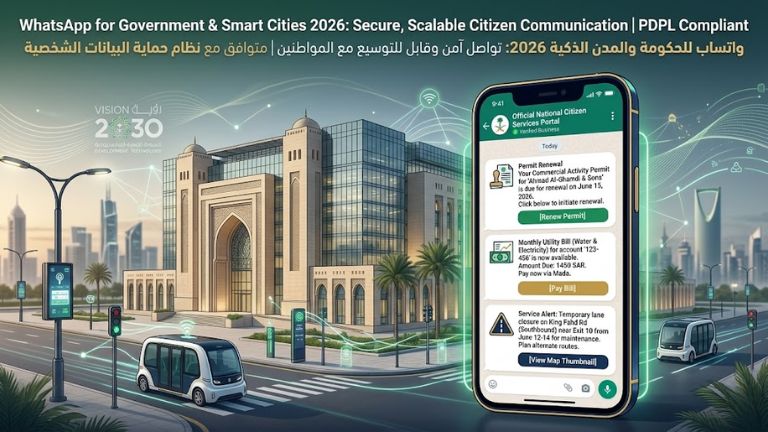
As Saudi Arabia and the UAE continue their rapid digital transformation under Vision 2030 and Centennial 2071, government entities and smart city projects are increasingly looking for secure, scalable, and citizen-friendly communication channels.
Traditional methods such as SMS, email, and phone calls often face limitations in terms of cost, engagement, and delivery speed. In this environment, many organizations are exploring WhatsApp Business API as a complementary channel for official citizen communication.
When implemented correctly with proper compliance and structured processes, WhatsApp can support high-volume, recurring citizen interactions while maintaining strong data protection standards.
Why Government & Smart City Projects Are Exploring WhatsApp
Citizens in KSA and UAE already use WhatsApp extensively in their daily lives. This creates an opportunity for government and public service organizations to communicate through a channel that citizens are already comfortable with.
Key areas where WhatsApp is being considered include:
- Permit and license renewals
- Bill and fine notifications
- Service status updates
- Appointment reminders
- Emergency and important public alerts
- Tax and payment reminders
- Smart city service notifications
These types of communications are recurring in nature, which can help generate consistent message volume over time.
Also Read About WhatsApp Mini-Apps & In-Chat Experiences for KSA & UAE

Potential for High Recurring Message Volume
One of the biggest advantages of using WhatsApp in government and public services is the possibility of recurring communication.
Unlike one-time marketing campaigns, government-related services often require repeated interactions with citizens. For example:
- Monthly utility bill reminders
- Annual permit and license renewals
- Regular traffic fine notifications
- Periodic service updates from municipalities
- Tax filing reminders and status updates
When a large government entity or smart city project adopts structured WhatsApp communication, it has the potential to generate millions of messages per month on a recurring basis. This is because citizen services are ongoing and not one-time in nature.
Organizations that successfully implement such systems at scale can see message volumes grow significantly over time, especially when multiple services are brought onto the platform.
Also Read About WhatsApp vs SMS vs Email – 2026 Comparison for Enterprises in KSA & UAE
Important Compliance Considerations
For government and public sector use of WhatsApp, compliance is the most critical factor. Any solution must align with:
- PDPL (Personal Data Protection Law) in Saudi Arabia
- NCA Essential Cybersecurity Controls
- Relevant regulations from SAMA (for financial-related communications)
- Meta’s official WhatsApp Business API policies
Key requirements usually include:
- Clear consent mechanisms
- Proper data handling and storage within approved jurisdictions
- Full audit trails
- Separation between service notifications and promotional messages
- Secure infrastructure and access controls
Only solutions built with these principles from the beginning are suitable for government and public service use cases.
Also Read About WhatsApp Business API for Smart Government & Citizen Services in Saudi Arabia
Realistic Approach to Scaling Message Volume
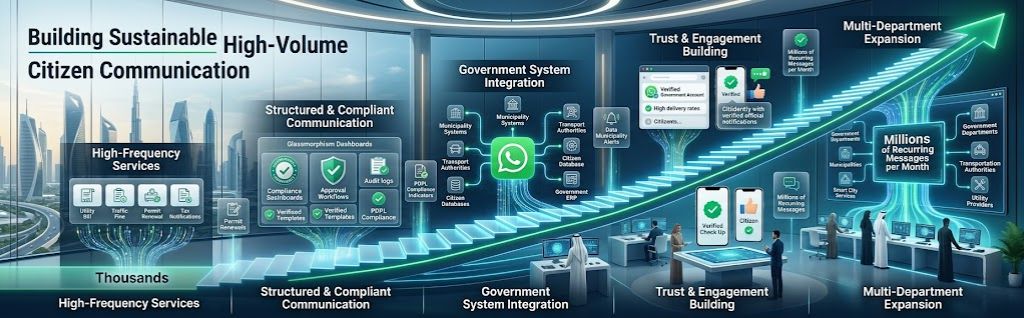
Achieving high message volumes (such as several million messages per month) in government projects typically requires:
- Starting with high-frequency services (billing, renewals, alerts)
- Building structured and compliant flows
- Integrating with existing government systems for automation
- Maintaining high trust and clarity in every message
- Expanding gradually across multiple departments and services
When done correctly, this model can create sustainable and recurring message volume rather than one-time spikes.
Key Success Factors for Government Projects
Organizations exploring WhatsApp for public services usually focus on:
- Strong emphasis on compliance and data protection from day one
- Clear separation between official service messages and any promotional content
- Integration with existing backend systems for automation
- Proper training and change management for internal teams
- Continuous monitoring of message performance and citizen feedback
Also Read About Choose the Right WhatsApp Business API Provider in KSA & UAE
Who Can Benefit from This Approach?
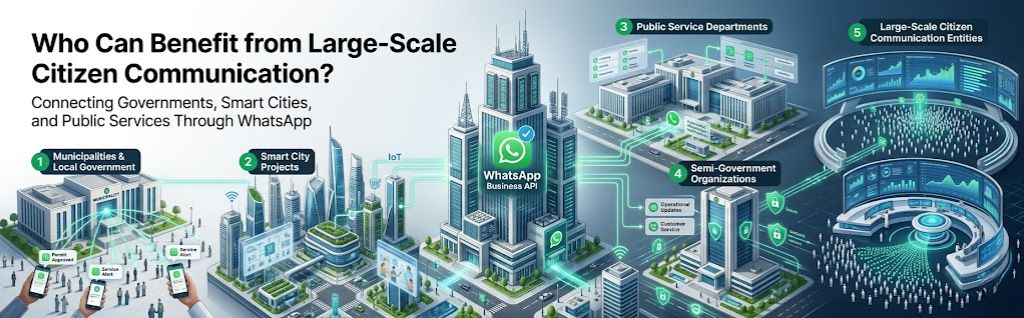
This model is particularly relevant for:
- Municipalities and local government bodies
- Smart city projects
- Public service departments (permits, licensing, utilities)
- Semi-government organizations
- Entities responsible for large-scale citizen communication
Ready to Explore WhatsApp for Government & Public Services?
If your organization is looking to improve citizen communication while maintaining full compliance, WhatsApp Business API when implemented correctly can be a valuable channel.
FAQs:
Q1: Can government entities use WhatsApp for citizen communication?
Many organizations are exploring WhatsApp as a complementary channel, provided it follows all regulatory requirements.
Q2: Is PDPL compliance mandatory for such projects?
Yes. Any solution handling citizen data must align with PDPL and other relevant regulations.
Q3: What kind of services are suitable for WhatsApp?
Services that require recurring communication, such as renewals, bill payments, alerts, and status updates, are generally well-suited.
Q4: Can WhatsApp help reduce manual workload in government departments?
When properly automated and integrated, it can help reduce repetitive manual communication.
Q5: Is it possible to send millions of messages per month?
Yes, in large-scale implementations with multiple recurring services, high message volumes are achievable over time.
Q6: How important is compliance in government WhatsApp projects?
Compliance is the most critical factor. Solutions must be built with PDPL, NCA, and Meta guidelines from the beginning.
Q7: Can WhatsApp be integrated with existing government systems?
Yes. Integration with backend systems is usually required for automation and scalability.
Q8: What is the difference between promotional and service messages?
Service messages are related to existing transactions or services. Promotional messages require separate consent and have different rules.
Q9: How long does it take to implement such a solution?
Implementation timelines vary depending on complexity, but usually range between 8 to 16 weeks for initial phases.
Q10: Is WhatsApp suitable only for large government projects?
It can be relevant for both large and mid-size public service initiatives, depending on the use case.
Q11: Can citizens reply to official messages?
Yes. Two-way communication is possible and can be managed according to defined processes.
Q12: What are the main risks if compliance is not followed?
Non-compliance can lead to regulatory issues and loss of trust. This is why compliance-first design is essential.
Q13: Can this be used for emergency or important public alerts?
WhatsApp can be considered as one of the channels for important notifications, alongside other official methods.
Q14: Do you help with compliance documentation?
Yes. We support clients in building solutions that align with regulatory requirements.
Q15: How can we start exploring this for our organization?
We recommend beginning with a confidential discussion to understand your specific requirements and compliance needs.