
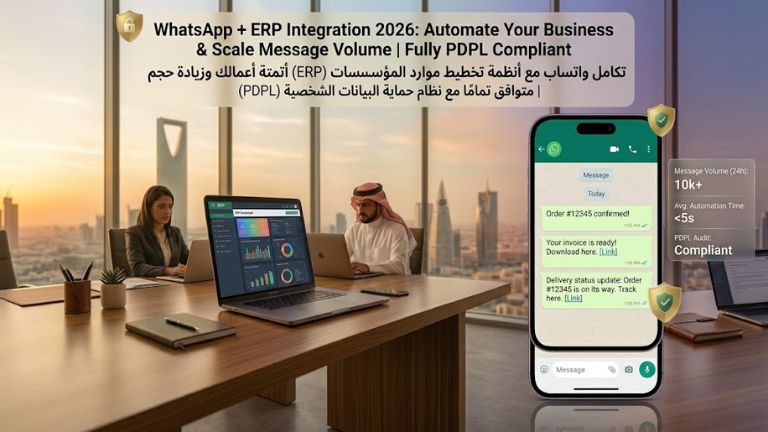
In 2026, one of the biggest challenges mid-to-large companies in Saudi Arabia and the UAE face is manual communication.
Even when companies use powerful ERP or CRM systems to manage orders, inventory, accounting, and operations, most customer communication (order confirmations, delivery updates, payment reminders, invoices) is still done manually through phone calls, emails, or SMS.
This creates three major problems:
- High manual workload
- Slow response time to customers
- Limited ability to scale message volume
The solution that forward-thinking companies are adopting is deep integration between WhatsApp Business API and their existing ERP/CRM systems.
This integration allows automatic, real-time, and personalized messages to be sent directly from the ERP/CRM to customers on WhatsApp without any manual effort from the team.
Also Read About How to Choose the Right WhatsApp Business API Provider
Why WhatsApp + ERP Integration is Becoming Critical in KSA & UAE
Most growing companies in Saudi Arabia and UAE are already using ERP or CRM systems (such as Odoo, SAP, Microsoft Dynamics, Zoho, or custom-built systems) to run their operations.
However, customer communication remains disconnected. This gap leads to:
- Delayed updates to customers
- Missed opportunities for engagement
- High operational cost due to manual work
By connecting WhatsApp Business API directly with ERP/CRM systems, companies can automate customer communication while maintaining full control and compliance.
Also Read About PDPL Compliance Checklist for WhatsApp Business API in Saudi Arabia 2026
Key Benefits of WhatsApp + ERP Integration
| Benefit | Before Integration | After WhatsApp + ERP Integration | Business Impact |
| Order Confirmation | Manual or Email | Automatic on WhatsApp | Faster response, higher trust |
| Delivery & Tracking Updates | Manual calls | Automatic real-time updates | Reduced support workload |
| Payment Reminders | Slow & Inconsistent | Automatic with payment links | Faster collections |
| Invoice & Document Sharing | Manual | Automatic & secure | Professional image |
| Customer Engagement | Low | Very High & Recurring | More repeat business |
| Manual Work | High | Significantly Reduced | Cost & time saving |
| Message Volume | Low & Irregular | High & Predictable | Scalable growth |
Real-World Examples of WhatsApp + ERP Integration
Example 1: Furniture & Home Appliances Company (Riyadh) After integrating WhatsApp with their ERP system, the company automated:
- Order confirmation with product details
- Expected delivery date notification
- Live delivery tracking updates
- Payment link for advance or balance amount
- Post-delivery feedback request
Result: They reduced manual follow-up calls by over 60% and saw a noticeable increase in repeat orders.
Also Read About WhatsApp Business API for Telecom Operators & Government Mobile Services
Example 2: Wholesale Distribution Company (Jeddah) The company automated daily and weekly messages through their ERP:
- Pending payment reminders to customers
- New stock arrival notifications to regular buyers
- Monthly statement of accounts
Result: Faster payment recovery and improved customer engagement without increasing team size.

Example 3: E-commerce & Retail Brand (Dubai) After integration, they started sending:
- Abandoned cart recovery messages
- Order shipped + tracking updates
- Loyalty points and reward updates
- Personalized offers based on purchase history from ERP data
Result: Significant increase in recurring message volume and customer retention.
Also Read About WhatsApp Business API for Retail, Hospitality & Customer Experience
Technical Architecture (Built for PDPL Compliance)
We design every integration with the following core principles:
- Data Sovereignty: Customer data remains on client-server or KSA/UAE sovereign infrastructure.
- PDPL Compliance: Explicit consent management, audit logs, and data minimization.
- Security: End-to-end encryption and secure API connections.
- Flexibility: Works with Odoo, SAP, Microsoft Dynamics, Zoho, or any custom ERP/CRM system.
- Scalability: Capable of handling high message volumes reliably.
Step-by-Step Implementation Process
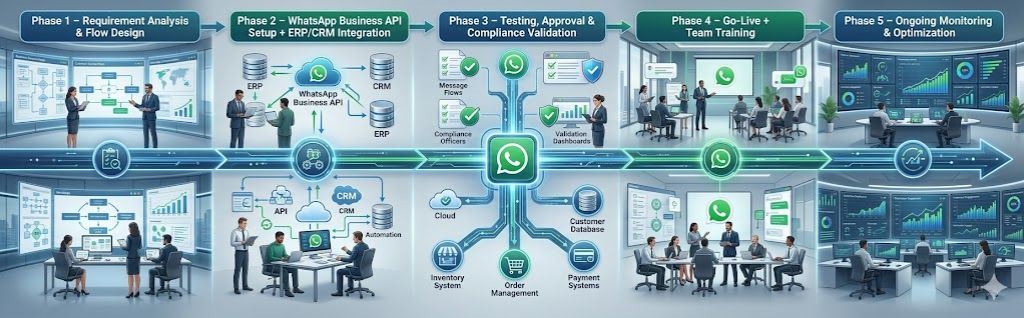
Phase 1: Requirement Analysis & Flow Design (1–2 weeks) Phase 2: WhatsApp Business API Setup + ERP/CRM Integration (3–5 weeks) Phase 3: Testing, Approval & Compliance Validation (1–2 weeks) Phase 4: Go-Live + Team Training (1 week) Phase 5: Ongoing Monitoring & Optimization
Typical timeline from start to live: 7 to 11 weeks.
Who Should Consider WhatsApp + ERP Integration?
This solution is highly recommended for:
- Companies already using any ERP or CRM system
- Wholesale, distribution, and trading businesses
- E-commerce and retail brands
- Manufacturing companies
- Service companies with recurring orders or subscriptions
- Any business that sends frequent updates to customers
Also Read About WhatsApp Mini-Apps & In-Chat Experiences for KSA
Ready to Automate Your Communication with WhatsApp + ERP?
If you want to reduce manual work, improve customer experience, and generate high recurring message volume, integrating WhatsApp with your ERP or CRM system is one of the smartest and most scalable moves in 2026.
FAQs
Q1: Can we integrate WhatsApp with our existing ERP or CRM system?
Yes. We have experience integrating with multiple ERP and CRM platforms.
Q2: Is this integration compliant with PDPL?
Yes. Every integration is built with full PDPL compliance and sovereign hosting.
Q3: Do we need to change our current ERP system?
No. We integrate with your existing system.
Q4: How long does it take to go live?
Usually between 7 to 11 weeks.
Q5: Will this increase our WhatsApp message volume?
Yes. Automation creates consistent and recurring message volume.
Q6: Can we send personalized messages using data from our ERP?
Yes. This is one of the biggest advantages of the integration.
Q7: Is payment collection possible through this integration?
Yes. We can send secure payment links automatically.
Q8: What kind of messages can be automated?
Order confirmation, delivery updates, payment reminders, invoices, feedback requests, and more.
Q9: Do you provide support after integration?
Yes. We offer ongoing support and continuous optimization.
Q10: Is this suitable only for large companies?
No. It works well for both mid-size and large organizations.
Q11: Can customers reply to automated messages?
Yes. Replies can be managed through WhatsApp or routed back to your ERP/CRM.
Q12: How do we ensure messages are not considered spam?
We strictly follow Meta’s rules and only send transactional/utility messages with proper consent.
Q13: Can we track which messages were opened?
Yes. We provide detailed analytics and reporting.
Q14: Can it work with multiple systems at the same time?
Yes. We can connect WhatsApp with your ERP, CRM, and other tools if needed.
Q15: How can we get started?
Book a confidential consultation with our team to discuss your current systems and requirements.
Also Read About Best AI SEO Strategies for Businesses in Riyadh