
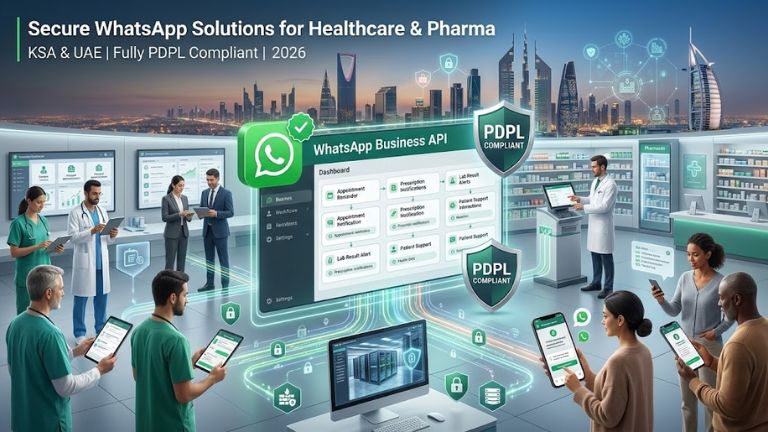
Healthcare organizations across Saudi Arabia and the UAE are rapidly transforming how they communicate with patients, healthcare professionals, pharmacies, and stakeholders.
In 2026, patients expect immediate responses, appointment confirmations, prescription reminders, laboratory updates, and healthcare support directly on the communication platform they use every day WhatsApp.
For hospitals, clinics, medical groups, pharmacies, pharmaceutical companies, diagnostic laboratories, and healthcare networks, WhatsApp Business API has become one of the most effective channels for secure patient communication and operational efficiency.
However, healthcare organizations operate in one of the most heavily regulated environments in the GCC. Patient information, medical records, prescriptions, and healthcare interactions require strict compliance with:
- Saudi PDPL (Personal Data Protection Law)
- UAE Data Protection Regulations
- NCA Cybersecurity Requirements
- Healthcare Data Governance Frameworks
- Internal Clinical Governance Policies
- Meta’s 2026 WhatsApp Business Platform Requirements
This guide is designed for:
- Hospital CEOs
- Healthcare CIOs
- Digital Transformation Leaders
- Healthcare IT Directors
- Compliance Officers
- Pharmaceutical Marketing Leaders
- Healthcare Operations Managers
who need secure, scalable, and compliant WhatsApp Business API solutions in KSA and UAE.
Why Healthcare Organizations Are Prioritizing WhatsApp in 2026
Traditional communication channels continue to create operational challenges:
Common Challenges
- Missed appointments
- High call center costs
- Low email engagement
- Delayed prescription reminders
- Patient no-shows
- Fragmented communication systems
- Slow patient response times
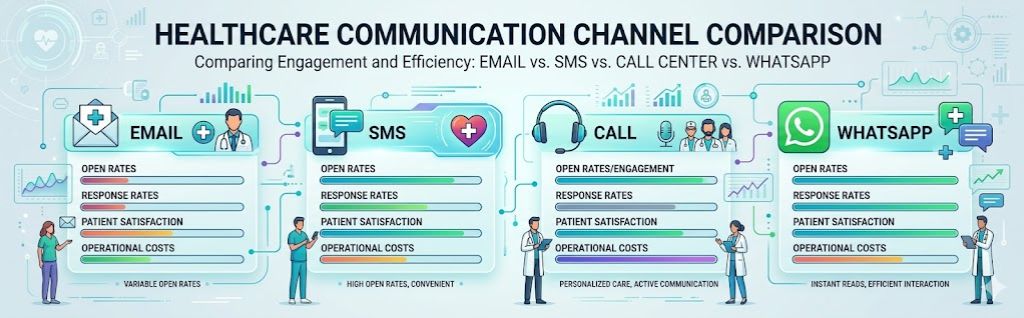
WhatsApp solves these challenges through:
Key Benefits
- 90%+ message open rates
- Real-time communication
- Rich media support
- Automated appointment reminders
- Secure patient engagement
- Two-way conversations
- Arabic and English communication
- Integration with Hospital Information Systems (HIS)
Understanding PDPL Compliance for Healthcare WhatsApp Deployments
Healthcare data is among the most sensitive categories of personal information.
Organizations deploying WhatsApp Business API must ensure every interaction complies with applicable regulations.
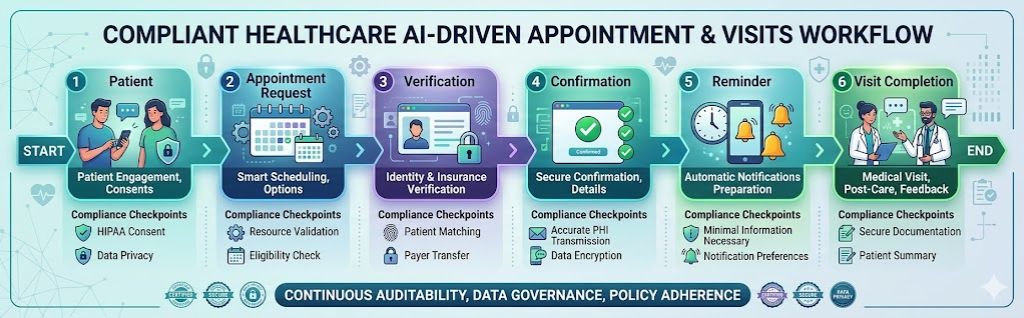
Key PDPL Requirements for Healthcare
Explicit Patient Consent
Patients must clearly consent before receiving healthcare communications.
Examples include:
- Appointment reminders
- Follow-up notifications
- Medication alerts
- Health awareness campaigns
Data Minimization
Only necessary patient information should be processed.
Purpose Limitation
Healthcare data must only be used for approved medical or operational purposes.
Data Security
Patient communication must be encrypted and protected from unauthorized access.
Auditability
Healthcare organizations must maintain complete records of:
- Consent
- Message delivery
- User interactions
- Access logs
Data Subject Rights
Patients must be able to:
- Access their data
- Correct inaccurate data
- Request deletion where applicable
Secure WhatsApp Use Cases for Hospitals & Medical Groups
Healthcare organizations across KSA and UAE are implementing advanced WhatsApp workflows.
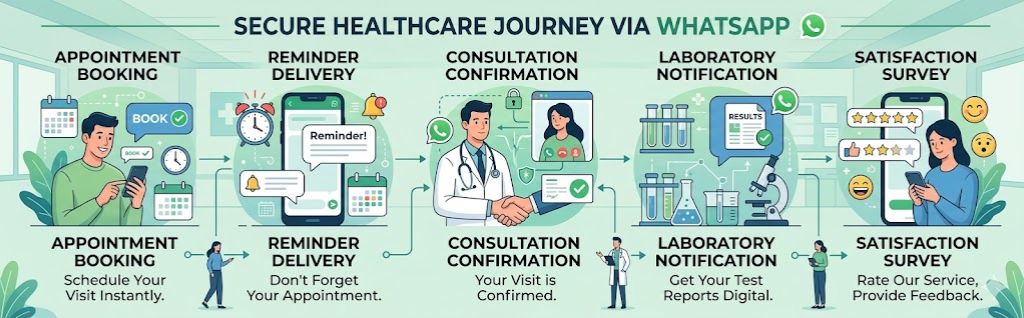
Appointment Booking & Reminders
Automated workflows can:
- Confirm appointments
- Send reminders
- Reschedule appointments
- Reduce patient no-shows
Benefits
- Lower operational workload
- Better patient experience
- Higher clinic utilization
Laboratory Result Notifications
Patients receive:
- Sample collection updates
- Test completion alerts
- Secure report access notifications
This reduces inbound support calls significantly.
Telemedicine Coordination
Healthcare providers can automate:
- Appointment scheduling
- Video consultation reminders
- Follow-up notifications
- Patient satisfaction surveys
Emergency Healthcare Alerts
Hospitals can send:
- Vaccination reminders
- Public health announcements
- Health awareness campaigns
- Emergency service notifications
while maintaining compliance and consent requirements.
WhatsApp Solutions for Pharmaceutical Companies
The pharmaceutical sector is increasingly adopting WhatsApp Business API for compliant engagement.
Healthcare Professional (HCP) Engagement
Pharmaceutical organizations can deliver:
- Medical updates
- Product information
- Event invitations
- CME program notifications
- Scientific content
through permission-based communication.
Sales Team Communication
Pharma sales teams can automate:
- Meeting confirmations
- Product launch notifications
- Training reminders
- Distributor communications
Pharmacovigilance Support
Structured workflows can assist with:
- Adverse event reporting
- Medical information requests
- Case follow-ups
- Compliance documentation
Structured AI Agents for Healthcare Communication
Meta’s 2026 framework emphasizes structured, task-specific automation.
Healthcare organizations benefit greatly from rule-based AI Agents.
Examples of Structured Healthcare AI Agents
Patient Appointment Assistant
Handles:
- Scheduling
- Rescheduling
- Appointment confirmations
Pharmacy Refill Assistant
Supports:
- Refill requests
- Pickup notifications
- Medication reminders
Laboratory Status Assistant
Provides:
- Sample tracking
- Result availability notifications
Healthcare Support Assistant
Answers approved FAQs and escalates clinical queries to human staff.
Client-Server Hosted WhatsApp Architecture for Healthcare
Healthcare organizations increasingly prefer client-controlled deployments.
Why Client-Server Hosting Matters
Data Sovereignty
Sensitive healthcare data remains under organizational control.
Regulatory Alignment
Supports compliance initiatives across Saudi Arabia and UAE.
Enhanced Security
Patient communication history remains within approved environments.
Internal Governance
Allows healthcare organizations to maintain complete oversight.
Secure Integrations with Healthcare Systems
The true value of WhatsApp Business API comes from integration.
Common Healthcare Integrations
Hospital Information Systems (HIS)
Automated patient communications.
Electronic Medical Records (EMR)
Trigger-based notifications.
Laboratory Information Systems (LIS)
Real-time testing updates.
Pharmacy Management Systems
Medication reminders and refill alerts.
CRM Platforms
Patient engagement and satisfaction management.
Benefits Achieved by Healthcare Organizations
Organizations implementing secure WhatsApp solutions commonly report:
Operational Benefits
- Reduced call center workload
- Improved patient engagement
- Lower appointment no-show rates
- Faster communication
Patient Experience Benefits
- Better accessibility
- Faster responses
- Personalized communication
- Improved satisfaction scores
Compliance Benefits
- Better audit readiness
- Improved consent management
- Stronger governance controls
Future of Healthcare Communication in KSA & UAE
By 2026 and beyond, healthcare organizations are expected to adopt:
- Intelligent appointment automation
- Predictive patient engagement
- Secure multilingual AI assistants
- Healthcare workflow automation
- Integrated telehealth communication
- Omnichannel patient experience platforms
Organizations investing now will be better positioned to meet evolving patient expectations and regulatory requirements.
FAQs
Q1: Is WhatsApp Business API suitable for hospitals in Saudi Arabia?
Yes. Hospitals can use WhatsApp Business API for appointment reminders, patient engagement, laboratory notifications, and support workflows while maintaining compliance requirements.
Q2: Is WhatsApp Business API PDPL compliant?
It can be deployed in a PDPL-aligned manner when proper consent management, security controls, audit trails, and governance processes are implemented.
Q3: Can clinics send appointment reminders through WhatsApp?
Yes. Appointment reminders are among the most common healthcare use cases.
Q4: Can healthcare providers automate patient communication?
Yes. Automated workflows can manage confirmations, reminders, follow-ups, and surveys.
Q5: Is WhatsApp secure for healthcare communication?
When implemented correctly with enterprise-grade controls, WhatsApp provides encrypted communication and strong security capabilities.
Q6: Can pharmaceutical companies use WhatsApp Business API?
Yes. Pharmaceutical organizations use it for HCP engagement, medical communications, events, and operational workflows.
Q7: Can WhatsApp integrate with hospital systems?
Yes. Integration with HIS, EMR, LIS, CRM, and pharmacy systems is common.
Q8: What is the biggest benefit for hospitals?
Improved patient engagement and operational efficiency.
Q9: Can WhatsApp reduce appointment no-shows?
Yes. Automated reminders significantly improve attendance rates.
Q10: Can healthcare providers communicate in Arabic and English?
Yes. Enterprise solutions support multilingual communication.
Q11: Can pharmacies send medication reminders?
Yes. Automated refill and medication reminder workflows are widely used.
Q12: Is patient consent required?
Yes. Appropriate consent mechanisms should be implemented.
Q13: Can WhatsApp support telemedicine workflows?
Yes. Scheduling and follow-up communication are common telemedicine use cases.
Q14: Can laboratories use WhatsApp notifications?
Yes. Labs can automate testing status and report availability notifications.
Q15: What healthcare organizations benefit most?
Hospitals, clinics, pharmacies, labs, medical groups, insurers, and pharmaceutical companies.
Q16: Can healthcare organizations maintain data sovereignty?
Yes. Client-server hosted architectures help organizations maintain control over sensitive data.
Q17: Can WhatsApp support healthcare surveys?
Yes. Post-visit feedback and patient satisfaction surveys are highly effective.
Q18: What integrations are most important?
HIS, EMR, LIS, pharmacy systems, and CRM platforms.
Q19: Is WhatsApp suitable for large healthcare networks?
Yes. Enterprise deployments can support millions of patient interactions annually.
Q20: How can healthcare organizations get started?
Begin with a compliance assessment, architecture review, and integration planning before deployment.