Mastering B2B Lead Generation Services in Saudi Arabia
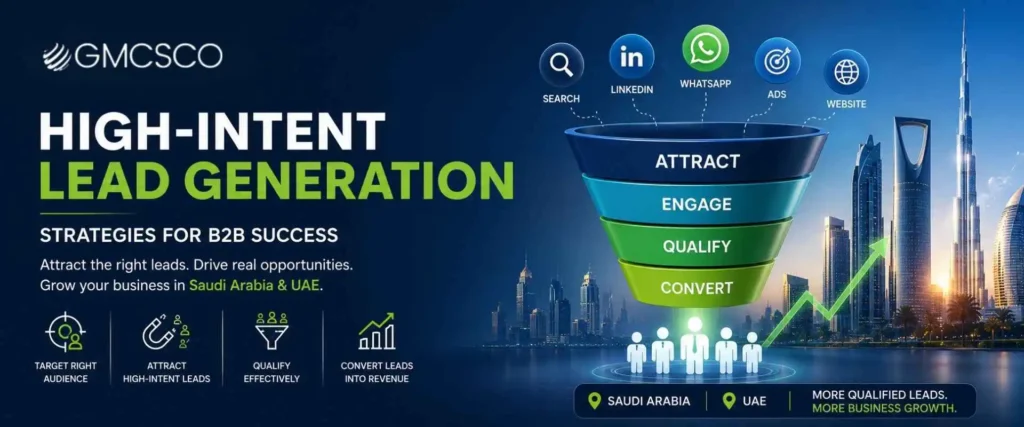
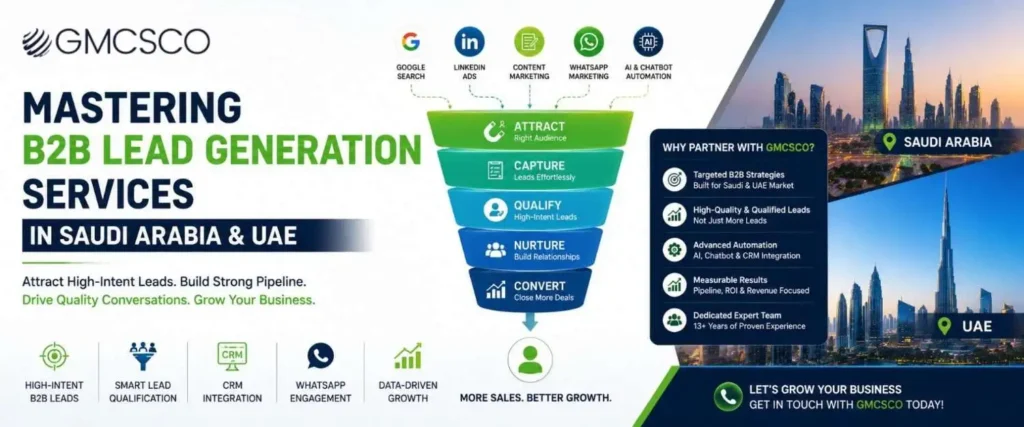
🎯 B2B Lead Generation — 2026 B2B Lead Generation Services: The Complete 2026 Guide for Saudi Arabia & UAE 20 strategies to build a connected system that attracts, captures, qualifies, and converts real B2B opportunities. 20B2B lead generation strategies 99.6%Saudi Arabia internet penetration 99%UAE internet penetration (2025) Quick Answer B2B lead generation services help businesses identify, attract, capture, qualify, and nurture potential business customers who could become sales opportunities. A complete strategy can combine SEO, Google Ads, LinkedIn marketing, content marketing, landing pages, WhatsApp, AI chatbots, CRM integration, lead qualification, and remarketing. For businesses targeting Saudi Arabia and the UAE, the objective isn’t simply generating the highest number of enquiries — it’s generating qualified, relevant, and commercially valuable B2B opportunities that the sales team can actually convert. B2B Buyers Research Before They Talk to Sales A few years ago, companies could rely on cold outreach, email lists, trade events, and basic website forms. Today, B2B buyers search Google, compare providers, read case studies, check LinkedIn, ask colleagues, use AI tools, and increasingly start the conversation through WhatsApp — meaning B2B companies need a connected system that captures demand across multiple digital touchpoints. The latest Saudi Internet Report shows 99.6% internet penetration, 61.3% of users online seven or more hours daily, and 45.2% AI tool adoption, with Google as the most used search engine and WhatsApp at 92.7% usage. DataReportal reported 11.1 million internet users and 99% penetration in the UAE at the beginning of 2025. The question isn’t whether the audience exists — it’s how to turn this digital audience into qualified business leads. What Does B2B Lead Generation Actually Mean? It’s the process of finding and attracting businesses or professionals who may need your product, and moving them into a structured sales process across four stages: 👋 Attract Bring the right audience to your brand. 📥 Capture Give interested prospects an easy way to contact you. ✅ Qualify Determine fit against your ideal customer profile. 🤝 Convert Move opportunities toward meeting, proposal, sale. Google Search → Service Page → Form / WhatsApp → CRM → Sales Rep → Customer Why Saudi Arabia Needs a Different Approach The Kingdom has its own business environment, search behaviour, language preferences, and digital ecosystem — 99.6% internet penetration with mobile phones used by 99.6% of internet users. B2B businesses need mobile-first lead journeys, Arabic and English search behaviour, Saudi-specific landing pages, commercial search intent, local business relevance, WhatsApp conversations, AI-assisted discovery, and CRM-based lead management. The strategy should be localized, not simply translated. Why 2026 Matters for B2B Lead Generation in Saudi Arabia Saudi Arabia has officially designated 2026 as the Year of Artificial Intelligence — SDAIA says the initiative reflects the Kingdom’s growing focus on AI, digital infrastructure, and innovation aligned with Saudi Vision 2030, with AI tool adoption reaching 45.2%, more than double the previous year. This doesn’t mean replacing SEO and advertising with AI — it means the buyer journey is becoming more digitally sophisticated, discovering companies through Google, AI search, LinkedIn, YouTube, WhatsApp, industry content, and referrals. The best strategy connects these touchpoints instead of treating each as isolated. Why Lead Quality Matters More Than Volume Campaign A 500 leads → 35 qualified → 5 sales opportunities. Campaign B 150 leads → 65 qualified → 18 sales opportunities — far greater commercial value. Professional B2B lead generation should focus on lead quality, buyer intent, qualification, sales alignment, conversion rate, and pipeline value — not just lead volume. The Core B2B Lead Generation Funnel 1 Awareness SEO, Google Ads, LinkedIn, content, social media, industry publications, AI search. 2 Consideration Service pages, case studies, industry pages, comparison articles, pricing, FAQs. 3 Intent Request a quotation, book a meeting, start a WhatsApp conversation, request a demo. 4 Qualification Industry, company size, location, service requirement, budget, timeline, authority. 5 Sales Consultation → Proposal → Negotiation → Contract → Customer. 20 B2B Lead Generation Strategies 1. Start With an Ideal Customer Profile Define exactly who you want to attract — location, company type, industry, decision maker, requirement, and potential value. A Saudi healthcare enterprise ICP looks nothing like a UAE real estate founder ICP; defining this prevents wasted spend attracting businesses unlikely to convert. 2. Build a Commercial Keyword Strategy 💡 Informational What is B2B lead generation? 🧭 Commercial Investigation Best B2B lead generation agency. ✅ Transactional B2B lead generation services Saudi Arabia. 3. Create Dedicated Saudi Arabia Landing Pages A page targeting “B2B lead generation services Saudi Arabia” shouldn’t just swap “UAE” for “Saudi Arabia” — it should discuss Saudi buyer behaviour, Arabic and English audiences, Riyadh, Jeddah, Eastern Province, industry-specific demand, WhatsApp, and CRM integration, creating genuine regional relevance. 4. Build Separate UAE Lead Generation Campaigns A UAE-focused page targeting Dubai, Abu Dhabi, and Sharjah should address local market competition, B2B decision makers, industry requirements, digital buying behaviour, and both English and Arabic audiences — genuinely useful to someone actually operating a business in the UAE. 5. Use Google Ads to Capture Existing B2B Demand “B2B lead generation agency Saudi Arabia” shows a much stronger commercial signal than “lead generation” — campaigns should be segmented around services, locations, industries, and commercial intent for stronger alignment: Keyword → Ad → Landing Page → Lead. 6. Use LinkedIn for B2B Decision Makers Professional targeting can reach CEOs, Founders, Marketing Directors, Sales Directors, and Procurement roles. LinkedIn should also support thought leadership, case studies, industry insights, and Account Based Marketing — particularly useful for high-value B2B services with longer decision cycles. 7. Build High Value Content Instead of generic articles, create content around real business decisions: “How Much Does B2B Lead Generation Cost in Saudi Arabia?”, “Google Ads vs LinkedIn Ads for B2B Lead Generation,” “How AI Is Changing B2B Lead Generation” — attracting prospects already thinking about solving the problem. 8. Optimize Content for Google and AI Search Google’s guidance says the same foundational SEO principles remain relevant for AI Overviews and AI Mode, recommending technically accessible, helpful, people-first content rather than special
Mastering B2B Lead Generation Services in Saudi Arabia Read More »