GMCSCO Media Group

Author name: Admin

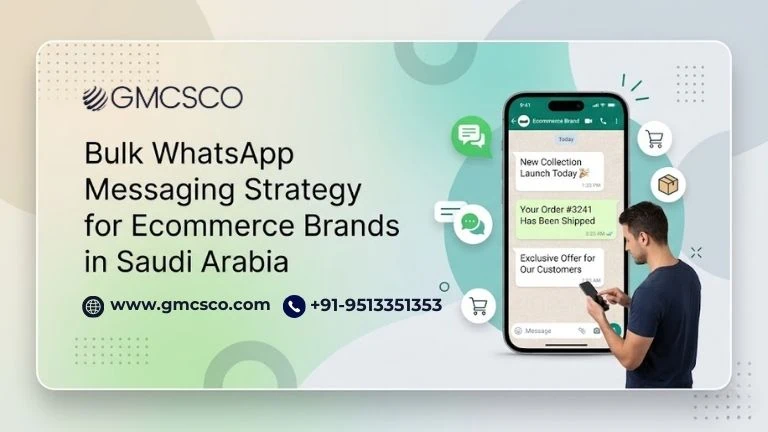
Bulk WhatsApp Messaging Strategy for Ecommerce Brands in Saudi Arabia

Bulk WhatsApp Messaging Strategy for Ecommerce Brands in Saudi Arabia

Ecommerce in Saudi Arabia is growing at an unprecedented pace. With increasing digital adoption, mobile first consumers, and strong logistics infrastructure, the market has become highly competitive. But growth brings a new set of challenges. Customer acquisition costs are rising. Conversion rates are fluctuating. And retaining customers is becoming harder than ever. Many ecommerce brands are still relying heavily on email campaigns, paid ads, and social media. While these channels still play a role, they are no longer enough to sustain consistent revenue growth. Customers today expect faster responses, personalized communication, and seamless buying experiences. This is exactly where a well defined Bulk WhatsApp Messaging Strategy is transforming how ecommerce brands operate in Saudi Arabia. The Core Challenge: Why Ecommerce Brands Are Struggling to Convert and Retain Customers Before diving into strategy, it is important to understand what is going wrong. Low Engagement Rates Email marketing continues to see declining open rates. Promotions often get ignored or filtered out. High Cart Abandonment A significant percentage of customers add products to cart but never complete the purchase. Delayed Customer Support Customers have questions before purchasing. Slow responses lead to drop offs. Limited Personalization Generic messaging does not resonate with modern consumers. Increasing Ad Costs Paid marketing is becoming expensive, reducing profit margins. Saudi ecommerce brands are actively looking for solutions that can improve engagement without increasing costs. Get WhatsApp Strategy Why WhatsApp Has Become a High Conversion Channel in Saudi Arabia WhatsApp is deeply embedded in everyday communication across Saudi Arabia. Customers use it not just for personal conversations but also for interacting with businesses. Here is why it works so effectively: Instant Visibility Messages are opened within minutes, unlike emails. Direct and Personal Communication It feels like a one to one conversation rather than mass marketing. High Trust Factor Customers are more likely to engage with brands on WhatsApp. Mobile First Experience Perfectly aligned with Saudi Arabia’s mobile driven consumer behavior. This makes WhatsApp one of the most powerful channels for ecommerce growth when used strategically. What Is a Bulk WhatsApp Messaging Strategy for Ecommerce A Bulk WhatsApp Messaging Strategy is not about sending mass messages randomly. It is about building a structured system that combines: Customer segmentation Automated messaging workflows Personalized communication AI powered interactions At the center of this system is the WhatsApp API, which enables businesses to send messages at scale while maintaining compliance and quality. For ecommerce brands, this strategy connects marketing, sales, and customer support into a single conversational channel. Also Read About Bulk WhatsApp marketing in Saudi Arabia Key Use Cases That Drive Ecommerce Sales Abandoned Cart Recovery This is one of the highest ROI use cases. Instead of sending an email reminder, brands send a WhatsApp message within minutes of cart abandonment. Messages can include: Product details Limited time offers Direct checkout links This significantly increases recovery rates. Order Updates and Notifications Keeping customers informed builds trust. WhatsApp is used for: Order confirmations Shipping updates Delivery notifications These interactions also create opportunities for upselling and cross selling. Personalized Product Recommendations Based on browsing and purchase history, brands can send tailored product suggestions. This increases average order value and customer satisfaction. Flash Sales and Promotions Time sensitive offers perform exceptionally well on WhatsApp due to high open rates. Customer Support Automation AI chatbots handle: Product inquiries Order tracking Return requests This reduces support workload while improving response time. Customer Retention Campaigns Brands use WhatsApp to: Offer loyalty rewards Share exclusive deals Re engage inactive customers Businesses that combine these use cases into a unified strategy see measurable improvements in both revenue and customer experience. If you are evaluating ways to improve your ecommerce performance, this is where conversational engagement begins to make a real impact. Start Free WhatsApp Consultation Step by Step: Building a High Performing WhatsApp Strategy Step 1: Define Clear Objectives Start with measurable goals: Increase conversion rates Reduce cart abandonment Improve customer retention Automate support Step 2: Choose the Right Technology A reliable platform powered by the WhatsApp API is essential. It should support: Automation CRM integration Campaign tracking Chatbot functionality Working with an experienced WhatsApp business solution provider ensures smooth implementation and scalability. Step 3: Segment Your Audience Segmentation is key to personalization. Divide customers based on: Purchase behavior Product interests Engagement level Step 4: Create High Converting Message Templates Messages should be: Clear and concise Personalized Action oriented Avoid overly promotional language. Focus on value. Step 5: Implement AI Chatbots Chatbots enable: Instant responses Lead qualification Guided shopping experiences This is especially useful for handling large volumes of inquiries. Step 6: Launch and Optimize Campaigns Track key metrics such as: Open rates Click through rates Conversion rates Use insights to continuously improve performance. Brands that take a structured approach to implementation often see faster results and better scalability. Also Read About How to send bulk WhatsApp messages to customers in Saudi Arabia legally The Role of AI in Ecommerce WhatsApp Marketing AI is redefining how ecommerce brands interact with customers. Instead of manual communication, businesses now rely on: Intelligent chatbots Automated workflows Predictive messaging Behavior based targeting AI enables brands to deliver personalized experiences at scale without increasing operational costs. This is particularly valuable in high growth ecommerce environments. Common Mistakes Ecommerce Brands Should Avoid Sending Too Many Messages Over messaging can lead to customer fatigue and opt outs. Lack of Personalization Generic messages reduce engagement and conversions. Ignoring Automation Manual processes limit scalability. Not Tracking Performance Without data, it is impossible to optimize campaigns. Using Unofficial Tools This can lead to compliance issues and account restrictions. Avoiding these mistakes ensures long term success and sustainable growth. Get WhatsApp Marketing Plan Future Trends in WhatsApp Commerce Conversational Commerce Growth Customers will increasingly complete purchases within chat interfaces. Hyper Personalization Messages will be tailored using advanced data insights. Voice and AI Interaction Voice based interactions will become more common. Deeper Ecommerce Integration Seamless connections between WhatsApp and ecommerce platforms will improve user experience. Forward thinking ecommerce brands in Saudi Arabia are

Bulk WhatsApp Messaging Strategy for Ecommerce Brands in Saudi Arabia Read More »
SMS Marketing vs WhatsApp Marketing Which Works Better in Saudi Arabia

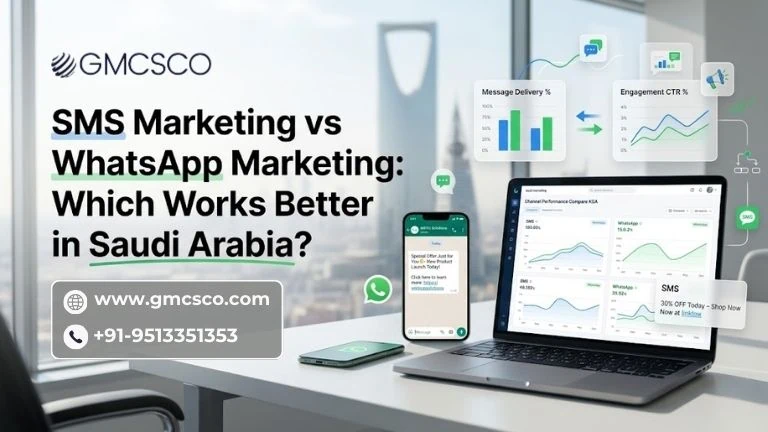
SMS Marketing vs WhatsApp Marketing: Which Works Better in Saudi Arabia?

Introduction: The Messaging Dilemma Businesses in Saudi Arabia Face If you run a business in Saudi Arabia today, customer communication has become more complicated than ever. Consumers expect instant responses. Marketing teams need high open rates. Sales teams want conversations that convert. At the same time, companies are trying to reduce customer acquisition costs while increasing engagement across digital channels. This is where mobile messaging comes into the spotlight. For years, SMS marketing dominated the communication landscape. Businesses used bulk text messages to send promotions, alerts, reminders, and notifications. But today another channel is rapidly transforming how companies interact with customers. WhatsApp. With over two billion global users and extremely high engagement rates in the Middle East, WhatsApp has become a powerful communication platform for brands that want direct conversations with customers. Now the big question many Saudi businesses are asking is simple. Should we invest in SMS marketing or WhatsApp marketing? Understanding the difference between these two channels can directly impact customer engagement, marketing ROI, and operational efficiency. This guide breaks down the real differences, practical business use cases, and strategic considerations companies must evaluate when choosing between SMS and WhatsApp marketing in Saudi Arabia. Discuss Your Messaging Strategy Why Messaging Channels Matter in the Saudi Digital Economy Saudi Arabia is experiencing one of the fastest digital transformations in the Middle East. Ecommerce growth, fintech adoption, digital government services, and mobile first consumer behavior are reshaping how businesses operate. According to multiple regional studies, mobile messaging is now one of the most trusted communication channels for customers across the GCC region. Customers check their phones dozens of times a day. They respond faster to messages than emails. And they increasingly prefer messaging apps for customer support. For businesses, this creates a powerful opportunity. The right messaging strategy can help companies: Increase marketing campaign open rates Improve customer experience Automate customer service interactions Drive faster purchase decisions Reduce support costs through automation However, choosing the wrong channel can also lead to wasted marketing budgets and low engagement. This is why the SMS marketing vs WhatsApp marketing debate has become such an important strategic discussion. Understanding SMS Marketing SMS marketing refers to sending promotional or transactional messages directly to customers through standard text messaging. This channel has existed for decades and remains widely used by banks, airlines, telecom companies, and retail brands. Common SMS Marketing Use Cases Appointment reminders Payment confirmations Promotional campaigns OTP verification codes Delivery notifications Flash sale announcements Also Read About bulk SMS marketing strategies in Saudi Arabia Key Advantages of SMS Marketing Universal reach SMS works on every mobile phone without requiring an internet connection. Immediate delivery Messages are typically delivered within seconds. High open rates SMS open rates can reach up to 90 percent because text messages appear directly on the phone. Simple implementation Businesses can easily send bulk messages through SMS gateway platforms. Limitations of SMS Marketing Despite its reliability, SMS has several modern limitations. Messages are limited in character length. It does not support rich media like images, videos, or product catalogs. Customers cannot easily engage in conversational interactions. Automation capabilities are limited compared to modern messaging platforms. For many businesses, SMS has become more of a notification tool rather than a customer engagement channel. What is WhatsApp Marketing? WhatsApp marketing involves communicating with customers using the WhatsApp messaging platform through business messaging tools. Unlike traditional SMS, WhatsApp allows businesses to create rich, interactive conversations with customers. Through the WhatsApp API, companies can integrate automation, chatbots, and CRM systems into their communication workflows. This turns WhatsApp into a powerful customer engagement platform. Common WhatsApp Marketing Use Cases Customer support conversations Product recommendations Order updates and delivery tracking Promotional campaigns Lead qualification conversations Appointment scheduling Customer feedback collection Businesses using the WhatsApp business API Saudi Arabia framework can automate many of these interactions while still maintaining a conversational experience. Key Advantages of WhatsApp Marketing Rich media support Businesses can send images, videos, product catalogs, PDFs, and voice notes. Two way conversations Customers can respond instantly and continue the conversation. Automation with AI chatbots Companies can automate customer service and marketing interactions. Personalized customer engagement Messages can be tailored based on user behavior and preferences. Higher engagement rates Customers are far more likely to respond to conversational messaging. Strategic Insight for Businesses Companies that want to improve customer engagement often begin exploring conversational messaging automation. Organizations looking to streamline customer communication workflows often explore AI powered messaging platforms that integrate with their CRM systems and sales pipelines. Get WhatsApp Strategy SMS Marketing vs WhatsApp Marketing: Key Differences Understanding the practical differences between these two channels is essential for making the right business decision. Customer Interaction SMS is mostly one way communication. WhatsApp enables real time conversations between businesses and customers. Content Format SMS supports only text messages. WhatsApp supports images, videos, documents, product catalogs, and interactive buttons. Automation Capabilities SMS platforms typically offer limited automation features. WhatsApp allows full integration with AI chatbots and automation workflows. Customer Engagement SMS messages are often ignored after initial reading. WhatsApp messages encourage continued interaction and conversation. Cost Efficiency SMS costs can increase significantly when sending bulk campaigns. WhatsApp messaging can become more cost effective when integrated with automated customer journeys. Personalization SMS campaigns are usually mass messaging campaigns. WhatsApp enables highly personalized conversations. Also Read About Top bulk SMS gateway providers in Saudi Arabia Real World Business Use Cases in Saudi Arabia Many Saudi companies are already shifting their communication strategies toward conversational messaging. Here are a few examples of how businesses use these channels differently. Ecommerce Retailers Ecommerce brands use SMS primarily for order confirmation and delivery notifications. However, they increasingly rely on WhatsApp marketing for ecommerce to share product recommendations, abandoned cart reminders, and personalized promotions. This creates a direct path between browsing and purchasing. Healthcare Clinics Clinics use SMS reminders for appointment notifications. But they use WhatsApp to allow patients to confirm appointments, ask questions, and receive follow up care instructions. Financial Institutions Banks rely on

SMS Marketing vs WhatsApp Marketing: Which Works Better in Saudi Arabia? Read More »

WhatsApp automation for internal employee communication and notifications in the UAE

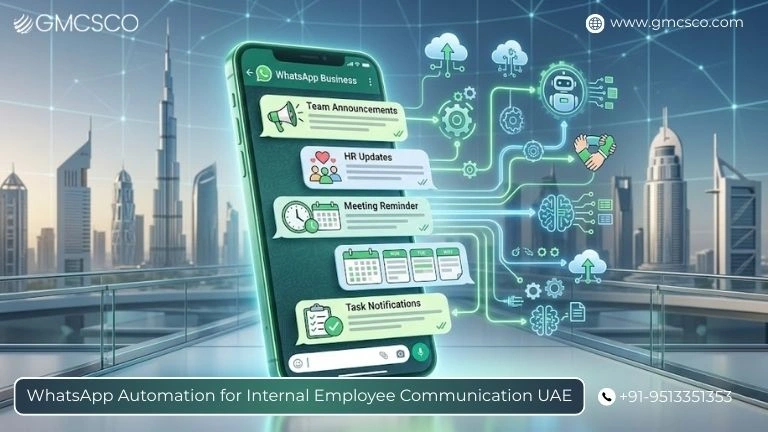
WhatsApp Automation for Internal Employee Communication in the UAE

Imagine running a bustling business in Dubai, where your team is spread across offices, remote locations, and even international borders. You need quick updates on projects, instant feedback from employees, and seamless coordination without drowning in endless email threads or disorganized group chats. This is where WhatsApp automation steps in as a game changer for internal employee communication. In the fast paced UAE business landscape, companies are turning to smart tools to keep their workforce connected and productive. As a VP of SEO Content Strategy with over 15 years in optimizing content for Google and AI search engines, I have seen how automation transforms operations for B2B SaaS firms and startups alike. Today, we dive into WhatsApp automation tailored for internal use in the UAE, helping business owners, marketing leaders, and enterprise decision makers streamline their teams. Whether you are a startup founder in Abu Dhabi or a corporate executive in Sharjah, this guide offers practical insights to boost efficiency. The Hidden Challenges in Internal Employee Communication Every business faces roadblocks in keeping employees aligned. In the UAE, where diverse workforces from various nationalities collaborate, communication gaps can lead to misunderstandings and delays. Think about HR teams juggling onboarding for new hires while fielding queries from existing staff about policies or benefits. Operational hurdles compound this. Remote work, amplified by the post pandemic shift, means teams might be in different time zones. Manual messaging leads to overlooked notifications, compliance risks under UAE labor laws, and wasted time chasing responses. For marketing leaders, coordinating campaigns across departments becomes a nightmare without centralized tools. These issues are not just annoyances. They impact productivity, employee satisfaction, and ultimately, the bottom line. Businesses in competitive sectors like tech and finance cannot afford such inefficiencies. Why WhatsApp Automation Matters in the UAE Business World The UAE stands out as a global hub for innovation, with free zones in Dubai and Abu Dhabi attracting startups and enterprises. Here, digital transformation is key, driven by initiatives like Vision 2031, which emphasizes smart technologies for economic growth. Globally, internal communication tools are evolving, but WhatsApp holds a unique edge in the UAE due to its widespread adoption. Over 90 percent of residents use it daily, making it a natural fit for employee interactions. Automation elevates this from casual chats to structured, efficient systems. In a market where speed is everything, adopting such solutions helps companies stay ahead. It addresses talent retention challenges in a transient expat heavy workforce and supports hybrid models prevalent in sectors like real estate and hospitality. If you are exploring ways to enhance team collaboration, consider how automation aligns with your goals. Consulting experts in AI driven tools can provide tailored advice to get started. Understanding WhatsApp Automation in Simple Terms At its core, WhatsApp automation uses the platforms API to create programmed responses, notifications, and workflows for internal use. It is not about spamming employees but building intelligent systems that handle routine tasks. For instance, integrate it with HR software to send automated reminders for training sessions or policy updates. AI powered chatbots can answer common queries like leave balances or expense reimbursements, freeing up managers. In the UAE, where data privacy under PDPL (Personal Data Protection Law) is crucial, automation ensures secure, compliant communication. It turns WhatsApp into a professional tool, similar to Slack or Microsoft Teams, but with the familiarity employees already love. Also Read About Automated WhatsApp Chatbot for Employee Real World Business Examples and Use Cases Picture a Dubai based logistics firm using WhatsApp automation to coordinate field teams. Drivers receive automated route updates and delivery confirmations, while managers get real time status reports. This cuts down on phone calls and errors. For marketing leaders in startups, automated polls and feedback loops via WhatsApp help gauge campaign ideas quickly. An enterprise in Abu Dhabi might use it for employee wellness checks, sending personalized messages based on survey responses. In retail, shift scheduling becomes effortless with bots confirming availability. These use cases show how it fits diverse industries, from fintech to education, enhancing employee engagement without overwhelming IT resources. Step by Step Guide to Implementing WhatsApp Automation Getting started is straightforward if approached methodically. First, assess your needs. Identify pain points like slow response times or information silos in your team. Next, choose the right setup. opt for WhatsApp Business API, which supports automation unlike the standard app. Partner with a verified provider to handle integration, ensuring compliance with UAE regulations. Then, map out workflows. For example, connect it to your CRM for automated onboarding messages. Test small, like starting with HR queries, before scaling to full team use. Train your staff on the new system to maximize adoption. Monitor metrics like response rates to refine it over time. If this seems complex, reaching out to specialists in business automation can simplify the process and ensure a smooth rollout. Unlocking Business Benefits: Efficiency and ROI The payoffs are significant. Automation reduces administrative time by up to 40 percent, allowing employees to focus on high value tasks. In the UAE, where labor costs are competitive but talent is premium, this boosts ROI quickly. Enhanced engagement leads to lower turnover. Employees appreciate instant, accessible communication, fostering a positive culture. Measurable outcomes include faster decision making and reduced errors, directly impacting revenue. For startups, it scales with growth without proportional costs. Enterprises see improved compliance and data insights from automated logs. Also Read About Predictive AI for WhatsApp Chatbot Common Pitfalls Businesses Face Without Automation Many companies stick to manual methods, leading to fragmented communication. Emails get buried, and group chats become chaotic, causing missed deadlines. Ignoring automation exposes risks like data breaches from unsecured sharing. In the UAE, non compliance with communication standards can invite fines. Over reliance on verbal updates erodes accountability. Businesses often underestimate these until productivity dips, highlighting the need for proactive solutions. Emerging Trends in WhatsApp Automation and Market Shifts Looking ahead, AI integration will deepen. Expect advanced chatbots using natural language processing for nuanced employee interactions.

WhatsApp Automation for Internal Employee Communication in the UAE Read More »

AI automation WhatsApp Business API for high-volume messaging in the Gulf region

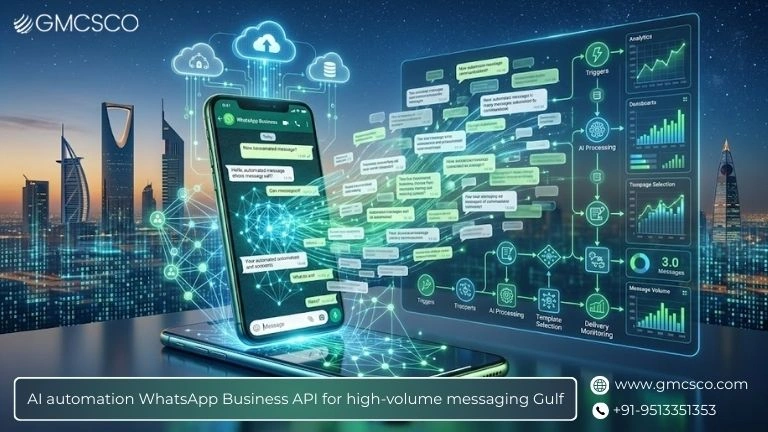
AI Automation WhatsApp Business API for High Volume Messaging in the Gulf

Across the Gulf region, customer communication has fundamentally changed. Customers no longer want emails waiting in inboxes or long call center queues. They expect instant responses, personalized interaction, and seamless service directly inside messaging apps they already use every day. And in the UAE, Saudi Arabia, Qatar, and across the GCC, one platform dominates business communication more than any other. WhatsApp. For businesses handling thousands or even millions of customer conversations each month, traditional communication systems simply cannot keep up. Sales teams miss leads. Support teams become overwhelmed. Marketing campaigns struggle to scale efficiently. This is where AI automation combined with WhatsApp Business API for high volume messaging in the Gulf becomes a transformational advantage rather than just another technology upgrade. Forward thinking enterprises are now using AI powered automation to manage customer conversations at scale while improving response speed, conversion rates, and operational efficiency. In this guide, we will explore how this technology works, why Gulf businesses are rapidly adopting it, and how organizations can implement it strategically for measurable ROI. The Communication Challenges Gulf Businesses Are Facing Today Companies across the GCC are experiencing rapid digital growth. However, communication infrastructure often remains outdated. Here are the most common operational problems business leaders report. 1. Massive Growth in Customer Inquiries Ecommerce expansion, fintech adoption, logistics platforms, healthcare services, and real estate sectors generate enormous messaging volumes daily. Manual teams cannot respond fast enough. Delayed responses directly reduce conversions. 2. Fragmented Customer Communication Channels Businesses typically manage conversations across: WhatsApp Email Website chat Instagram SMS Call centers Without automation, customer data becomes scattered and inefficient. Also Read About high-volume WhatsApp API messaging strategies 3. Rising Customer Expectations in the UAE Market Consumers in Dubai and across the Gulf expect premium digital experiences. Instant replies are no longer impressive. They are expected. 4. High Operational Costs Scaling customer support traditionally means hiring more agents. That model does not scale sustainably. AI automation changes this equation completely. Advisory Insight Many enterprise leaders begin exploring messaging automation only after customer demand overwhelms internal teams. The smarter move is proactive automation planning before growth bottlenecks appear. Organizations evaluating scalable communication strategies often start by assessing AI driven WhatsApp automation opportunities early. Why WhatsApp Became the Core Business Communication Channel in the Gulf The Gulf region has one of the highest WhatsApp penetration rates globally. Several factors drive this dominance. High smartphone adoption Mobile first consumer behavior Preference for conversational commerce Trust in familiar messaging platforms Multilingual communication needs Customers already communicate with friends and family on WhatsApp. Businesses entering the same environment remove friction from engagement. Instead of forcing customers onto portals or forms, companies meet them where conversations naturally happen. This shift created demand for enterprise level messaging infrastructure, which is exactly what the WhatsApp Business API enables. Also Read About AI chatbot automation trends in the Gulf What Is AI Automation in WhatsApp Business API? Let us simplify the concept. The WhatsApp Business API allows companies to send and receive messages at scale through verified business accounts. AI automation adds intelligence on top of that communication layer. Together, they create a powerful system capable of: Automatically responding to customers Handling thousands of conversations simultaneously Qualifying leads instantly Booking appointments Providing support answers Sending notifications and updates Routing conversations to human agents when needed Instead of human teams managing every interaction manually, AI handles repetitive communication while humans focus on high value conversations. Think of it as building a digital customer engagement workforce operating twenty four hours a day. How AI Powered WhatsApp Automation Actually Works Businesses often assume implementation is complicated. In reality, modern platforms simplify adoption significantly. Here is the operational flow. Step 1: Customer Initiates Conversation A user sends a message through WhatsApp after seeing an ad, website button, or QR code. Step 2: AI Understands Intent Conversational AI analyzes the message using natural language understanding. The system identifies whether the user wants: Product information Pricing details Support assistance Order tracking Booking services Step 3: Automated Intelligent Response The chatbot provides relevant responses instantly using structured workflows and AI learning. Step 4: Workflow Automation Actions can automatically trigger: CRM updates Lead creation Payment links Appointment scheduling Internal notifications Step 5: Human Escalation When Needed Complex queries transfer smoothly to live agents with full conversation history. This hybrid model delivers efficiency without sacrificing customer experience. Strategic Recommendation Before implementing automation, companies should map customer conversation journeys. Understanding frequent inquiries helps maximize AI effectiveness from day one. Consulting experienced automation specialists such as GMCSCO can help businesses design scalable messaging architecture aligned with growth goals. Real World Use Cases Across Gulf Industries AI WhatsApp automation is no longer experimental. It is actively transforming industries. Ecommerce and Retail Online retailers handle thousands of daily inquiries related to delivery updates, product availability, and returns. Automation enables: Instant order tracking Abandoned cart recovery Personalized promotions Automated customer support Conversion rates increase while support costs decline. Also Read About WhatsApp API compliance in Saudi Arabia Real Estate Companies Property inquiries move extremely fast in Dubai and Abu Dhabi markets. AI chatbots can: Qualify buyers automatically Schedule property viewings Share brochures instantly Capture investor data Sales teams receive only high intent prospects. Banking and Fintech Financial institutions use secure messaging automation for: Account notifications Loan inquiries KYC guidance Customer onboarding Response time improvements significantly enhance trust. Healthcare Providers Hospitals and clinics automate: Appointment bookings Reminder notifications Patient FAQs Follow up care communication Operational efficiency improves dramatically. Logistics and Delivery Companies Real time shipment updates through WhatsApp reduce inbound support calls by large margins. Soft CTA If your organization handles repetitive customer communication daily, exploring AI enabled WhatsApp automation can reveal immediate efficiency opportunities worth evaluating. Step by Step Adoption Strategy for Enterprises Successful implementation requires planning rather than simply deploying a chatbot. Phase 1: Communication Audit Analyze: Customer inquiry volume Response delays Support workload Sales funnel communication gaps Phase 2: Define Automation Objectives Common goals include: Reducing support costs Increasing lead conversion Improving response speed Scaling

AI Automation WhatsApp Business API for High Volume Messaging in the Gulf Read More »

AI chatbot automation with WhatsApp API for Gulf enterprises driving support, sales and analytics in 2026

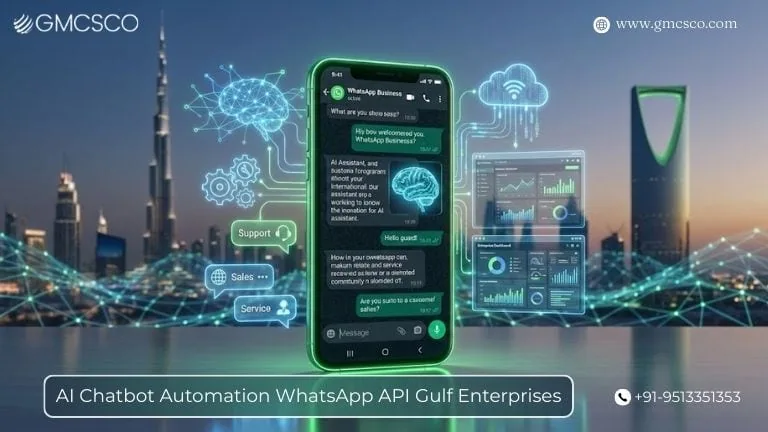
AI Chatbot Automation with WhatsApp API: The Ultimate Game-Changer for Gulf Enterprises in 2026

Imagine this: It’s 2 AM in Riyadh. A customer in Jeddah messages your e-commerce store on WhatsApp asking about a delayed delivery. Instead of waiting until morning for a human reply — and risking a lost sale — an intelligent AI chatbot instantly confirms the order status, offers a discount for the inconvenience, and even suggests similar products. The customer replies “شكراً” (thank you), completes an upsell, and rates the experience 5 stars. That’s not science fiction. That’s AI chatbot automation with WhatsApp Business API happening right now across Saudi Arabia, UAE, Qatar, and the wider Gulf. In 2026, Gulf enterprises that master this technology aren’t just keeping up — they’re dominating customer conversations, slashing support costs by up to 60%, and turning WhatsApp into a full revenue engine. With over 33 million active WhatsApp users in Saudi Arabia alone (opening the app 30+ times daily), this isn’t optional. It’s essential. As a professional SEO expert, content strategist, and conversion copywriter who has helped dozens of GCC enterprises scale conversational commerce, I’ve seen the transformation firsthand. This deep-dive guide — packed with 2025–2026 data, real Gulf examples, implementation blueprints, and compliance insights — shows exactly how to deploy AI chatbot automation via WhatsApp API for maximum ROI in the Kingdom and across the Gulf. Why WhatsApp + AI Is Exploding for Gulf Enterprises Right Now WhatsApp isn’t just popular in the Gulf — it’s the default communication lifeline. 98% open rates and 45–60% click-through rates dwarf email (20% opens) and SMS (11% opens). Globally, 5 million businesses already use the WhatsApp Business API, with 80% of large enterprises integrated or planning to by the end of 2025 (data still holds strong into 2026). In the UAE, 85.8% of the 16–64 population uses WhatsApp daily. Saudi Arabia mirrors this hyper-adoption. Message volume through the API is forecast to hit 3.57 trillion between 2024–2027 — a staggering 1,590% jump in daily traffic. Saudi Arabia’s Vision 2030 supercharges this shift. The Kingdom aims to become a global AI hub, with the Saudi Data and AI Authority (SDAIA) driving adoption. The local AI market is projected to grow from USD 2.14 billion in 2025 to USD 16.90 billion by 2032 (CAGR 34.3%). AI-powered chatbots specifically are exploding at 19.1% CAGR, reaching USD 1.2 billion by 2034. Gulf enterprises in retail, banking, logistics, healthcare, and government now expect instant, personalized, Arabic-first experiences. Customers won’t tolerate slow responses. They demand conversational commerce on the app they already live in. Also Read About WhatsApp Business API Compliance Saudi Arabia 2026 What Exactly Is AI Chatbot Automation with WhatsApp Business API? The WhatsApp Business API lets enterprises send and receive unlimited messages at scale (unlike the free WhatsApp Business app limited to one device). Layer on generative and agentic AI and you get true automation: Understands natural Arabic (including Saudi dialect and slang) Remembers conversation history across sessions Triggers complex workflows (booking → payment → confirmation) Hands off seamlessly to human agents when needed Integrates with your CRM, ERP, inventory, or payment systems (SADAD, Mada, Apple Pay) Important 2026 update: Since January 15, 2026, Meta strictly limits general-purpose AI assistants (like raw ChatGPT clones) on the Business API. Compliant platforms now use task-specific, enterprise-tuned models or hybrid architectures — ensuring full PDPL compliance and brand safety. This actually benefits serious Gulf enterprises by weeding out low-quality spam bots. 7 Transformative Benefits for Gulf Enterprises 24/7 Instant Support at 1/3 the Cost AI handles 70–80% of routine queries. One Riyadh-based retailer reduced call-center staffing by 55% while cutting response time from hours to seconds. Massive Revenue Uplift Through Conversational Commerce Cart recovery, in-chat catalogs, personalized offers, and one-click payments inside WhatsApp drive 30–50% higher conversion than website funnels. Gulf e-commerce (projected SR 67+ billion) is thriving here. Hyper-Personalization at Scale AI analyzes past purchases, location, and preferences to recommend products in perfect Arabic. A Dubai fashion brand saw 3x offer redemption rates with AI-driven Ramadan campaigns. Lead Generation & Qualification on Autopilot Chatbots qualify prospects 24/7, book appointments, and even collect payments — turning cold messages into warm revenue. Seamless Logistics & Post-Purchase Delight Real-time tracking, COD verification, and issue resolution reduce failed deliveries by 60%. Logistics giants across the GCC rely on this daily. Regulatory Compliance Made Simple Approved message templates + explicit opt-in logging = full PDPL alignment (Saudi Personal Data Protection Law). Explicit consent, data minimization, and easy deletion requests are built-in when using enterprise platforms. Data Goldmine for Strategic Insights Every conversation feeds analytics dashboards showing sentiment, drop-off points, and buying signals — insights impossible with traditional channels. Real emotional trigger: Stop losing customers to silence. Start building loyalty through conversations they actually enjoy. Also Read About Enterprise Use Cases for WhatsApp Business API in KSA Gulf Success Stories That Prove the ROI Huspy (UAE → expanding to KSA): At Dubai AI Week 2025, Huspy launched the GCC’s first AI-powered mortgage chatbot on WhatsApp. Customers now get instant rate comparisons, eligibility checks, and document uploads entirely in-chat. Result? Faster closings and massive market share in a traditionally slow sector. Saudi Retail & E-commerce Leaders: Major chains use AI for personalized National Day offers sent to millions. One reported 45% increase in store footfall and 70% support cost reduction. Telecom Giants (STC, Mobily, Zain): AI handles bill reminders with payment links, SIM activations, and network troubleshooting — slashing store visits by 40%. Healthcare & Government: Appointment booking, lab report delivery, and permit tracking now happen instantly, aligning perfectly with Vision 2030’s citizen-centric digital services. These aren’t outliers. They’re the new standard. Step-by-Step: How to Implement AI Chatbot Automation on WhatsApp API Get Verified on WhatsApp Business Platform Submit business docs, website, and phone number (toll-free or dedicated business line). Choose a Compliant BSP (Business Solution Provider) Look for official Meta partners with strong Gulf presence, Arabic AI, PDPL tools, and local payment integrations. Design Conversational Flows Map customer journeys: welcome → intent detection → workflow triggers → human handoff → feedback. Train & Deploy AI

AI Chatbot Automation with WhatsApp API: The Ultimate Game-Changer for Gulf Enterprises in 2026 Read More »

Task-specific AI bots using WhatsApp Business API in UAE for sales, support, booking and payment automation

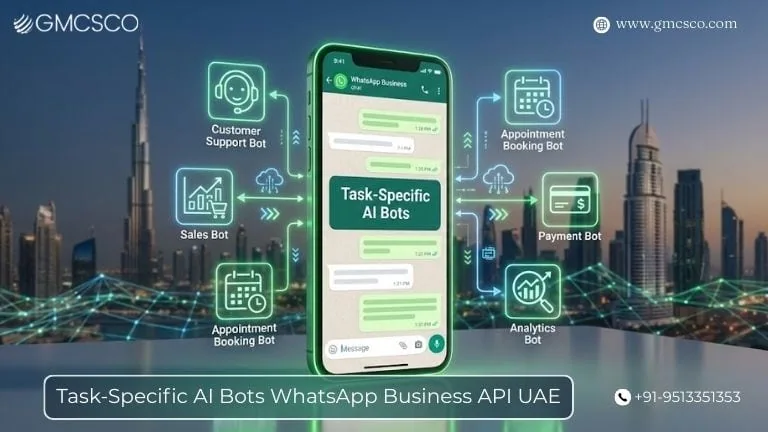
Task-Specific AI Bots WhatsApp Business API UAE: The Future of Smart Business Automation (2026)

The UAE doesn’t wait for the future. It builds it. From AI strategy frameworks to smart government services, the country has positioned itself as a global innovation hub. Under the leadership of entities like the UAE Artificial Intelligence Office and initiatives driven by the Ministry of Artificial Intelligence, artificial intelligence is no longer experimental — it’s operational. Now in 2026, one technology is quietly transforming businesses across Dubai, Abu Dhabi, Sharjah, and beyond: Task-specific AI bots powered by the WhatsApp Business API. If your business operates in the UAE and you’re not using them, your competitors probably are. Let’s break it down clearly — what they are, why they matter, and how they’re reshaping customer engagement in the Emirates. What Are Task-Specific AI Bots on WhatsApp? Unlike generic chatbots that try to answer everything, task-specific AI bots are designed to complete one defined objective — extremely well. For example: Booking an appointment Processing a payment Tracking an order Collecting KYC documents Generating a quotation Registering event attendees These bots are connected through the official WhatsApp Business API, allowing businesses in the UAE to automate conversations at scale securely and compliantly. Instead of overwhelming users with menus, they guide customers through a focused workflow. The result? Higher completion rates. Lower drop-offs. Better user experience. Why the UAE Is Perfect for WhatsApp AI Automation The UAE stands out as one of the best markets for WhatsApp Automation for Business, mainly because people here are highly connected and comfortable with digital technology in their daily lives. The UAE offers: Over 90% smartphone penetration across the population One of the highest WhatsApp usage rates in the world A digitally savvy and tech-friendly audience A strong and forward-thinking regulatory environment supporting AI innovation Cities like Dubai and Abu Dhabi have become global business hubs, home to thousands of startups, fintech companies, real estate agencies, e-commerce brands, and luxury businesses — all competing to capture customer attention in a fast-moving market. Also Read About WhatsApp Business API at Scale in GCC Enterprises Customers in the UAE now expect: Instant responses without waiting Smooth multilingual communication in Arabic and English 24/7 customer support Fast, seamless digital experiences across every touchpoint This is exactly where WhatsApp Automation makes a real difference. Task-focused AI bots help businesses respond instantly, manage conversations efficiently, and deliver personalized customer experiences at scale something modern UAE customers increasingly demand. Why Generic Chatbots Fail (And Task-Specific Bots Win) Many businesses previously installed “smart chatbots” that tried to answer everything. What happened? Confused conversations High bounce rates Frustrated customers Low conversions Task-specific bots solve this by focusing on one outcome. For example: Instead of saying: “How can I help you today?” A task-specific bot says: “Let’s book your consultation in under 60 seconds.” Clear. Direct. Efficient. In a fast-paced UAE market, clarity converts. Real-World Use Cases in the UAE (2026) 1. Real Estate Viewing Booking Bot (Dubai) Dubai’s real estate market remains highly competitive. Agencies use task-specific WhatsApp bots to: Capture property preferences Verify budget Schedule viewing slots Send location pin Confirm via calendar The entire process happens in under two minutes. No calls. No delays. 2. Fintech KYC Automation Bot (Abu Dhabi) Fintech startups in Abu Dhabi deploy AI bots to: Collect Emirates ID Validate documents Perform instant KYC checks Approve onboarding This reduces manual review time by 60%. 3. Healthcare Appointment Bot Clinics automate: Appointment booking Insurance verification Reminder messages Rescheduling Patients now prefer booking and managing appointments through WhatsApp using automated healthcare chat solutions. 4. E-commerce Order Tracking Bot Retail brands integrate WhatsApp bots that: Track delivery Send shipment updates Handle returns Provide refund status Customer support tickets drop significantly. Why WhatsApp Business API Is Essential The WhatsApp Business App is limited. To scale automation in the UAE, companies need the official WhatsApp Business API. Benefits include: Automated workflows CRM integration Verified green tick accounts High-volume messaging Secure infrastructure It ensures compliance and performance. Arabic + English AI = Competitive Advantage The UAE is multicultural. Your AI bot must support: Arabic English Code-switching (mixed language) Advanced NLP models in 2026 handle: Voice messages Regional dialects Intent detection Context memory A bilingual AI bot increases engagement significantly. ROI: Why Task-Specific Bots Deliver Faster Returns Let’s look at a typical UAE SME: 5 customer support agents AED 6,000 average monthly salary AED 30,000 monthly support cost If a task-specific AI bot automates 60% of repetitive interactions: Operational cost drops Response time improves Lead conversion increases Many UAE businesses report ROI within 3–4 months. This isn’t just automation. It’s profitability engineering. Compliance & Data Protection in the UAE The UAE has introduced strong data protection laws under the Federal Decree-Law No. 45 of 2021 (PDPL). Businesses must ensure: Secure hosting Encrypted communication Consent management Data transparency Working with compliant AI providers is critical. Trust is everything in the Emirates. Also Read About WhatsApp Business API Services for UAE, KSA, USA & Beyond 2026 Trends in WhatsApp AI Bots UAE Micro-Task Bots Instead of one big chatbot, businesses deploy multiple small bots for specific functions. AI + Human Hybrid Model Bots handle simple tasks, humans manage high-value conversations. Voice-Based WhatsApp Automation Customers send voice notes — bots respond intelligently. In-Chat Payments Full checkout happens inside WhatsApp. AI Analytics Bots analyze conversation data to optimize marketing strategy. How to Choose the Right WhatsApp AI Bot Provider in UAE Ask these questions before investing: Are you an official WhatsApp Business API provider? Do you comply with UAE data protection laws? Can the bot integrate with our CRM? Does it support Arabic NLP? Can we customize workflows for specific tasks? Don’t just buy automation. Build a strategic automation ecosystem. Voice Search Optimized Answer What are task-specific AI bots on WhatsApp Business API in UAE? Task-specific AI bots are automated systems designed to complete one focused action such as booking appointments, processing orders, or verifying documents through WhatsApp using the official Business API. They improve efficiency, reduce costs, and increase customer satisfaction in the UAE market. Frequently Asked Questions Q: What

Task-Specific AI Bots WhatsApp Business API UAE: The Future of Smart Business Automation (2026) Read More »

Scroll to Top