
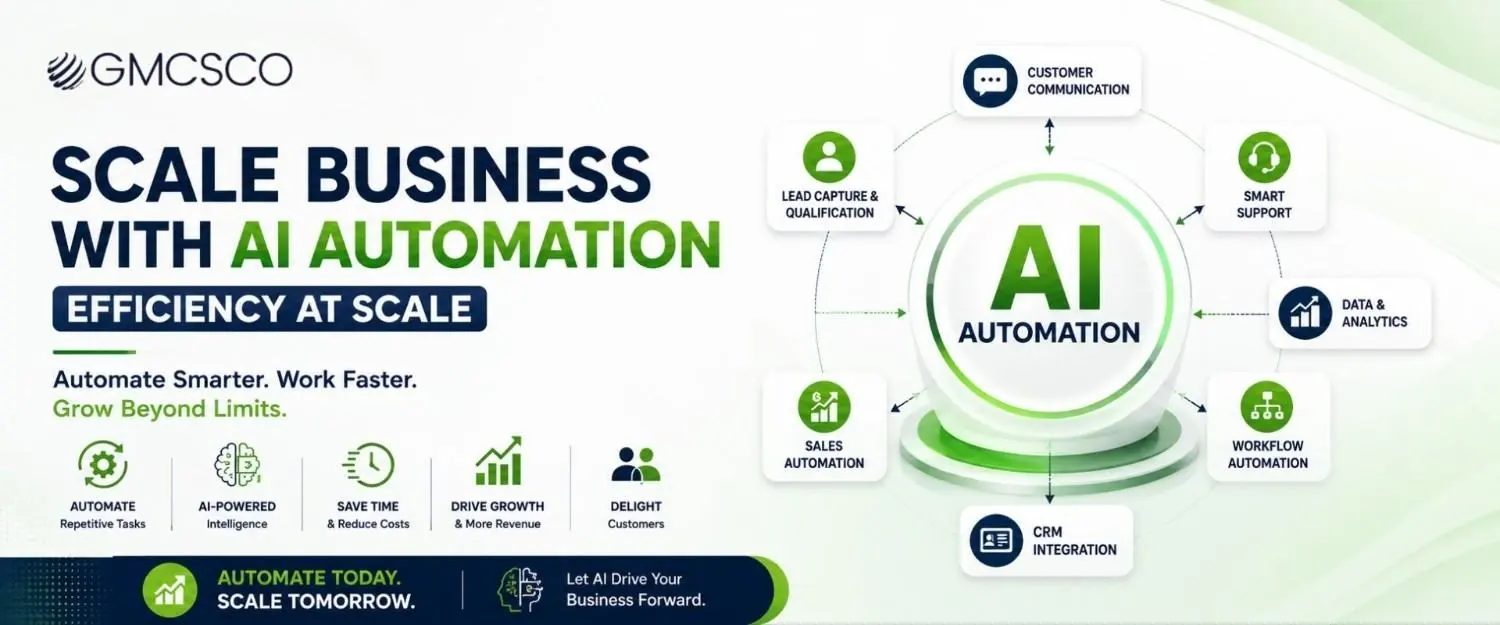
⚙️ AI Business Automation — 2026
How AI Automation Helps Scale a Business: The Complete Guide for Saudi Arabia & UAE
17 ways to build a human + AI operating model — automating repetitive work while keeping people focused on strategy, relationships, and judgment.
Quick Answer
AI automation helps businesses scale by automating repetitive work, improving response times, processing information faster, and allowing employees to focus on higher-value activities. Instead of scaling only by hiring more people, businesses can use AI across Lead capture → Customer communication → Qualification → Sales follow-up → CRM updates → Marketing → Support → Reporting → Internal workflows. The objective isn’t to replace every human task — it’s to create a human + AI operating model where AI handles repetitive, data-intensive work while people focus on strategy, relationships, creativity, complex decisions, and revenue-generating activities. For businesses in Saudi Arabia and the UAE, this aligns with the region’s broader focus on AI adoption and digital transformation.
Growth Creates More Work, Not Just More Revenue
Business growth sounds simple: more customers, more sales, more revenue. But operationally, growth creates another problem — more work. More leads mean more follow-ups. More customers mean more support requests. More sales mean more CRM updates. More campaigns mean more marketing operations. More transactions mean more reporting. Eventually, businesses reach a point where adding more employees becomes the default answer to increasing workload — but hiring alone doesn’t always solve the underlying problem. If a process is inefficient with 10 employees, adding 20 more may simply make the inefficient process more expensive. Instead of asking “how many more people do we need?”, businesses can ask: “which parts of our operation can be intelligently automated?”
What Is AI Business Automation?
Traditional automation follows predefined rules — “if a customer submits a form → send an email.” AI automation adds a layer of intelligence: “Customer submits enquiry → AI understands the enquiry → identifies intent → classifies the lead → provides an appropriate response → updates CRM → routes qualified lead to sales.”
📋 Traditional Automation
Rule → Action.
🤖 AI Automation
Data → Understanding → Decision support → Action.
The best business systems can combine both.
Why AI Automation Matters for Growth
Scaling a business creates four common challenges: more work, more complexity, more data, and more customer expectations. AI automation can address parts of all four — an AI chatbot handles routine questions, CRM automation updates records, AI lead qualification prioritizes prospects, automated reporting summarizes performance, AI content workflows accelerate marketing production, and workflow automation moves information between systems. The result can be greater operational capacity without increasing manual workload at the same rate.
AI Automation vs Traditional Automation
| Traditional Automation | AI Automation |
|---|---|
| Rule-based | Context-aware |
| Predictable inputs | Can handle variable inputs |
| Fixed workflows | Can adapt within defined boundaries |
| “If X, do Y” | Understand → decide → act |
| Limited interpretation | Natural-language understanding |
| Best for repetitive rules | Useful for complex information-heavy tasks |
AI is not automatically better for every process. “Invoice amount > SAR 50,000 → require approval” doesn’t necessarily require AI. The strongest strategy uses AI where intelligence is useful and traditional automation where rules are sufficient.
17 Ways AI Automation Helps Scale a Business
1. Automate Repetitive Tasks
Copying data between systems, updating CRM records, sending routine follow-ups, categorizing enquiries, generating standard reports, scheduling meetings, answering repetitive questions, creating internal notifications, sorting incoming requests — AI automation can reduce the manual work involved without necessarily eliminating the role, allowing employees to spend less time on repetitive administration.
2. Automate Lead Capture
A growing business receives leads from Google Ads, SEO, social media, website forms, WhatsApp, landing pages, chatbots, and referral campaigns — without automation, these leads end up scattered. AI can connect these channels into one workflow: Website enquiry → AI identifies requirement → Lead added to CRM → Lead categorized → Lead score assigned → WhatsApp/email follow-up → Sales notification.
3. Automate Lead Qualification
Not every lead deserves the same sales response. AI can identify signals such as service requirement, company size, budget range, location, buying timeline, business problem, and intent — “we need WhatsApp automation for 50 sales agents and want implementation next month” represents stronger intent than “what is WhatsApp API?”
4. Accelerate Customer Response
A prospect may contact multiple providers simultaneously — the faster company often has the advantage. AI chatbots can respond immediately: “Do you provide CRM integration?” → “Yes. We can help integrate CRM workflows with WhatsApp, lead capture and customer communication. Would you like to discuss your current CRM setup?” — then collect information and route the conversation.
5. Scale Customer Support
Pricing, service availability, account information, order status, appointment details, documentation, basic troubleshooting — AI handles suitable routine questions while complex issues transfer to human agents, creating a hybrid model: AI handles routine requests, humans handle complex cases.
6. Automate WhatsApp Communication
Particularly valuable for businesses targeting Saudi Arabia and the UAE: Lead clicks advertisement → WhatsApp conversation → AI qualification → Service recommendation → CRM update → Sales handover → Automated follow-up, connecting communication, qualification, and sales into one workflow.
7. Automate Sales Follow-Up
“I’ll get back to you next week” often gets lost when the salesperson gets busy. AI and workflow automation create structured reminders: Meeting completed → CRM updated → Follow-up reminder → Relevant information sent → Sales notification → Opportunity updated — making follow-up systematic rather than memory-dependent.
8. Automate CRM Management
A CRM is only valuable when its data is accurate. AI automation can assist with contact creation, lead categorization, conversation summaries, activity logging, lead scoring, task creation, sales-stage updates, and follow-up reminders — Conversation → Summary → CRM record → Next action, reducing administrative work.
9. Automate Marketing Operations
Content research, content briefs, email workflows, lead segmentation, campaign reporting, audience analysis, social media workflows, personalization, and lead scoring — but AI-generated marketing content should still be reviewed for accuracy, originality, and brand quality. Google’s current guidance specifically warns against creating large volumes of low-value, unoriginal content simply to manipulate rankings — the goal is AI-assisted productivity, not AI-generated content at scale without human value.
10. Automate Business Reporting
Managers need answers to how many leads were generated, which channel produced the best leads, which campaigns converted, which salespeople have the strongest pipeline, where opportunities get stuck, and which services generate the most revenue. AI can turn raw CRM data into performance summaries, key trends, and recommended actions — reducing time spent manually preparing reports.
11. Create AI-Powered Internal Knowledge Systems
Growing businesses accumulate SOPs, training documents, product information, pricing rules, sales materials, FAQs, and policies. An internal AI knowledge assistant lets employees ask “What is our onboarding process for enterprise clients?” and retrieve answers from approved internal sources — reducing repetitive internal questions.
12. Automate Document Processing
Invoices, forms, contracts, applications, purchase orders, and reports still consume significant manual time. AI can assist with extracting and classifying information: Invoice uploaded → AI extracts vendor and amount → Data validated → Accounting workflow triggered → Approval requested. Sensitive or high-risk documents should still have appropriate human review and governance.
13. AI Automation for Human Resources
Candidate screening, interview scheduling, employee FAQs, onboarding, training reminders, and internal communication: New employee joins → Welcome workflow → Documents → Training schedule → System access checklist → HR follow-up. AI can assist, but employment decisions can involve significant fairness, privacy, and compliance considerations — human oversight remains important.
14. AI Automation for Finance
Invoice classification, expense categorization, payment reminders, financial reporting, data reconciliation, and document extraction — AI should support, not blindly replace, financial controls and approvals.
15. AI Automation for E-Commerce
Product enquiries, customer support, order updates, abandoned-cart communication, product recommendations, customer segmentation, and post-purchase engagement: Customer asks about product → AI answers → Customer purchases → Order workflow → Delivery communication → Post-purchase follow-up → Review request. See our ecommerce development services.
16. AI Automation for Real Estate
Property enquiries, lead qualification, property recommendations, viewing scheduling, WhatsApp communication, lead distribution, and follow-up — “I need a 3-bedroom villa in Dubai with a budget of AED 3 million” gets collected by AI and routed to the relevant agent, who can then focus on the actual sales conversation.
17. AI Automation for Professional Services
Consulting, legal, financial, marketing, and technology businesses can automate lead qualification, appointment booking, client onboarding, document collection, FAQs, follow-up, reporting, and customer communication — improving operational consistency while keeping expert professionals involved where judgment is required.
💬 Ready to Scale Without Scaling Complexity?
Your business doesn’t need more manual processes to handle growth. GMCSCO can help identify where AI, automation, WhatsApp, CRM, and intelligent workflows create measurable operational efficiency.
Why AI Automation Is Relevant for Saudi Arabia
Saudi Arabia has made data and AI a strategic national priority. SDAIA’s AI Adoption Framework discusses identifying opportunities for AI application within organizations, understanding organizational needs, designing customized solutions, and assessing AI readiness — describing generative AI as part of the Kingdom’s broader economic diversification and technological advancement journey. Businesses should approach AI as a business transformation initiative, not simply a technology purchase.
Why AI Automation Is Relevant for UAE Businesses
The UAE’s National Strategy for Artificial Intelligence 2031 explicitly focuses on building an AI ecosystem, deploying AI in priority sectors, and using AI to improve services and economic outcomes. This creates opportunities to apply AI automation across customer experience, sales, marketing, operations, finance, HR, business intelligence, and digital services.
AI Automation Does Not Mean Automating Everything
Businesses sometimes approach AI with “what can we automate?” A better question is “which business processes would benefit most from intelligent automation?” Some activities require human judgment, negotiation, empathy, strategic thinking, creative direction, legal review, financial approval, and relationship management. The best approach: automate the repetitive, augment the complex, keep humans responsible for important decisions.
AI Automation vs AI Transformation
⚙️ AI Automation
Automates individual tasks. Example: an AI chatbot answers FAQs.
🔄 AI Transformation
Redesigns the broader process: Lead generation → AI qualification → CRM → Sales routing → Automated follow-up → Proposal → Onboarding → Retention.
The transformation approach can create much greater strategic value because the entire customer journey improves.
How to Identify AI Automation Opportunities
For every process, ask: What is the process? (e.g. lead qualification) How much manual work is involved? (4 hours/day) How repetitive is it? (highly repetitive) Does it require human judgment? (moderate) What systems are involved? (website + WhatsApp + CRM) What happens if it’s delayed? (potential lost sales) Can AI assist safely? (yes) — that’s a strong automation candidate.
A Simple AI Automation Opportunity Matrix
| Process | Automation Potential | Business Impact |
|---|---|---|
| Lead capture | High | High |
| Lead qualification | High | High |
| FAQ support | High | Medium/High |
| CRM updates | High | High |
| Sales reporting | High | Medium |
| Appointment scheduling | High | Medium |
| Invoice extraction | High | High |
| Strategic negotiation | Low | High human involvement |
| Complex legal decisions | Low | High human involvement |
| Executive strategy | Low | Human-led |
This helps businesses prioritize rather than automate randomly.
📅 Identify Your Highest-Impact Automation Opportunities
Schedule a strategy call with GMCSCO to map which processes in your business should be automated first.
The AI Automation Technology Stack
AI Models
For understanding and generating information.
Automation Platform
For connecting workflows.
CRM
For customer and sales data.
For conversational communication.
AI Chatbot
For customer interaction.
Knowledge Base
For company-specific information.
Analytics
For performance measurement.
APIs
For connecting business systems.
Human Approval
For important decisions.
The goal isn’t to buy every tool — it’s to build the right connected system for your business.
AI Automation and Data Governance
AI automation depends on data, which makes governance extremely important. Businesses should consider what data is being collected, where it’s stored, who can access it, which AI system processes it, how long it’s retained, and what happens if the AI produces an incorrect result. For Saudi businesses, SDAIA provides official resources related to data governance and personal-data protection; the UAE also has a broader policy environment around AI, cybersecurity, and digital transformation. Governance should be included from the beginning — not as an afterthought.
Responsible AI Automation
A mature strategy should include human oversight, data security, access controls, auditability, testing, monitoring, error handling, fallback processes, and clear accountability. For customer-facing AI, businesses should also define: When should AI transfer the conversation to a human? What information should AI be allowed to provide? What decisions should require approval? These questions are just as important as choosing the AI model.
AI Automation for Sales Scaling
Consider a company receiving 1,000 leads a month. If every lead requires manual qualification, manual CRM entry, manual follow-up, and manual scheduling, the sales team can quickly become overloaded. An AI-assisted system can handle Lead capture → Initial qualification → CRM creation → Lead scoring → Automated response → Meeting scheduling → Sales alert, letting salespeople focus more heavily on qualified opportunities. That’s the real meaning of scaling with AI automation.
AI Automation for Customer Experience
Customers increasingly expect fast answers, 24/7 availability, personalization, easy communication, and consistent service. AI can support these expectations through chatbots, WhatsApp automation, personalized communication, automated notifications, and knowledge assistants. But automation should not create a frustrating experience — if a customer repeatedly asks “can I speak to a human?” and the system refuses to transfer them, the automation has failed. Good automation knows when to stop automating.
The Human + AI Model
🤖 AI
Speed + scale + repetitive work + data processing.
🧑💼 Humans
Strategy + empathy + creativity + relationships + judgment.
Together: Human + AI = scalable operations — particularly valuable for service businesses where relationships remain critical.
Common AI Automation Mistakes
Automating Without a Strategy
Buying AI software doesn’t create business transformation.
Automating Broken Processes
Improve the process first, then automate it.
Using AI Where Rules Are Better
Not every workflow requires AI.
Ignoring Data Quality
Poor data creates poor automation.
No Human Handover
Customers need an easy path to people.
No Measurement
You need to know if automation actually improves the business.
Automating Too Much Too Quickly
Start with high-impact workflows.
Ignoring Governance
AI needs security, privacy, and accountability.
Treating AI as Expertise
AI should accelerate expertise, not replace genuine business knowledge.
How GMCSCO Can Help Businesses Scale With AI Automation
Instead of treating AI as a standalone chatbot, GMCSCO connects Lead Generation → AI Chatbot → WhatsApp → Lead Qualification → CRM → Sales Automation → Customer Communication → Reporting → Customer Retention:
The exact architecture depends on the company’s processes, systems, data, and business objectives.
📅 Scale Smarter With GMCSCO
Want to know which processes in your business should be automated first? Schedule a strategy call and start building your AI automation roadmap.
A Practical AI Automation Roadmap
Discover
Map business processes, customer journey, sales/marketing workflows, support and internal processes.
Prioritize
Rank opportunities by business impact, automation potential, complexity, risk, and expected ROI.
Pilot
Choose one high-value process, e.g. AI lead qualification — build, test, and measure it.
Integrate
Connect CRM, WhatsApp, website, AI, automation, and analytics.
Optimize
Monitor accuracy, response time, conversion, cost, satisfaction, and employee productivity.
Scale
Once the workflow works reliably, expand automation to additional departments and customer journeys.
This is safer than attempting a complete AI transformation overnight.
KPIs for Measuring AI Automation
Efficiency
Hours saved, tasks automated, processing/response time.
Sales
Lead response time, qualified rate, meeting rate, revenue per lead.
Customer Experience
First response, resolution time, satisfaction, escalation rate.
Operations & ROI
Cost per process, error rate, manual workload, business value.
The objective isn’t to maximize the number of automated tasks — it’s to maximize measurable business value.
Frequently Asked Questions
What is AI automation for business?
AI automation uses artificial intelligence and workflow automation to perform or assist with repetitive, data-intensive, and decision-support tasks across business operations.
Can AI automation help scale a business?
Yes. AI automation can increase operational capacity, improve response times, reduce repetitive workload, and help teams manage higher volumes without increasing manual work at the same rate.
What businesses can use AI automation?
Almost any business with repetitive processes can explore AI automation, including B2B companies, e-commerce, real estate, healthcare, logistics, professional services, technology companies, and enterprises.
What is the difference between AI and automation?
Automation follows predefined processes, while AI can interpret information, generate responses, classify data, and support decisions. Businesses can combine both technologies.
Can AI automate sales?
AI can assist with lead capture, qualification, follow-up, CRM updates, appointment scheduling, customer communication, and sales prioritization. Human salespeople remain important for complex negotiations and relationship-building.
Can AI automate WhatsApp?
AI and automation can be integrated into appropriate WhatsApp business workflows for customer communication, qualification, support, and follow-up, subject to applicable platform rules and business requirements.
Is AI automation expensive?
The cost depends on the number of processes, integrations, AI usage, customization, infrastructure, and implementation requirements. A focused automation pilot can be more practical than attempting to automate an entire organization at once.
Should businesses replace employees with AI?
Not necessarily. A strong strategy often uses AI to remove repetitive work and allow employees to focus on higher-value activities, while retaining human oversight for important decisions.
Is AI automation suitable for Saudi Arabia?
Yes. Saudi Arabia has made data and AI a strategic priority, and SDAIA provides frameworks and resources around AI adoption, organizational readiness, and responsible AI implementation.
Is AI automation suitable for UAE businesses?
Yes. The UAE has an established national AI strategy and broader digital-transformation initiatives aimed at increasing AI adoption and economic value.
How should a business start with AI automation?
Start by identifying repetitive, high-volume, and measurable processes. Prioritize one high-impact workflow, build a pilot, measure results, and then expand.
Final Thoughts
AI automation is not simply about replacing manual tasks — it’s about redesigning how a business operates. A growing company can use AI to capture more leads, respond faster, qualify prospects, automate follow-up, support customers, update CRM, process information, generate insights, improve employee productivity, and scale operations. The most successful approach isn’t “let’s automate everything with AI” — it’s “let’s identify where AI can create the greatest business value.” For businesses in Saudi Arabia and the UAE, the opportunity is particularly relevant as both markets continue developing strong national strategies around AI and digital transformation. The next stage isn’t simply adopting AI — it’s building an AI-enabled business operation, connecting AI + Automation + CRM + Data + People + Customer Experience into one scalable system.
Ready to Scale Smarter With AI Automation?
GMCSCO helps businesses in Saudi Arabia and the UAE use AI, automation, WhatsApp, CRM, and intelligent workflows to improve efficiency and build scalable customer journeys.