
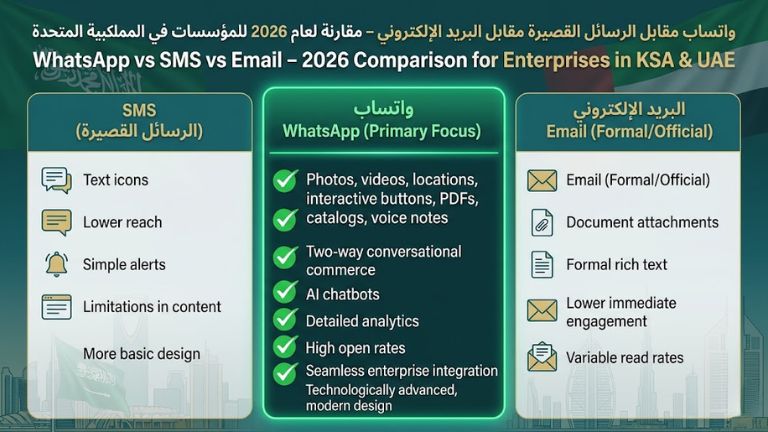
In 2026, enterprises in Saudi Arabia and the UAE are making critical decisions about their customer and employee communication channels. This detailed comparison helps decision-makers understand why WhatsApp Business API has become the preferred choice for large organizations.
WhatsApp Business API vs SMS vs Email – 2026 Head-to-Head Comparison
Ready to move from low-response SMS and email to high-performing WhatsApp automation? Talk to GMCSCO today.
Key Insights for KSA & UAE Enterprises in 2026
- WhatsApp dominates engagement — 4–6 times higher than SMS or Email.
- Cost efficiency at scale — High-volume users benefit from lower per-message rates and free service windows.
- Regulatory Advantage — Easier to maintain PDPL compliance with proper consent flows and audit trails.
- Future-Proof — Meta continues to invest heavily in WhatsApp as the primary business messaging platform.
When to Still Use SMS or Email?
- SMS: For legal mandatory notifications or users without WhatsApp.
- Email: For detailed reports, contracts, or formal correspondence.
Turn customer messages into real conversations with automated WhatsApp flows and quick replies. Chat on WhatsApp with us Today
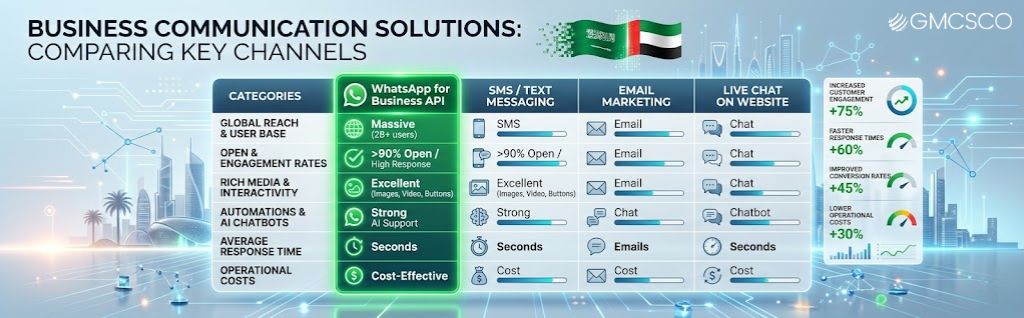
Recommendation
For most enterprise use cases in KSA & UAE in 2026, WhatsApp Business API is the clear winner when implemented with proper PDPL compliance and sovereign architecture.
FAQs
Q1: Is WhatsApp really better than SMS for business?
Yes, dramatically higher engagement and lower long-term cost.
Q2: How much can we save by switching to WhatsApp?
Most clients see 40-70% cost reduction at scale.
Q3: Is WhatsApp secure enough for enterprise use?
Yes, with end-to-end encryption and proper sovereign hosting.
Q4: Can we use WhatsApp for marketing?
Yes, with proper consent and approved templates.
Q5: What is the biggest advantage of WhatsApp?
Real-time two-way conversation and rich media.
Q6: Does WhatsApp support Arabic fully?
Yes, with excellent RTL support.
Q7: How does PDPL compliance work on WhatsApp?
Through explicit consent, audit logs, and data sovereignty.
Q8: Is email still useful?
Yes, for long-form and formal communication.
Q9: What is Meta’s per-message rate in KSA?
Varies by category – typically SAR 0.06–0.18.
Q10: Can we combine WhatsApp with SMS?
Yes, hybrid strategies work well.
Q11: How fast is WhatsApp delivery?
Usually under 2 seconds.
Q12: Is AI allowed on WhatsApp?
Yes, structured, task-specific AI Agents only.
Q13: Which industries benefit most?
Banking, Retail, Telecom, Government, Healthcare, Logistics.
Q14: What is the main risk of using WhatsApp?
Non-compliance with PDPL or Meta policies.
Q15: How can we get started?
Book a consultation – we provide a free assessment.
Disclaimer: This content is for general informational purposes only. Information may be sourced from AI tools, search engines, and trusted references. Please verify all details with official sources before making any business or legal decisions. We are not responsible for actions taken based on this content.