
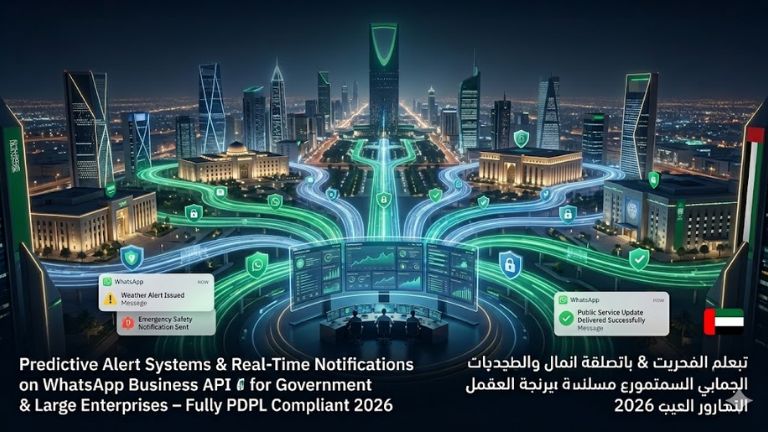
In 2026, government entities and large organizations in Saudi Arabia and the UAE are under growing pressure to deliver faster, more proactive, and highly personalized communication to millions of citizens, residents, and employees. Predictive Alert Systems and real-time notification platforms powered by WhatsApp Business API have emerged as one of the most effective, secure, and scalable solutions to meet this demand while maintaining strict compliance with PDPL, NCA, and other regulatory frameworks.
This comprehensive, in-depth guide is written specifically for government CIOs, Digital Transformation Directors, Project Heads, and senior leaders in large organizations who need reliable, intelligent, and fully compliant notification systems capable of handling high message volumes with complete data sovereignty.
Ready to move beyond traditional notification channels? Book a 30-minute strategy call with our government solutions team to evaluate how Predictive Alert Systems can transform citizen and employee engagement in your organization.
Why Predictive Alert Systems Have Become Essential in 2026
Government and large organizations in the GCC manage millions of interactions every month — from permit renewals and utility bill reminders to emergency alerts and employee communications.
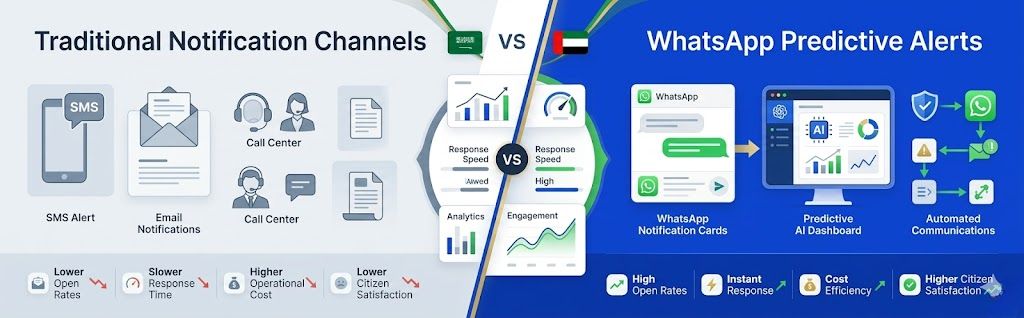
Traditional methods (SMS, email, mobile apps) suffer from low open rates, high costs, and limited interactivity. WhatsApp, on the other hand, consistently achieves 92–98% open rates and near-instant delivery, making it the preferred channel for proactive, predictive communication.
Meta’s 2026 policy updates support structured, task-specific predictive alerts, provided they follow clear business rules and maintain proper consent — creating an ideal environment for government and enterprise use cases.
Understanding PDPL & NCA Compliance for Government Notifications
Government and large public-sector projects must strictly adhere to the Personal Data Protection Law (PDPL) and National Cybersecurity Authority (NCA) guidelines.
Key compliance requirements we follow in every predictive alert deployment include:
- Explicit, documented, and easily withdrawable citizen/employee consent
- Data minimization and purpose limitation
- Secure data storage within approved sovereign environments
- Complete audit trails for every notification sent and received
- Breach notification within 72 hours to SDAIA and affected individuals
- Strong encryption and role-based access controls
All our predictive alert systems are built with sovereign-first architecture, ensuring sensitive data never leaves the client’s or government-approved infrastructure.
Ensure full regulatory compliance while unlocking the power of WhatsApp. Request a complimentary compliance and architecture assessment tailored for your entity.
High-Impact Use Cases for Government & Large Organizations
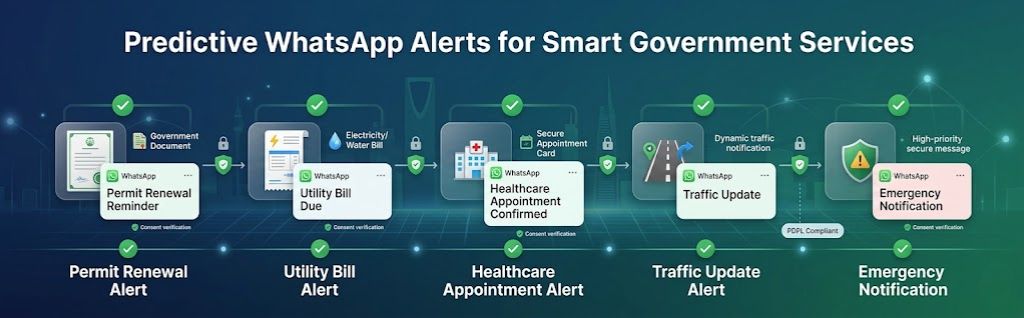
Here are proven, high-value predictive alert use cases currently deployed across the GCC:
- Citizen Services & Permit Management — Automatic expiry alerts for Iqama, driving licenses, business permits, and vehicle registration sent 30 to 45 days in advance.
- Utility & Public Services — Smart consumption alerts, bill due reminders, and outage notifications with predictive maintenance updates.
- Healthcare & Public Health — Vaccination reminders, appointment scheduling, medicine expiry alerts, and health campaign notifications.
- Transportation & Smart Mobility — Real-time traffic alerts, public transport updates, permit status, and predictive delay notifications.
- Internal Government & Employee Communications — Payroll alerts, policy updates, training reminders, and emergency staff notifications for large workforces.
- Emergency & Disaster Management — Structured, compliant public safety alerts during natural events or security situations.
Technical Architecture for Sovereign Predictive Systems
For government and critical infrastructure clients, we strongly recommend a Hybrid Sovereign Model that includes dedicated predictive AI engines running inside client/government infrastructure, secure API gateways, real-time integration, comprehensive monitoring, and automated failover within sovereign environments.
Discover the right sovereign architecture for your scale and security requirements. Request a technical deep-dive session with our solution architects.
AI Ethics in Predictive Alert Systems
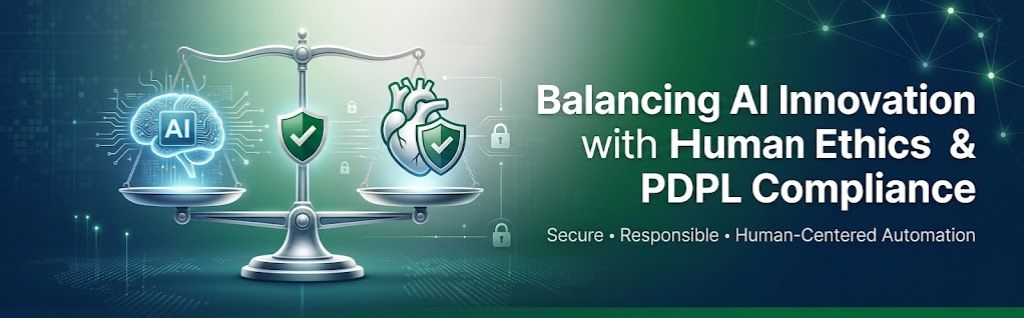
As organizations in Saudi Arabia and the UAE deploy predictive alert systems on WhatsApp Business API, ethical considerations are no longer optional — they are central to building trust, ensuring regulatory compliance, and aligning with Vision 2030’s emphasis on responsible digital transformation.
Key ethical principles we follow include:
- Consent and Transparency — Citizens and employees must clearly understand when, why, and how their data is used for predictions, with easy opt-out options.
- Privacy and Data Minimization — Collect only the minimum data necessary and store it securely on sovereign/client-controlled servers.
- Bias and Fairness — Regular audits to prevent discrimination based on nationality, gender, location, or income level.
- Accountability and Human Oversight — AI supports, but does not replace, human judgment in critical areas with clear escalation paths.
- Safety and Unintended Consequences — Avoid alert fatigue by limiting frequency and allowing users to control preferences.
- Cultural Sensitivity and Islamic Values — Respect local values, privacy norms, and principles of trust, justice, and stewardship (Amanah).
At GMCSCO, we believe technology must serve humanity with responsibility. Our predictive alert systems are designed with strong ethical frameworks that go beyond minimum legal requirements. We prioritize transparency, user control, fairness, and data sovereignty — ensuring every alert respects individual dignity while delivering genuine value. This ethical foundation is essential for building long-term trust with citizens, customers, and employees in Saudi Arabia and the UAE.
Real-World Impact & ROI for Government & Large Organizations
Organizations implementing these predictive alert systems in 2026 have reported 45–70% reduction in manual follow-up work, 30–50% improvement in on-time permit renewals and bill payments, and significantly higher citizen and employee satisfaction scores.
Build a system that is not only compliant but also ethically exemplary. Book an ethics and governance consultation with our experts.
FAQs
Q1: What is a Predictive Alert System on WhatsApp Business API?
A Predictive Alert System uses intelligent automation and data analytics to send timely, relevant, and proactive notifications via WhatsApp before an event occurs (e.g., permit expiry, bill due date, or potential service disruption). Unlike traditional reactive messaging, it anticipates citizen or employee needs and delivers information at the optimal moment, significantly improving response rates and user satisfaction.
Q2: Why is WhatsApp Business API preferred over SMS or Email for government notifications in 2026?
WhatsApp consistently delivers 92–98% open rates and near-instant delivery in the GCC, far surpassing SMS (around 30–40% open rates) and email (under 25%). It supports rich media, interactive buttons, two-way conversation, and end-to-end encryption, while being significantly more cost-effective at scale. Meta’s 2026 policy updates now better support structured, consent-based predictive messaging for government and enterprise use cases.
Q3: How do your solutions ensure full compliance with Saudi PDPL, NCA, and UAE data protection regulations?
All systems are built with sovereign-first architecture. We implement explicit consent mechanisms, data minimization, purpose limitation, complete audit trails, 72-hour breach notification protocols, and strong encryption. Data is processed and stored only within approved government or client-controlled environments in KSA or UAE. Every deployment undergoes rigorous compliance reviews aligned with SDAIA, NCA, and PDPL requirements.
Q4: Can these predictive alerts be used for emergency and disaster management?
Yes. The system supports structured emergency notifications that comply with Meta’s policies and local regulations. Alerts can be prioritized, geo-targeted, and include clear escalation paths while maintaining full auditability. Human oversight is always maintained for critical communications.
Q5: Where is the citizen or employee data stored?
Data sovereignty is non-negotiable. In government and large enterprise deployments, we use a Hybrid Sovereign Model where predictive AI engines, databases, and processing run inside your approved infrastructure or government-approved cloud environments. Sensitive personal data never leaves KSA or UAE sovereign territory.
Q6: How do you prevent alert fatigue and ensure citizens/employees are not overwhelmed?
We implement intelligent frequency controls, user preference management, and smart scheduling. Citizens and employees can easily manage notification preferences through WhatsApp itself. Our systems are designed to send high-value, relevant alerts only, respecting cultural norms and Islamic principles of respect and Amanah (trust).
Q7: Do you support Arabic language and Gulf-specific cultural nuances?
Absolutely. All AI models and message templates are fully localized in Modern Standard Arabic and regional Gulf dialects where required. Messages are crafted with cultural sensitivity, professional tone, and alignment with local values and regulatory expectations.
Q8: What kind of integration is required with existing government systems?
Our platform offers secure, API-first integration with major government platforms including CRM, ERP, permit management systems, utility billing, HRIS, and smart city platforms. We support both real-time and batch integrations with comprehensive logging and monitoring.
Q9: How do you handle AI Ethics and bias in predictive alerts?
Ethical AI is embedded by design. We conduct regular bias audits, ensure fairness across demographics, maintain full human oversight for sensitive decisions, and follow clear accountability frameworks. Our systems align with Vision 2030 and UAE AI principles, emphasizing transparency, consent, and human dignity.
Q10: What is the typical ROI and impact for government entities?
Organizations using these systems report 45–70% reduction in manual follow-up work, 30–50% improvement in timely renewals and payments, and significantly higher citizen/employee satisfaction scores. Many also see substantial cost savings compared to traditional SMS and call center operations.
Q11: Can we start with a pilot project before full-scale deployment?
Yes. We strongly recommend starting with a focused pilot (e.g., one department or service like Iqama renewals or utility billing) to demonstrate value, measure compliance, and gain internal buy-in before enterprise-wide rollout.
Q12: Who owns the WhatsApp Business Account and the data?
The government entity or organization fully owns the WhatsApp Business Account and all associated data. GMCSCO acts only as the implementation and managed service partner. You maintain complete control at all times.
Q13: How quickly can a predictive alert system be deployed?
A focused pilot can typically be deployed within 4–8 weeks, depending on integration complexity. Full-scale sovereign deployments usually take 3–6 months, including rigorous compliance, security testing, and change management.
Q14: What support and SLAs do you provide?
We offer 24/7 premium support, dedicated account management, quarterly compliance reviews, continuous optimization, and Service Level Agreements (SLAs) tailored for government and critical infrastructure clients (typically 99.9% uptime).
Disclaimer: This content is for general informational purposes only. Information may be sourced from AI tools, search engines, and trusted references. Please verify all details with official sources before making any business or legal decisions. We are not responsible for actions taken based on this content.