
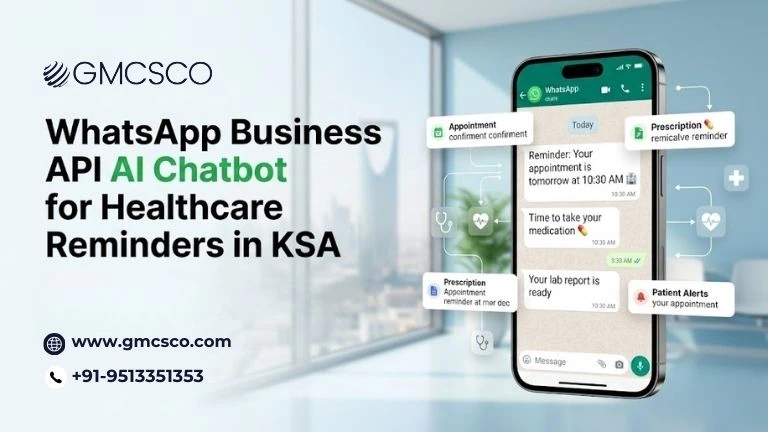
Healthcare organizations in Saudi Arabia are rapidly embracing digital transformation. Hospitals, medical centers, dental clinics, and diagnostic labs are under increasing pressure to improve patient communication while also reducing operational costs. One of the most common operational challenges healthcare providers face today is missed appointments and poor patient follow up.
Missed appointments create significant revenue loss. Doctors waste valuable consultation time. Staff members spend hours manually calling patients for reminders. At the same time, patients expect convenient communication through the same platforms they use daily.
This is where WhatsApp powered AI chatbots built on the WhatsApp Business API are transforming healthcare communication.
An intelligent WhatsApp chatbot can automatically remind patients about appointments, medication schedules, follow ups, lab results, vaccination reminders, and wellness checkups. For healthcare providers in the Kingdom of Saudi Arabia, this technology is becoming an essential tool for improving patient engagement while streamlining operations.
In this guide we will explore how AI powered WhatsApp chatbots work for healthcare reminders in KSA, why hospitals are adopting them rapidly, and how organizations can implement them successfully.
The Real Operational Challenges Healthcare Providers Face
Healthcare communication is far more complex than many industries. Hospitals and clinics manage thousands of patient interactions every day.
Common operational challenges include:
- Manual appointment reminder calls
- Patient no shows leading to revenue loss
- Staff time wasted on repetitive communication
- Difficulty sending multilingual reminders to diverse patient populations
- Poor patient follow up after treatments
- Medication adherence issues
- Missed vaccination schedules
- Delayed test result notifications
For large hospitals and clinics across cities like Riyadh, Jeddah, and Dammam, these communication challenges scale quickly.
Research across healthcare systems globally shows that missed appointments alone can reach 20 percent to 30 percent if no reminder system is used. For healthcare providers this translates into massive operational inefficiencies.
Patients also increasingly prefer messaging over phone calls. In Saudi Arabia, WhatsApp penetration exceeds 85 percent among smartphone users. This makes WhatsApp the most natural communication channel between healthcare providers and patients.
Instead of relying on staff members to manually manage reminders, AI powered WhatsApp automation allows healthcare providers to communicate instantly, reliably, and at scale.
Healthcare leaders exploring digital patient engagement platforms should strongly evaluate WhatsApp automation as part of their communication strategy.
Why This Topic Matters in Saudi Arabia’s Healthcare Landscape
Saudi Arabia is undergoing one of the largest healthcare modernization initiatives in the region. Vision 2030 is driving major investments in digital health infrastructure, patient centric services, and smart hospital technologies.
Several trends make WhatsApp chatbot automation highly relevant in the Saudi healthcare ecosystem.
First, mobile first communication is dominant in the region. Patients are far more likely to respond to WhatsApp messages compared to email or traditional SMS.
Second, the healthcare sector is expanding rapidly with new private hospitals, specialty clinics, and telemedicine platforms entering the market.
Third, healthcare providers are under pressure to improve patient satisfaction scores and reduce operational waste.
Fourth, the population includes both Arabic and international patients, making multilingual communication essential.
AI powered WhatsApp chatbots provide a powerful solution that aligns perfectly with these trends.
Healthcare organizations can send automated appointment reminders in Arabic and English. Patients can confirm or reschedule appointments directly from the chat. Medication reminders can be delivered on schedule without manual intervention.
As Saudi Arabia continues its healthcare digital transformation, conversational AI platforms are becoming a strategic tool rather than just a convenience.
Healthcare leaders looking to modernize patient communication should explore how WhatsApp Business API solutions can fit into their digital engagement strategy.
Also Read About WhatsApp Chatbot for Clinics and Hospitals
What Is a WhatsApp Business API AI Chatbot for Healthcare?
In simple terms, a WhatsApp Business API AI chatbot is an automated messaging assistant that interacts with patients through WhatsApp.
Unlike the standard WhatsApp Business app, the Business API allows hospitals and healthcare systems to automate large scale communication securely and integrate with existing healthcare software systems.
The AI chatbot acts like a virtual patient assistant.
It can automatically send reminders, answer common questions, guide patients through appointment scheduling, and deliver important healthcare notifications.
Key capabilities include:
- Appointment reminders before scheduled visits
- Medication reminders for chronic patients
- Follow up reminders after procedures
- Vaccination schedule alerts
- Lab result notifications
- Health check reminders
- Insurance documentation prompts
- Patient satisfaction surveys
The chatbot can also integrate with hospital systems such as:
- Hospital Information Systems
- Electronic Medical Records
- Patient scheduling platforms
- Healthcare CRM systems
- Telemedicine platforms
This integration allows the chatbot to trigger reminders automatically based on real patient data.
Instead of staff manually tracking appointments, the system runs continuously and communicates with patients in real time.
Organizations exploring healthcare workflow automation should consider conversational AI platforms that integrate with existing medical systems.
Practical Use Cases of WhatsApp AI Chatbots in Healthcare
To understand the real impact of this technology, let us look at several practical use cases used by hospitals and clinics in Saudi Arabia.
Appointment Reminders for Clinics
One of the most common use cases is automated appointment reminders.
Patients receive a WhatsApp message 24 hours before their appointment.
The message includes appointment time, doctor name, clinic location, and an option to confirm or reschedule.
This simple automation dramatically reduces patient no show rates.
Many healthcare providers report reductions of up to 40 percent in missed appointments.
Medication Adherence Reminders
Patients managing chronic conditions such as diabetes or hypertension often forget medication schedules.
AI chatbots can send daily reminders and even ask patients to confirm medication intake.
This improves treatment outcomes and strengthens patient relationships with healthcare providers.
Vaccination Schedule Reminders
Pediatric clinics can use WhatsApp chatbots to remind parents about upcoming vaccination schedules.
Parents receive clear instructions and can easily confirm appointments.
Lab Result Notifications
Diagnostic centers often struggle with communicating test results efficiently.
Instead of requiring patients to call the clinic, the chatbot can notify patients when results are ready and guide them through next steps.
Post Treatment Follow Ups
Hospitals can schedule automated follow ups after surgeries or treatments.
Patients receive messages asking about recovery progress and are encouraged to contact the clinic if issues arise.
Healthcare organizations seeking stronger patient engagement strategies can greatly benefit from intelligent messaging systems like these.
Also Read About WhatsApp Automation Workflows for Customer Daily Reminders in the Gulf
How Healthcare Providers Can Implement WhatsApp Reminder Chatbots
Implementing a WhatsApp Business API chatbot requires a structured approach. Healthcare organizations should follow a clear process to ensure compliance, integration, and usability.
Step 1: Define Communication Objectives
Healthcare providers should first define their communication goals.
Common objectives include reducing appointment no shows, improving patient engagement, or automating routine reminders.
Clear goals help design the chatbot workflow effectively.
Step 2: Choose the Right WhatsApp Business API Platform
Hospitals must work with an official WhatsApp Business API provider capable of supporting enterprise scale healthcare messaging.
Security, compliance, and data privacy are critical in healthcare environments.
Step 3: Integrate With Healthcare Systems
The chatbot should connect with scheduling systems, EMR platforms, and CRM databases to ensure reminders are triggered automatically.
This integration eliminates manual work for staff.
Step 4: Design Patient Friendly Conversations
The chatbot must communicate clearly in both Arabic and English.
Messages should be simple, respectful, and easy for patients to understand.
Step 5: Enable Smart AI Responses
Patients often ask common questions such as clinic hours, appointment rescheduling, or insurance queries.
AI powered responses help reduce call center workload.
Step 6: Monitor Performance and Improve
Healthcare providers should track metrics such as reminder delivery rates, patient response rates, and no show reduction.
Continuous improvement ensures the system delivers maximum value.
Organizations exploring healthcare automation often begin with appointment reminders and gradually expand to more advanced patient engagement features.
Business Benefits for Hospitals and Clinics
Healthcare leaders are investing in WhatsApp AI automation because it delivers measurable operational improvements.
Reduced Patient No Shows
Automated reminders dramatically reduce missed appointments.
This directly increases clinic revenue and improves doctor schedule efficiency.
Lower Administrative Workload
Staff no longer need to spend hours calling patients for reminders.
This allows healthcare teams to focus on patient care rather than repetitive tasks.
Improved Patient Experience
Patients appreciate timely reminders delivered through a familiar platform like WhatsApp.
Communication becomes simple and convenient.
Higher Patient Retention
Regular follow ups and wellness reminders strengthen relationships between patients and healthcare providers.
Scalable Patient Communication
Hospitals can communicate with thousands of patients simultaneously without increasing staff workload.
Healthcare organizations that prioritize patient engagement platforms typically see improved satisfaction scores and operational efficiency.
If your healthcare organization is exploring ways to modernize communication with patients, consulting experienced automation specialists can help identify the right strategy.
Also Read About KSA chatbot automation
Common Mistakes Healthcare Businesses Make Without Automation
Despite the benefits, many healthcare providers still rely on outdated communication methods.
Several common mistakes limit operational efficiency.
First, many clinics depend on manual phone calls for reminders. This approach is slow and inconsistent.
Second, some organizations rely only on SMS reminders which lack conversational capabilities.
Third, patient engagement is often treated as a secondary operational task rather than a strategic priority.
Fourth, communication systems are often disconnected from scheduling software, creating workflow inefficiencies.
Finally, some healthcare providers underestimate the importance of multilingual communication in diverse patient populations.
AI powered messaging platforms solve these problems by creating a unified patient communication system.
Healthcare leaders should view patient engagement technology as a long term operational investment rather than a short term tool.
Future Trends in Healthcare Communication Automation
The role of AI chatbots in healthcare is expanding rapidly.
Several emerging trends will shape the next generation of patient engagement platforms.
Conversational AI Patient Assistants
Future chatbots will function more like digital health assistants capable of guiding patients through treatment journeys.
Telemedicine Integration
Chatbots will automatically guide patients to video consultations when needed.
Predictive Health Notifications
AI systems will analyze patient data and trigger proactive health reminders.
Personalized Patient Journeys
Automation platforms will deliver customized communication based on patient history and health conditions.
Voice and Multimodal Messaging
Patients will interact through voice notes, images, and video instructions.
Healthcare organizations adopting conversational AI early will be better positioned to deliver patient centric services in the evolving healthcare ecosystem.
Choosing the Right Implementation Partner
Deploying a WhatsApp Business API chatbot in healthcare requires technical expertise, security compliance, and healthcare workflow understanding.
This is why many hospitals partner with specialized AI automation firms.
A reliable implementation partner should offer:
- WhatsApp Business API integration
- Healthcare system integration support
- Secure messaging architecture
- Arabic and English chatbot design
- AI conversation optimization
- Scalable infrastructure for large healthcare networks
Companies like GMCSCO support healthcare providers in building intelligent WhatsApp automation systems tailored for patient communication and operational efficiency.
Healthcare organizations considering WhatsApp automation should work with experienced consultants who understand both conversational AI and healthcare workflows.
Also Read About AI-Powered WhatsApp Chatbot KSA 2026
Explore AI Automation Opportunities for Your Healthcare Organization
Digital patient engagement is becoming a critical differentiator for modern healthcare providers.
Hospitals and clinics that adopt intelligent messaging systems are seeing measurable improvements in patient satisfaction and operational performance.
If your healthcare organization is evaluating automation opportunities, exploring WhatsApp chatbot solutions with experienced specialists such as GMCSCO can help you design a scalable patient communication strategy.
The right implementation approach ensures technology aligns with both clinical operations and patient experience goals.
Frequently Asked Questions
Q: How does a WhatsApp chatbot send healthcare reminders?
A WhatsApp chatbot integrates with hospital scheduling systems. When an appointment or medication schedule is recorded, the system automatically sends reminders through WhatsApp to the patient.
Q: Is WhatsApp communication safe for healthcare use?
WhatsApp Business API uses end to end encryption. However healthcare providers must also ensure their chatbot platform follows proper data privacy and security practices.
Q: Can WhatsApp chatbots communicate in Arabic?
Yes. AI chatbots can support multiple languages including Arabic and English which is essential for healthcare providers in Saudi Arabia.
Q: Do patients need to install a special app?
No. Patients receive reminders directly on WhatsApp which they already use daily.
Q: Can patients reschedule appointments through WhatsApp?
Yes. Advanced chatbots allow patients to confirm, cancel, or reschedule appointments directly through the conversation.
Q: How much can appointment reminders reduce no shows?
Many healthcare providers report reductions between 30 percent and 40 percent after implementing automated reminder systems.
Q: Can WhatsApp chatbots integrate with hospital systems?
Yes. WhatsApp Business API chatbots can integrate with electronic medical records, scheduling systems, and healthcare CRM platforms.
Q: Are WhatsApp reminders better than SMS?
WhatsApp messages typically have higher open rates and allow two way conversations, making them more effective for patient communication.
Q: Can chatbots answer patient questions?
AI powered chatbots can answer common questions such as clinic hours, appointment availability, insurance queries, and location information.
Q: Is this technology suitable for small clinics?
Yes. WhatsApp automation solutions can scale for both small clinics and large hospital networks.
Final Thoughts
Healthcare providers in Saudi Arabia are entering a new era of digital patient engagement.
As hospitals continue to modernize their operations, communication technologies will play a critical role in improving efficiency and patient satisfaction.
AI powered WhatsApp chatbots are emerging as one of the most effective tools for delivering appointment reminders, medication alerts, and proactive healthcare communication.
For hospitals, clinics, and diagnostic centers, this technology reduces operational workload while improving patient outcomes.
Organizations that embrace conversational AI early will be better positioned to deliver patient centric healthcare services in the years ahead.
Healthcare leaders seeking to implement intelligent WhatsApp automation systems can work with experienced providers such as GMCSCO to build scalable patient engagement platforms that align with modern healthcare expectations.
Disclaimer: This content is for general informational purposes only. Information may be sourced from AI tools, search engines, and trusted references. Please verify all details with official sources before making any business or legal decisions. We are not responsible for actions taken based on this content.