
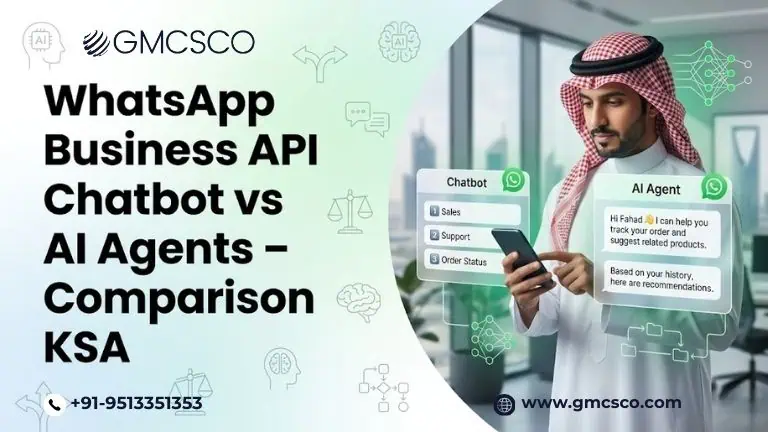
Imagine running a bustling e-commerce store in Riyadh. Your team handles hundreds of customer inquiries daily, from order updates to product recommendations. But as your business grows, so do the delays in responses, leading to frustrated customers and lost sales. In Saudi Arabia’s fast-paced market, where digital transformation is key to staying competitive, choosing the right automation tool can make all the difference. This is where comparing WhatsApp Business API chatbots and AI agents becomes crucial. Both promise to streamline customer interactions, but they serve different needs. In this article, we will break down the differences, benefits, and practical applications to help you decide what fits your business best.
Industry Problems and Operational Challenges
Businesses in Saudi Arabia face unique hurdles in customer service. With the Kingdom’s Vision 2030 pushing for economic diversification, companies in retail, finance, and logistics are under pressure to scale efficiently. Traditional customer support methods, like phone calls or emails, often lead to long wait times and high operational costs. For instance, handling peak-hour queries during Ramadan or major sales events can overwhelm teams, resulting in errors and dissatisfaction.
Moreover, data privacy regulations under the Personal Data Protection Law add complexity. Businesses must ensure secure, compliant communication while maintaining high engagement. Without automation, these challenges escalate, leading to higher churn rates and missed revenue opportunities. Many startups and enterprises struggle with inconsistent response times, especially across time zones or with multilingual customers speaking Arabic and English.
Also Read About WhatsApp Business API Chatbot Setup
Why This Topic Matters in Today’s KSA and Global Business Environment
In Saudi Arabia, the adoption of digital tools aligns directly with national goals for innovation. The AI market in the Kingdom is projected to grow significantly, driven by initiatives like the National Strategy for Data and AI. Globally, customer expectations have shifted toward instant, personalized interactions, with messaging apps like WhatsApp leading the charge. Over 80 percent of Saudis use WhatsApp daily, making it a prime channel for business communication.
Comparing WhatsApp Business API chatbots and AI agents is timely because it addresses the need for scalable solutions in a market where e-commerce is booming. For KSA businesses, this means better compliance with local regulations, enhanced customer loyalty, and a competitive edge in the Middle East. Ignoring these tools could mean falling behind as competitors leverage automation for faster growth.
If you are exploring ways to optimize your customer interactions, consider consulting experts in AI automation solutions. They can provide tailored advice to align with your goals.
Clear Explanation of the Concept in Simple Terms
At its core, a WhatsApp Business API chatbot is a programmed tool that automates responses on WhatsApp. It uses predefined rules or scripts to handle basic queries, like greeting customers or sending order confirmations. Think of it as a reliable assistant for routine tasks, integrated directly with the WhatsApp Business Platform.
On the other hand, AI agents represent a more advanced evolution. These are intelligent systems powered by machine learning and natural language processing. Unlike chatbots, AI agents can understand context, learn from interactions, and perform complex actions, such as integrating with CRM systems or making decisions based on real-time data.
The key difference lies in capability. Chatbots follow fixed paths, while AI agents adapt dynamically, offering a more human-like experience.
Also Read About AI Chatbot & Automation Trends on WhatsApp API
Practical Business Examples and Use Cases
In Saudi Arabia, retail giants use WhatsApp Business API chatbots for simple tasks like broadcasting promotions or tracking deliveries. For example, a Jeddah-based fashion store might set up a chatbot to answer FAQs about sizes and returns, freeing up staff for in-store duties.
AI agents shine in more intricate scenarios. A Riyadh bank could deploy an AI agent to handle loan inquiries, pulling data from customer accounts to provide personalized advice. In logistics, AI agents manage end-to-end processes, like rerouting shipments based on weather updates or customer preferences.
Another use case is in healthcare. Clinics in Dammam use chatbots for appointment reminders, but AI agents go further by analyzing symptoms and suggesting preliminary consultations, all while ensuring compliance with KSA health regulations.
Step by Step Adoption or Implementation Explanation
Adopting these tools starts with assessing your needs. First, evaluate your customer query volume and complexity. For basic automation, begin with WhatsApp Business API setup.
Step one: Register for a WhatsApp Business Account and verify your business through Meta’s platform. This ensures compliance with KSA regulations.
Step two: Choose a Business Solution Provider to integrate the API. They handle technical aspects like message templates for marketing or utility purposes.
Step three: Design your chatbot flows. Use tools to create scripts for common interactions, testing them for accuracy.
For AI agents, the process is more involved.
Step four: Integrate advanced AI models, perhaps using platforms that support natural language understanding.
Step five: Train the system with your data, ensuring privacy compliance. Monitor performance and iterate based on analytics.
Finally, launch with a pilot group of customers to gather feedback before full rollout.
Ready to implement? Exploring customer engagement platforms can help you map out a smooth transition without disrupting operations.
Business Benefits Including Efficiency and ROI Impact
Both tools boost efficiency, but in different ways. WhatsApp chatbots reduce response times by up to 80 percent for simple queries, cutting labor costs. In KSA’s competitive market, this translates to higher customer satisfaction scores.
AI agents deliver even greater ROI. They resolve 65 to 75 percent of support tickets autonomously, as seen in global benchmarks. For Saudi businesses, this means savings on staffing and faster scaling. One study shows AI-driven automation can increase revenue by 15 percent through personalized upsells.
Measurable outcomes include lower churn and higher net promoter scores. In finance, AI agents detect fraud in real time, saving millions annually.
Common Mistakes Businesses Make Without This Solution
Without automation, companies often rely on manual processes, leading to errors like delayed responses. In Saudi Arabia, this can violate service level agreements and damage reputation.
Another pitfall is ignoring data insights. Businesses miss opportunities for personalization, resulting in generic communications that fail to engage.
Overlooking compliance is risky too. Sending unsolicited messages without opt-ins can lead to penalties under local laws.
Finally, scaling without tools causes bottlenecks, especially during high-demand periods like Hajj season, when customer volumes spike.
Future Trends and Market Evolution
Looking ahead, AI automation in Saudi Arabia will integrate more deeply with emerging technologies. By 2030, the Kingdom’s AI market could contribute billions, fueled by Vision 2030 investments.
Trends include hybrid models combining chatbots and AI agents for seamless handoffs to human agents. Voice-enabled AI on WhatsApp will cater to Arabic speakers, enhancing accessibility.
Globally, agentic AI will dominate, with systems that proactively engage customers. In KSA, regulations will evolve to support ethical AI use, promoting trust.
Businesses should prepare by investing in training and partnerships to stay ahead.
To navigate these trends, consider business automation consulting services. They offer insights into upcoming innovations tailored to your sector.
Also Read About WhatsApp Business API Compliance Saudi Arabia 2026
Frequently Asked Questions
Q: What is the main difference between a WhatsApp Business API chatbot and an AI agent?
A chatbot relies on predefined scripts for basic responses, while an AI agent uses advanced learning to handle complex, context-aware interactions.
Q: How much does WhatsApp Business API cost in KSA?
Pricing is per-message, varying by category like marketing or utility, starting from fractions of a cent, with service messages free within 24 hours.
Q: Are AI agents suitable for small businesses in Saudi Arabia?
Yes, they scale well, offering cost-effective automation for growing startups in retail or services.
Q: What regulations must businesses follow when using WhatsApp Business API in KSA?
Comply with Personal Data Protection Law, obtain opt-ins, and use approved templates to avoid blocks.
Q: How do AI agents improve customer engagement compared to chatbots?
AI agents provide personalized, adaptive responses, leading to higher resolution rates and satisfaction.
Q: Can WhatsApp chatbots integrate with other systems?
Yes, through the API, they connect to CRMs for better data flow.
Q: What industries in Saudi Arabia benefit most from these tools?
Retail, finance, logistics, and healthcare see strong gains in efficiency.
Q: How secure are AI agents on WhatsApp?
End-to-end encryption protects data, with added compliance features for KSA businesses.
Q: What is the ROI timeline for implementing AI agents?
Many see returns within six months through reduced support costs and increased sales.
Q: How does Vision 2030 influence adoption in KSA?
It promotes digital innovation, encouraging AI for economic diversification.
Choose the right automation solution for your business in KSA book your free consultation today.
Solution Overview Section Introducing a Reliable Implementation Partner
When choosing between a WhatsApp Business API chatbot and an AI agent, implementation is key. Start with a hybrid approach: use chatbots for volume handling and AI agents for depth. Reliable partners ensure seamless integration, from API setup to AI training.
GMCSCO stands out as a trusted provider in KSA, offering compliant solutions that blend these technologies for optimal results.
For strategic guidance, reach out to experts like GMCSCO. Their WhatsApp chatbot services can transform your operations without overwhelming your team.
Strong Conclusion Focused on Business Outcomes
In summary, while WhatsApp Business API chatbots excel in simplicity and cost-effectiveness, AI agents offer superior intelligence for complex needs. For Saudi businesses, the choice depends on your scale and goals, but both drive efficiency in a market shaped by digital demands.
Embracing these tools leads to tangible outcomes: faster responses, happier customers, and stronger growth. As KSA advances under Vision 2030, staying automated is essential.
Disclaimer: This content is for general informational purposes only. Information may be sourced from AI tools, search engines, and trusted references. Please verify all details with official sources before making any business or legal decisions. We are not responsible for actions taken based on this content.