
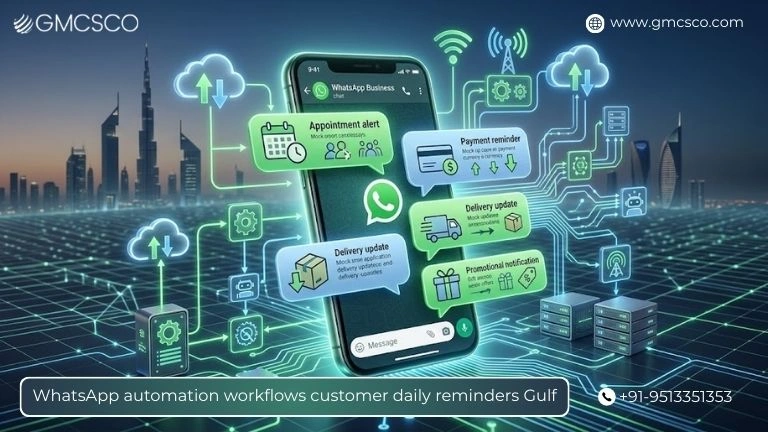
Why Businesses Are Struggling to Stay Consistent With Customer Communication
Every growing business eventually faces the same operational challenge.
Customers forget appointments.
Payments get delayed.
Service renewals are missed.
Follow ups depend heavily on manual teams.
In fast moving Gulf markets such as the UAE, Saudi Arabia, and Qatar, customer expectations have changed dramatically. Clients now expect instant communication, personalized reminders, and seamless service experiences across digital channels.
Yet many companies still rely on manual calls, emails that go unread, or scattered CRM alerts handled by overloaded staff.
This gap between customer expectation and operational execution creates revenue leakage that businesses rarely measure accurately.
This is where WhatsApp automation workflows for customer daily reminders in the Gulf are transforming how modern organizations operate.
Instead of chasing customers manually, intelligent automation ensures communication happens automatically, consistently, and at the right moment.
Businesses are no longer asking whether automation is necessary. They are asking how quickly they can implement it without disrupting operations.
Also Read About WhatsApp Business API for Gulf
The Real Operational Problems Businesses Face Today
Across industries in the Gulf region, decision makers consistently report similar challenges.
1. Missed Appointments and Low Attendance
Healthcare clinics, salons, consultants, and service providers lose daily revenue because customers forget bookings.
Manual reminder calls consume employee time and still fail to achieve consistency.
2. Payment Collection Delays
Finance teams spend hours sending reminders for invoices, subscriptions, or installment payments.
Delayed payments directly impact cash flow stability.
3. Customer Follow Up Breakdowns
Sales opportunities often disappear simply because follow ups were delayed or forgotten.
Human dependent systems rarely scale efficiently.
4. Rising Customer Acquisition Costs
When retention drops, businesses spend more on acquiring new customers instead of nurturing existing ones.
Automation directly solves this imbalance.
5. Communication Channel Fragmentation
Customers prefer WhatsApp, yet businesses still depend heavily on email or SMS systems that generate lower engagement.
In the Gulf, WhatsApp penetration exceeds most global markets, making it the most effective customer communication channel available today.
Many organizations begin improving customer engagement by evaluating AI automation solutions that integrate messaging directly with CRM and operational workflows.
Also Read About WhatsApp Business API Automation for Daily Updates in KSA
Why WhatsApp Automation Matters Especially in the Gulf Business Environment
The Gulf region presents unique digital behavior patterns.
Customers in the UAE and neighboring markets actively use WhatsApp for both personal and professional communication. Unlike Western markets where email dominates enterprise interaction, WhatsApp acts as a primary communication layer.
Several regional trends explain this shift.
Mobile First Business Culture
Executives, customers, and service users operate primarily through smartphones.
Multinational Customer Base
Businesses interact with diverse audiences speaking different languages. Automated workflows enable multilingual reminder systems without expanding teams.
High Service Expectations
Luxury retail, healthcare, real estate, logistics, education, and fintech sectors compete heavily on customer experience.
Daily reminders delivered intelligently improve satisfaction instantly.
Rapid Digital Transformation Initiatives
Governments across the Gulf actively encourage AI adoption and automation driven operations.
Companies adopting messaging automation early gain measurable competitive advantage.
What Are WhatsApp Automation Workflows for Customer Daily Reminders?
In simple terms, WhatsApp automation workflows are predefined communication processes that automatically send messages to customers based on specific triggers.
These triggers can include:
- Appointment schedules
- Payment due dates
- Subscription renewals
- Daily service reminders
- Delivery updates
- Customer onboarding steps
- Usage notifications
Instead of employees manually sending messages, automation platforms connected to the WhatsApp Business API execute communication automatically.
How the Workflow Works
A customer performs an action. The system detects the event.
Automation rules activate.
Personalized reminders are delivered instantly.
The experience feels human, timely, and helpful rather than promotional.
This is why automated WhatsApp reminders achieve significantly higher open and response rates compared to email campaigns.
Practical Example
A medical clinic in Dubai schedules patient appointments.
One day before the visit, the system sends an automated WhatsApp reminder.
Two hours before the appointment, another confirmation message is triggered.
If the patient requests rescheduling, the chatbot updates the system automatically.
No receptionist involvement required.
Operational efficiency increases immediately.
Businesses exploring customer engagement platforms should prioritize automation systems capable of integrating messaging workflows with internal databases and CRM platforms.
Also Read About WhatsApp chatbot for customer reminders
Real Business Use Cases Across Gulf Industries
Automation adoption is expanding rapidly across sectors.
Healthcare and Clinics
Daily appointment reminders
Medication reminders
Follow up consultation alerts
Lab report notifications
Healthcare providers report major reductions in no show rates.
Real Estate Companies
Property viewing reminders
Document submission alerts
Payment installment reminders
Investor communication updates
Real estate firms benefit from faster deal closures.
Education Institutions
Class reminders
Fee payment notifications
Parent communication updates
Student onboarding workflows
Automation improves administrative efficiency significantly.
Logistics and Delivery Businesses
Shipment updates
Delivery confirmations
Driver arrival alerts
Customer feedback requests
Customers stay informed without calling support teams.
Fitness and Wellness Centers
Membership renewal reminders
Session bookings
Trainer scheduling updates
Daily motivation engagement messages
Retention improves when engagement becomes consistent.
Step by Step Guide to Implement WhatsApp Reminder Automation
Organizations often assume automation implementation is complex. In reality, structured adoption simplifies the process.
Step 1: Identify Reminder Opportunities
Audit customer touchpoints where reminders improve outcomes.
Common areas include payments, appointments, onboarding, and renewals.
Step 2: Map Customer Journeys
Understand when customers need communication rather than when businesses want to send messages.
Timing determines success.
Step 3: Integrate WhatsApp Business API
Enterprise level messaging requires official API integration connected with business systems.
Step 4: Design Automation Workflows
Create trigger based communication flows such as:
- Daily reminders
- Escalation notifications
- Confirmation messages
- Follow ups
Step 5: Personalize Messaging
Include customer names, booking details, or account information.
Personalization increases engagement dramatically.
Step 6: Connect CRM and Data Systems
Automation works best when synced with customer databases.
Step 7: Monitor Performance Metrics
Track delivery rate, response rate, attendance improvement, and payment recovery speed.
Optimization becomes continuous.
Many companies accelerate adoption by consulting automation specialists who design workflows aligned with operational goals rather than generic messaging setups.
Business Benefits and Measurable ROI Impact
Executives care about outcomes, not technology buzzwords.
WhatsApp automation directly impacts core business metrics.
Increased Customer Attendance
Automated reminders reduce missed appointments by significant margins.
Faster Payment Cycles
Consistent reminders improve collection efficiency.
Reduced Operational Costs
Customer support teams handle fewer repetitive tasks.
Improved Customer Experience
Customers appreciate timely reminders that simplify their lives.
Scalable Communication
Businesses grow without proportionally increasing staff.
Higher Customer Retention
Regular communication builds long term relationships.
Better Data Insights
Automation platforms generate behavioral analytics that guide decision making.
In competitive Gulf markets, operational speed often determines market leadership.
Common Mistakes Businesses Make Without Proper Automation
Despite clear benefits, implementation mistakes remain common.
Treating WhatsApp Like Bulk Marketing
Reminder workflows should feel helpful, not promotional.
Lack of Workflow Strategy
Automation without customer journey mapping leads to message fatigue.
Ignoring Compliance Requirements
Businesses must follow approved messaging templates and consent rules.
Poor System Integration
Disconnected tools create inconsistent customer experiences.
Over Automation Without Human Escalation
Customers still need access to human support when required.
Balanced automation performs best.
Before deploying automation at scale, organizations should evaluate customer engagement architecture across sales, service, and operations teams.
Future Trends: Where WhatsApp Automation in the Gulf Is Heading
The next phase of messaging automation is already emerging.
AI Driven Conversational Reminders
Systems will adjust reminder timing based on customer behavior patterns.
Predictive Engagement
AI will anticipate missed payments or cancellations before they happen.
Voice and Multilingual Automation
Arabic, English, Hindi, and multilingual conversational AI will dominate Gulf markets.
Deep CRM Intelligence
Automation will connect marketing, operations, and finance communication into one ecosystem.
Hyper Personalization
Messages will adapt dynamically using real time customer data.
Companies investing today position themselves ahead of competitors still dependent on manual communication.
Also Read About High-volume WhatsApp automation
Frequently Asked Questions
Q: What is WhatsApp automation for customer reminders?
It is a system that automatically sends scheduled or trigger based reminders to customers through WhatsApp without manual intervention.
Q: Is WhatsApp automation allowed for businesses in the UAE?
Yes, businesses can legally use automation through official WhatsApp Business API providers while following consent and compliance policies.
Q: Which industries benefit most from reminder automation?
Healthcare, education, logistics, finance, real estate, hospitality, and subscription based businesses see strong results.
Q: Do automated reminders improve payment collections?
Yes. Businesses often experience faster payment completion due to timely reminders delivered on preferred communication channels.
Q: Can WhatsApp reminders integrate with CRM systems?
Modern automation platforms integrate directly with CRM, ERP, and booking software.
Q: Are customers comfortable receiving automated WhatsApp messages?
Yes, when messages are relevant, timely, and helpful rather than promotional.
Q: How long does implementation usually take?
Depending on complexity, deployment can range from a few days to several weeks.
Q: Can automation handle multilingual customers?
Yes. AI powered systems support multiple languages commonly used across Gulf markets.
Q: Is WhatsApp automation suitable for enterprise companies?
Enterprise organizations increasingly rely on automation to manage large scale customer communication efficiently.
Choosing the Right Implementation Partner for Automation Success
Technology alone does not guarantee results.
Successful automation depends on workflow strategy, system integration, compliance management, and ongoing optimization.
Businesses typically look for partners that understand Gulf market behavior, enterprise messaging infrastructure, and AI automation strategy.
An experienced implementation partner helps organizations design reminder workflows aligned with revenue outcomes instead of simply deploying chatbots.
Companies working with GMCSCO often focus on building scalable WhatsApp automation ecosystems that integrate customer engagement, CRM intelligence, and AI driven workflows into one operational framework.
If your organization is evaluating AI automation, WhatsApp chatbot services, or customer engagement platforms, consulting specialists who understand regional business operations can significantly reduce implementation risk and accelerate ROI realization. Teams at GMCSCO frequently guide enterprises through automation readiness assessments and workflow strategy planning.
The Strategic Shift Businesses Must Make Now
Customer communication is no longer a support function.
It has become a revenue driver.
Daily reminders powered by automation influence attendance, payments, renewals, loyalty, and customer satisfaction simultaneously.
Businesses across the Gulf are transitioning from reactive communication toward proactive engagement models.
Those who automate intelligently gain operational clarity and predictable customer behavior.
Those who delay continue absorbing hidden inefficiencies.
Conclusion: Automation Is Becoming the Backbone of Customer Engagement
WhatsApp automation workflows for customer daily reminders in the Gulf represent more than a messaging upgrade.
They signal a broader transformation in how businesses operate, scale, and compete.
Organizations adopting structured automation reduce manual workload, improve customer relationships, and unlock measurable efficiency gains across departments.
As AI driven communication continues evolving, companies that invest early build stronger digital infrastructure capable of supporting long term growth.
Forward thinking enterprises increasingly collaborate with experienced automation strategists such as GMCSCO to design future ready customer engagement systems that align technology with real business outcomes.
The opportunity is clear.
Consistent communication creates consistent revenue.
And intelligent automation makes that consistency possible at scale.
Disclaimer: This content is for general informational purposes only. Information may be sourced from AI tools, search engines, and trusted references. Please verify all details with official sources before making any business or legal decisions. We are not responsible for actions taken based on this content.