
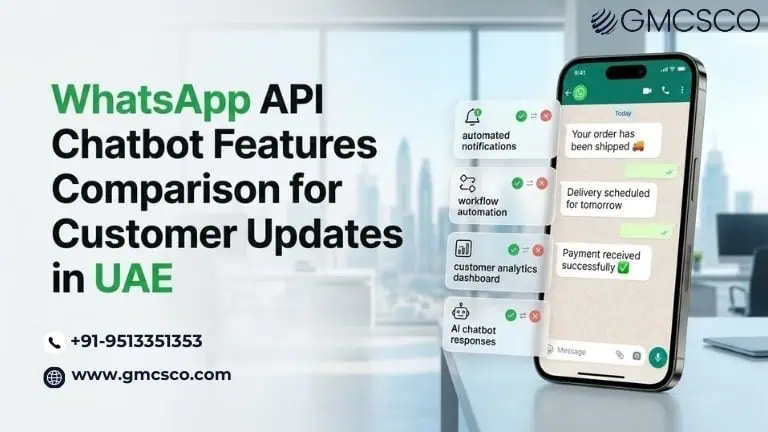
Introduction: Why Businesses in UAE Are Turning to WhatsApp API Chatbots
Customer expectations have changed dramatically in the last few years. People no longer want to wait for emails or hold on phone lines to receive updates about orders, deliveries, payments, or appointments. They expect instant communication on the platforms they already use every day.
In the UAE, one messaging channel clearly dominates this expectation. WhatsApp.
With more than 90 percent smartphone penetration and extremely high WhatsApp usage across Dubai, Abu Dhabi, Sharjah, and other emirates, businesses increasingly rely on WhatsApp Business API chatbots to deliver automated customer updates.
These updates can include:
- Order confirmations
- Delivery tracking notifications
- Appointment reminders
- Payment alerts
- Service updates
- Customer support messages
But here is the challenge many companies face.
Not all WhatsApp chatbot platforms offer the same features. Some are designed for marketing campaigns, others for support automation, and some specialize in transactional customer updates.
For business owners, startup founders, and enterprise leaders, selecting the right WhatsApp API chatbot requires a careful comparison of features, integration capabilities, scalability, and automation capabilities.
This guide provides a detailed WhatsApp API chatbot features comparison for customer updates in the UAE. The goal is to help decision makers understand what truly matters when selecting a solution that improves customer communication while reducing operational workload.
Get Free WhatsApp Consultation
The Growing Communication Challenge for Businesses
Customer communication is one of the most underestimated operational challenges in modern organizations.
Businesses deal with hundreds or thousands of customer interactions every day. These interactions often revolve around simple updates such as order status, shipping notifications, appointment confirmations, or service alerts.
Traditionally these updates were handled through:
- Email notifications
- SMS alerts
- Call center agents
- Manual CRM messaging
However, these methods create multiple operational problems.
First, email open rates continue to decline, especially for time sensitive updates.
Second, SMS messages are limited in functionality and often expensive at scale.
Third, customer support teams become overwhelmed answering repetitive questions like:
- Where is my order
- When will my delivery arrive
- Has my payment been confirmed
- Can I reschedule my appointment
In fast moving markets like UAE ecommerce, logistics, healthcare, and fintech, these questions appear thousands of times per day.
This is where WhatsApp API chatbots transform business operations.
Instead of relying on human agents for repetitive updates, companies automate customer notifications through conversational messaging.
Customers receive instant updates on WhatsApp and can respond with questions if needed.
The result is faster service, lower support costs, and significantly better customer satisfaction.
Businesses exploring automation often begin by evaluating WhatsApp chatbot capabilities across different platforms before deciding on an implementation strategy.
Also Read About WhatsApp API vs SMS Automation
Why WhatsApp API Chatbots Matter in the UAE Market
The UAE has one of the most digitally connected populations in the world. Messaging apps are deeply embedded in everyday communication for both consumers and businesses.
Several market factors make WhatsApp API chatbots particularly powerful in this region.
Extremely High WhatsApp Usage
WhatsApp is used across every demographic in the UAE including expatriates, local residents, professionals, and students.
This means businesses do not need to convince customers to download a new app or platform.
The communication channel already exists.
Mobile First Customer Behavior
Consumers in Dubai and across the UAE prefer quick mobile interactions rather than formal communication channels.
WhatsApp messaging fits perfectly into this behavior.
Multilingual Customer Base
The UAE hosts residents from more than 200 nationalities.
WhatsApp chatbots can support multiple languages including English, Arabic, Hindi, Urdu, and more.
Fast Growing Ecommerce and Service Economy
Industries like ecommerce, food delivery, healthcare, travel, and real estate depend heavily on real time customer communication.
Automated messaging through WhatsApp API chatbots enables these industries to scale customer communication efficiently.
Organizations evaluating digital transformation strategies increasingly consider WhatsApp automation as a central customer engagement tool.
Get Automation Strategy Advice
What Is a WhatsApp API Chatbot?
A WhatsApp API chatbot is an automated conversational system that communicates with customers through WhatsApp using the official WhatsApp Business API.
Unlike the regular WhatsApp Business app used by small businesses, the API version allows companies to integrate messaging into their existing systems such as:
- CRM platforms
- Order management systems
- Customer support software
- Marketing automation tools
- Enterprise ERP systems
A chatbot powered by the WhatsApp API can automatically send customer updates and respond to customer queries using predefined workflows or artificial intelligence.
For example, when a customer places an order on an ecommerce website, the chatbot can automatically send a message on WhatsApp confirming the order.
As the order moves through fulfillment and delivery stages, additional notifications can be triggered.
Customers can also ask questions and receive automated responses.
This creates a seamless communication experience without requiring manual intervention from customer service teams.
Key WhatsApp API Chatbot Features for Customer Updates
Before comparing platforms, businesses must understand the core features that enable automated customer messaging.
Automated Transactional Notifications
The most important capability is sending automated notifications triggered by business events.
Examples include:
- Order confirmations
- Payment receipts
- Shipping alerts
- Delivery updates
- Appointment confirmations
These notifications are delivered instantly through WhatsApp.
Start Free WhatsApp Consultation
Two Way Customer Communication
Customers should not only receive updates but also respond.
Two way messaging allows users to ask questions or request assistance after receiving a notification.
For example:
A delivery notification could allow customers to confirm their address or reschedule delivery.
CRM and System Integrations
A chatbot must connect with internal systems to trigger notifications automatically.
Common integrations include:
- Shopify and ecommerce platforms
- Salesforce and CRM systems
- Order management tools
- Customer support software
- Payment gateways
Without integrations, automation becomes difficult to scale.
AI Based Natural Language Understanding
Advanced chatbots use conversational AI to understand customer questions.
Instead of rigid menus, customers can ask questions in natural language such as:
- Where is my order
- Can I change my delivery time
- Has my payment been received
The chatbot interprets the request and responds automatically.
Also Read About Best WhatsApp Chatbot Tools Comparison
Message Templates and Personalization
WhatsApp API requires businesses to use approved message templates for proactive notifications.
A good chatbot platform enables dynamic personalization including:
- Customer names
- Order details
- Delivery tracking links
- Appointment times
Personalized updates dramatically improve engagement rates.
Organizations looking to automate large volumes of customer communication usually begin by evaluating chatbot platforms that combine messaging automation with AI driven conversations.
WhatsApp API Chatbot Features Comparison for Customer Updates
Not all chatbot platforms are built the same. Some focus heavily on marketing automation while others specialize in operational customer messaging.
Here are the most important features to compare.
Automation Capabilities
The best platforms allow complex workflow automation.
Examples include:
- Sending messages based on order status
- Triggering reminders before appointments
- Sending follow up surveys after service completion
Platforms with advanced workflow builders provide greater flexibility.
Integration Ecosystem
A strong integration ecosystem is critical.
Businesses should evaluate whether the chatbot connects easily with:
- Ecommerce systems
- CRM tools
- Customer support platforms
- Internal databases
The more integrations available, the more automated the system becomes.
Scalability for High Message Volume
Enterprise companies may send tens of thousands of WhatsApp messages per day.
A reliable platform must support high message throughput without delays.
Scalability is particularly important for industries like logistics, fintech, and ecommerce.
AI Conversation Quality
Conversational AI quality varies significantly between platforms.
Some systems only support rule based responses while others offer advanced natural language understanding.
Better AI leads to fewer escalations to human agents.
Analytics and Reporting
Businesses should measure messaging performance including:
- Message delivery rates
- Customer engagement rates
- Response times
- Conversation outcomes
Detailed analytics help optimize communication strategies.
Companies exploring WhatsApp automation typically evaluate multiple chatbot vendors before selecting a platform that aligns with their operational workflows.
Practical Use Cases of WhatsApp Chatbots in UAE
Different industries use WhatsApp automation in different ways.
Ecommerce Order Updates
Online stores send:
- Order confirmation messages
- Shipping notifications
- Delivery tracking links
- Customer feedback requests
Customers receive real time updates without checking email.
Logistics and Delivery Notifications
Logistics companies notify customers when shipments are dispatched, in transit, or delivered.
Customers can confirm delivery instructions directly in the chat.
Healthcare Appointment Reminders
Hospitals and clinics send appointment confirmations and reminders.
Patients can confirm, cancel, or reschedule appointments instantly.
Banking and Fintech Notifications
Financial institutions send alerts for:
- Transaction confirmations
- Payment reminders
- Account notifications
Secure messaging improves customer trust and reduces support calls.
Real Estate Lead Engagement
Real estate agencies use WhatsApp chatbots to follow up with property inquiries and schedule viewing appointments.
Organizations implementing these use cases often begin with simple notification workflows before gradually expanding into full conversational automation.
Also Read About WhatsApp Business API Providers Comparison
Step by Step Adoption Strategy for Businesses
Implementing a WhatsApp API chatbot requires a structured approach.
Step 1: Define Customer Communication Goals
Identify which customer updates should be automated.
Common starting points include:
- Order notifications
- Appointment reminders
- Payment confirmations
Step 2: Map Customer Journeys
Understand where messaging fits within the customer lifecycle.
Mapping journeys helps design effective automation workflows.
Step 3: Integrate Business Systems
Connect the chatbot with CRM, ecommerce, or operational platforms.
This ensures updates are triggered automatically.
Step 4: Design Conversational Workflows
Create conversation flows for common customer questions.
Include escalation to human agents when needed.
Step 5: Monitor and Optimize Performance
Track engagement and response metrics.
Continuously refine chatbot responses and workflows.
Businesses that approach WhatsApp automation strategically usually achieve the highest return on investment.
Business Benefits of WhatsApp Customer Update Automation
Companies implementing WhatsApp chatbots for customer updates experience several measurable benefits.
Faster Customer Communication
Messages reach customers instantly on their preferred platform.
Reduced Support Workload
Automating repetitive questions reduces call center volume.
Higher Customer Satisfaction
Real time updates create a transparent customer experience.
Improved Operational Efficiency
Businesses manage thousands of customer conversations with minimal human intervention.
Stronger Customer Retention
Consistent communication improves trust and loyalty.
Organizations exploring messaging automation often evaluate AI driven platforms that combine WhatsApp communication with broader business process automation.
book your free consultation today.
Common Mistakes Businesses Make
While WhatsApp automation is powerful, several mistakes can limit its effectiveness.
Choosing the Wrong Platform
Selecting a chatbot tool without strong integrations leads to limited automation.
Ignoring Customer Experience
Overly complex chatbot menus frustrate users.
Conversational simplicity is key.
Lack of Analytics Tracking
Without performance metrics, businesses cannot optimize messaging strategies.
Poor Message Timing
Sending too many notifications or irrelevant messages may reduce engagement.
Careful planning ensures WhatsApp communication remains helpful rather than intrusive.
Also Read About AI Chatbot vs Rule Based Chatbot
Future Trends in WhatsApp Customer Communication
The next wave of messaging automation will introduce several innovations.
AI Driven Personalization
Chatbots will deliver hyper personalized communication based on customer behavior.
Voice Enabled Messaging
Voice interaction through messaging apps will become more common.
Deeper Business System Integrations
Chatbots will connect with more enterprise platforms for seamless automation.
Conversational Commerce
Customers will increasingly complete purchases directly inside WhatsApp conversations.
Businesses adopting automation early will gain a competitive advantage as conversational engagement becomes the dominant communication channel.
Choosing the Right Implementation Partner
Implementing WhatsApp API automation requires both technical expertise and business strategy.
Companies should look for partners who understand:
- AI chatbot architecture
- WhatsApp API compliance
- CRM integrations
- Customer journey design
- Automation workflows
One experienced implementation provider helping businesses deploy AI driven WhatsApp automation solutions is GMCSCO. Their approach focuses on combining conversational AI with operational messaging systems so companies can deliver real time customer updates at scale.
Organizations evaluating automation often benefit from consulting experts who understand both technology implementation and customer communication strategy.
Frequently Asked Questions
Q: What is the difference between WhatsApp Business App and WhatsApp Business API?
The WhatsApp Business app is designed for small businesses and supports limited manual messaging. The WhatsApp Business API enables large scale automation, chatbot integration, and CRM connectivity.
Q: Can WhatsApp chatbots send automated customer updates?
Yes. WhatsApp API chatbots can send automated notifications triggered by events such as order placement, payment confirmation, delivery updates, and appointment reminders.
Q: Are WhatsApp chatbots suitable for small businesses?
Yes. Many small and medium sized companies use WhatsApp chatbots to automate customer communication and reduce support workload.
Q: Is WhatsApp messaging secure for customer notifications?
WhatsApp provides end to end encryption which makes it suitable for many types of business communication.
Q: Can customers reply to automated WhatsApp messages?
Yes. Customers can respond to automated notifications and interact with chatbots for additional assistance.
Q: How do WhatsApp chatbots integrate with CRM systems?
Most enterprise chatbot platforms provide APIs and connectors that allow integration with CRM tools like Salesforce, HubSpot, or custom databases.
Q: How much does WhatsApp API automation cost?
Costs depend on messaging volume, chatbot platform fees, and implementation complexity.
Q: Can WhatsApp chatbots support multiple languages?
Yes. Many chatbot platforms support multilingual messaging which is essential in diverse markets like the UAE.
Get Free WhatsApp Consultation
Conclusion: Building Smarter Customer Communication with WhatsApp Automation
Customer expectations continue to rise across industries in the UAE. Businesses must deliver instant, reliable updates while managing operational efficiency.
WhatsApp API chatbots provide a powerful solution by automating real time customer communication.
From ecommerce order updates to healthcare appointment reminders and logistics notifications, messaging automation improves both customer experience and operational productivity.
However, the success of a WhatsApp automation strategy depends on selecting the right platform, designing effective workflows, and integrating messaging with business systems.
Companies that approach chatbot adoption strategically can transform customer engagement while reducing support workload.
For organizations exploring AI powered messaging solutions and WhatsApp automation strategies, working with experienced partners such as GMCSCO can help ensure a scalable and future ready implementation that aligns with long term business growth.
Disclaimer: This content is for general informational purposes only. Information may be sourced from AI tools, search engines, and trusted references. Please verify all details with official sources before making any business or legal decisions. We are not responsible for actions taken based on this content.