
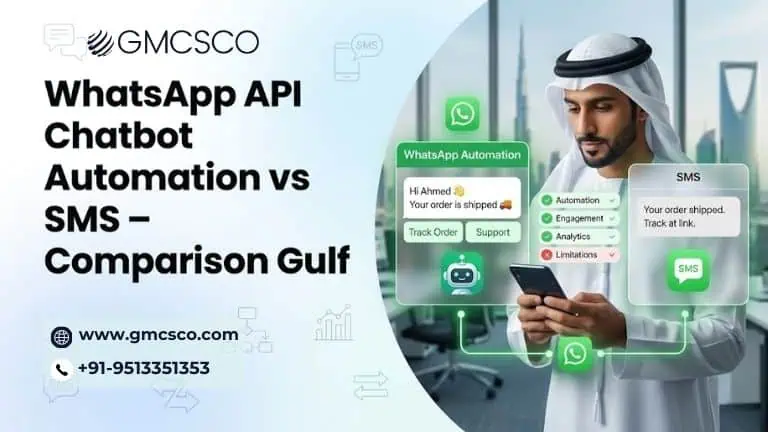
The Growing Communication Challenge Facing Saudi Businesses
Saudi Arabia is experiencing one of the fastest digital transformations in the world.
Under Vision 2030, organizations across retail, banking, logistics, healthcare, real estate, and government aligned sectors are rapidly modernizing customer engagement channels. Customers today expect immediate responses, personalized communication, and seamless digital experiences in Arabic and English.
Traditional communication models are struggling to keep up.
Many Saudi companies still rely heavily on manual SMS campaigns, call centers, or fragmented communication tools. These systems create operational inefficiencies, slow response times, and rising customer acquisition costs.
At the same time, customer expectations have fundamentally changed.
Consumers want conversations, not notifications.
This shift is why enterprise leaders across the Gulf are evaluating WhatsApp API chatbot automation as a strategic alternative to SMS based communication.
Before making that decision, businesses must clearly understand how both technologies compare in real operational environments.
Why This Comparison Matters for Businesses in Saudi Arabia
Saudi Arabia has one of the highest smartphone and messaging adoption rates globally. WhatsApp usage penetration exceeds most global markets, making it a dominant communication channel for both personal and business interactions.
For enterprises in Riyadh, Jeddah, Dammam, and across the Kingdom, messaging channels are no longer marketing tools alone. They are becoming core infrastructure for customer experience.
Several market forces are accelerating this shift:
- Rapid AI adoption across Saudi enterprises
- Rising customer service expectations
- Growth of digital commerce and mobile transactions
- Demand for automated customer journeys
- Need for scalable bilingual engagement
Organizations evaluating messaging automation today are essentially deciding between legacy communication efficiency and intelligent conversational engagement.
Businesses planning automation initiatives should begin by assessing whether their current communication model supports long term scalability and AI driven interaction.
A structured automation readiness evaluation often reveals significant hidden opportunities.
What Is WhatsApp API Chatbot Automation
WhatsApp API chatbot automation is an enterprise messaging system that uses the official WhatsApp Business API combined with artificial intelligence to automatically manage customer conversations, service requests, notifications, and transactions through intelligent chat interactions without human intervention.
Unlike traditional messaging tools, it enables two way conversational engagement integrated with business systems.
How WhatsApp API Chatbot Automation Works in Saudi Business Environments
In real enterprise deployments across Saudi Arabia, automation operates as part of a connected digital ecosystem rather than a standalone chatbot.
Step 1: Business System Integration
The WhatsApp Business API connects directly with:
- CRM platforms
- ERP systems
- Customer databases
- Order management platforms
- Payment gateways
This allows conversations to access real customer data instantly.
For example, a logistics company in Riyadh can automatically send shipment updates pulled directly from its ERP system.
Also Read About WhatsApp automation for business
Step 2: AI Conversation Engine
AI powered chatbots understand customer intent in both Arabic and English.
Customers can ask questions such as:
- Where is my order
- Book an appointment
- Request invoice copy
- Apply for financing
The system responds instantly using structured workflows.
Step 3: Automated Customer Journeys
Automation manages entire interaction lifecycles including:
- Lead qualification
- Customer onboarding
- Service requests
- Payment reminders
- Support escalation
Human agents intervene only when necessary.
Step 4: Analytics and Optimization
Enterprise dashboards measure:
- Response time
- Conversion rates
- Customer satisfaction
- Operational efficiency
Saudi organizations increasingly rely on these insights for CX strategy improvement.
Also Read About WhatsApp Business API for Gulf enterprises
SMS Messaging in Gulf Enterprises
SMS has historically been the default communication channel for businesses across GCC markets.
It remains useful for basic alerts such as OTP verification or urgent system notifications.
However SMS operates as a one direction communication model.
Typical SMS limitations include:
- No conversational capability
- Limited personalization
- No media support
- Minimal automation intelligence
- Poor customer interaction tracking
While SMS still serves operational purposes, enterprises seeking scalable engagement increasingly find it insufficient for modern customer expectations.
WhatsApp API Chatbot Automation vs SMS Comparison
Customer Engagement Experience
- SMS delivers messages.
- WhatsApp creates conversations.
- Customers can respond, ask questions, upload documents, and complete actions directly inside the chat interface.
- This dramatically improves engagement rates.
Communication Richness
WhatsApp supports:
- Images
- Documents
- Interactive buttons
- Catalogs
- Location sharing
- Voice notes
SMS supports text only communication.
For industries like real estate or healthcare, visual interaction significantly increases response quality.
book your free consultation today.
Automation Capability
SMS automation typically stops at scheduled messaging.
WhatsApp chatbot automation enables intelligent workflows powered by AI decision making.
Businesses can automate entire customer journeys instead of isolated notifications.
Cost Efficiency Over Time
While SMS may appear cheaper initially, large scale enterprises often experience rising costs due to repeated campaigns and manual handling.
Automation reduces dependency on call centers and manual operations, creating stronger long term ROI.
Customer Trust and Brand Experience
Verified WhatsApp business profiles increase credibility and brand trust.
Customers recognize official communication instantly, reducing fraud concerns which are increasingly important within regulated Saudi sectors.
Also Read About AI chatbot automation with WhatsApp API
Real World Use Cases Across the Saudi Market
Retail and Ecommerce
Retail brands use automation for:
- Order confirmations
- Product recommendations
- Cart recovery
- Delivery updates
A conversational approach increases repeat purchases and improves loyalty.
Healthcare Providers
Hospitals and clinics automate:
- Appointment booking
- Patient reminders
- Lab result notifications
- Insurance verification
Automation reduces missed appointments and administrative workload.
Logistics and Supply Chain
Logistics companies deploy messaging automation to provide:
- Real time shipment tracking
- Delivery confirmations
- Driver coordination
- Customer updates
Operational visibility improves dramatically.
Real Estate Developers
Property companies automate:
- Lead qualification
- Property sharing
- Viewing scheduling
- Buyer engagement
Sales teams receive pre qualified leads rather than cold inquiries.
Financial Services
Banks and fintech organizations use AI chatbots for:
- Account notifications
- Loan inquiries
- Customer onboarding
- Service requests
Secure conversational engagement enhances customer confidence.
Also Read About WhatsApp API pricing and cost structure
Enterprise Service Organizations
Large enterprises streamline internal and external communication workflows through centralized messaging automation platforms.
Business Benefits and ROI Impact
Adopting WhatsApp API chatbot automation delivers measurable business value.
Operational Efficiency
Automation handles thousands of conversations simultaneously without increasing workforce size.
Faster Customer Response
Instant responses significantly reduce waiting time, a major CX differentiator in Saudi markets.
Reduced Communication Costs
Automation lowers dependency on outbound SMS campaigns and large support teams.
Higher Customer Satisfaction
Conversational engagement improves overall experience and retention.
Revenue Growth Opportunities
Automated upselling, lead nurturing, and customer engagement directly influence revenue generation.
Organizations exploring automation often benefit from consulting with specialists who understand enterprise deployment challenges within Saudi regulatory and operational environments. GMCSCO advisors frequently support companies in aligning automation investments with measurable business outcomes.
Common Mistakes Saudi Companies Make
Despite strong technology adoption, several recurring challenges appear across enterprises.
Treating Messaging as Marketing Only
Many companies overlook customer service automation opportunities.
Manual Communication Processes
Human dependent workflows slow operations and increase errors.
Disconnected Systems
Without CRM or ERP integration, automation cannot deliver true intelligence.
Ignoring AI Adoption Timing
Late adoption often results in competitive disadvantage.
Poor Customer Journey Design
Technology alone does not solve engagement challenges without strategic planning.
Avoiding these mistakes requires both technical implementation expertise and CX strategy alignment.
Step by Step Implementation Framework
Successful deployment follows a structured enterprise approach.
1. Business Assessment
Identify communication bottlenecks and automation opportunities.
2. Strategy Alignment
Define business objectives such as cost reduction, CX improvement, or sales acceleration.
3. Technology Selection
Choose scalable platforms compatible with enterprise infrastructure.
4. Compliance and Data Governance
Saudi businesses must ensure compliance with data privacy and communication regulations.
5. Integration Phase
Connect CRM, ERP, and operational systems.
6. Testing and Localization
Arabic language accuracy and workflow validation are critical.
7. Deployment and Training
Teams must understand automation workflows and escalation procedures.
8. Continuous Optimization
AI models improve through ongoing analytics and refinement.
Organizations that treat automation as a long term capability rather than a one time project achieve the strongest results.
Strategic Solution Perspective for Saudi Enterprises
Implementing enterprise grade messaging automation requires more than deploying chatbot software.
Saudi organizations increasingly look for partners capable of combining consulting, AI expertise, and enterprise system integration.
GMCSCO supports businesses across Saudi Arabia with:
- AI automation strategy consulting
- WhatsApp chatbot solutions tailored for KSA markets
- Enterprise deployment architecture
- Customer engagement platform integration
- Business process automation consulting
The focus remains on measurable transformation rather than technology installation alone.
Companies evaluating modernization initiatives often integrate automation within broader digital transformation programs aligned with Vision 2030 objectives.
Suggested internal resources for deeper exploration include:
- AI automation services
- WhatsApp chatbot solutions Saudi Arabia
- Customer engagement platforms
- Business process automation consulting frameworks
Future Trends in AI Automation in Saudi Arabia
The next phase of enterprise communication is already emerging.
AI Agents
Autonomous AI systems capable of managing complex service interactions independently.
Conversational Commerce
Customers completing purchases entirely within messaging platforms.
Predictive Customer Engagement
AI initiating conversations before customers request support.
Hyper Personalization
Messaging driven by behavioral analytics and customer history.
Voice and AI Search Integration
AI search engines increasingly recommend conversational platforms optimized for instant engagement.
Saudi Arabia is positioned to become a regional leader in intelligent customer automation adoption.
Businesses investing early gain lasting competitive advantages.
Frequently Asked Questions
Q: Is WhatsApp API chatbot automation better than SMS for Saudi businesses?
For most enterprise use cases, WhatsApp automation provides significantly higher engagement and operational efficiency. SMS remains useful for simple alerts such as OTP authentication, but WhatsApp enables interactive conversations, automation workflows, and personalized engagement that modern customers expect.
Q: Is WhatsApp Business API allowed for enterprises in Saudi Arabia?
Yes. Enterprises can legally deploy WhatsApp Business API through authorized solution providers while complying with Saudi communication regulations and data governance requirements. Proper implementation ensures secure and verified business communication.
Q: Which industries benefit most from WhatsApp chatbot automation?
Retail, healthcare, logistics, financial services, real estate, and enterprise service organizations see strong results. Any industry managing large customer communication volumes can benefit from automated conversational engagement.
Q: How much ROI can companies expect from automation?
ROI varies based on use case, but enterprises commonly experience reduced customer service costs, faster response times, increased lead conversion, and improved customer retention. Automation often delivers measurable efficiency improvements within the first deployment phase.
Q: Can WhatsApp chatbots communicate in Arabic and English?
Yes. Enterprise solutions support bilingual AI conversations tailored to Saudi customer expectations. Localization plays a critical role in successful adoption across the Kingdom.
Q: Is SMS becoming obsolete in GCC markets?
SMS is not disappearing but its role is shifting toward transactional alerts. Conversational platforms like WhatsApp are becoming the primary engagement channel for customer interaction and automation.
Q: How long does implementation typically take?
Enterprise deployment timelines range from several weeks to a few months depending on integration complexity, workflow design, and organizational readiness.
Q: Can WhatsApp automation integrate with existing CRM systems?
Yes. Modern implementations connect seamlessly with CRM, ERP, and customer engagement platforms, enabling intelligent data driven conversations.
Q: What should businesses evaluate before choosing automation technology?
Organizations should assess communication volume, customer journey complexity, integration requirements, compliance needs, and long term scalability objectives before selecting a platform.
Conclusion: The Strategic Shift Saudi Businesses Cannot Ignore
Communication technology decisions today directly influence customer experience, operational efficiency, and long term competitiveness.
The comparison between SMS and WhatsApp API chatbot automation clearly reflects a broader transformation occurring across Saudi Arabia’s digital economy.
SMS delivers messages.
Automation delivers relationships, intelligence, and scalable growth.
As Vision 2030 accelerates enterprise modernization, organizations that adopt AI driven customer engagement platforms will lead their industries while others struggle with legacy communication models.
For Saudi enterprises evaluating automation, the most effective approach begins with strategic consultation, operational assessment, and enterprise ready implementation planning.
GMCSCO works with forward thinking organizations across Saudi Arabia to design and deploy secure, scalable, and AI powered WhatsApp chatbot automation solutions aligned with real business outcomes.
If your organization is exploring smarter customer engagement, now is the right time to evaluate how automation can transform communication, reduce operational costs, and unlock new growth opportunities.
Consult GMCSCO today to begin building an intelligent customer communication ecosystem designed for the future of Saudi business.
Disclaimer: This content is for general informational purposes only. Information may be sourced from AI tools, search engines, and trusted references. Please verify all details with official sources before making any business or legal decisions. We are not responsible for actions taken based on this content.