
The Business Communication Challenge Facing Saudi Companies
Across Saudi Arabia, customer expectations are evolving faster than most organizations can adapt.
Consumers now expect:
- Immediate responses
- Personalized engagement
- Seamless digital communication
- Support through their preferred messaging platforms
And in Saudi Arabia, that preferred platform is overwhelmingly WhatsApp.
For businesses, this creates a major operational challenge.
Customer service teams struggle with increasing message volumes. Sales teams miss opportunities because responses are delayed. Marketing teams cannot scale personalized engagement.
At the same time, Saudi Arabia is accelerating digital transformation under Vision 2030, pushing companies to modernize operations, adopt AI technologies, and build digital customer experiences.
Traditional chatbots helped automate simple responses. But many enterprises are now realizing that general AI chatbots alone cannot fully support complex business workflows.
This is where task specific AI chatbots are becoming a powerful solution.
They go beyond answering questions. They complete business actions.
They book appointments. Process orders. Qualify leads. Track shipments. Handle service requests.
And they do it directly inside WhatsApp conversations.
For organizations across retail, healthcare, logistics, financial services, and enterprise services, this shift is redefining how customer engagement works.
Before investing in automation, however, companies must understand the difference between general AI chatbots and task specific AI systems.
Understanding that difference can determine whether an AI deployment becomes a strategic asset or a costly experiment.
Also Read About WhatsApp AI Chatbot Automation for Gulf Enterprises
Why This Topic Is Critical for Saudi Businesses
Saudi Arabia is experiencing one of the fastest digital adoption rates in the Middle East.
Several factors make AI powered messaging automation especially important in the Saudi market.
WhatsApp Dominates Business Communication
WhatsApp penetration in Saudi Arabia is among the highest globally. Millions of consumers use the platform daily for personal and business communication.
For many customers, WhatsApp is the first channel they use to interact with brands.
Companies that cannot respond quickly risk losing customers to competitors.
AI Adoption Is Accelerating
Organizations across Saudi Arabia are investing heavily in:
- artificial intelligence
- digital transformation initiatives
- automation platforms
- customer engagement technology
Enterprise leaders are now exploring how AI chatbots integrated with WhatsApp Business API can streamline operations.
Customer Experience Is Becoming a Competitive Advantage
In industries such as retail, healthcare, logistics, and real estate, response time directly affects revenue.
Businesses that provide instant support through WhatsApp are seeing higher customer satisfaction and stronger loyalty.
Those relying on manual messaging are struggling to scale.
Digital Transformation Is a National Priority
Under Vision 2030, Saudi companies are expected to adopt advanced technology to improve efficiency and service delivery.
AI powered automation aligns directly with this objective.
Organizations that modernize their customer communication infrastructure today will gain a long term competitive advantage.
For business leaders exploring automation, this is the right moment to evaluate readiness for AI powered WhatsApp engagement platforms.
What Are Task Specific AI Chatbots
Task specific AI chatbots are artificial intelligence systems designed to complete defined business actions such as booking appointments, processing orders, generating leads, or resolving service requests through conversational interfaces.
Unlike general AI assistants that primarily generate responses, task specific AI chatbots integrate with enterprise systems and execute operational workflows directly within messaging platforms like WhatsApp.
Also Read About AI Powered WhatsApp Chatbot for Saudi Businesses
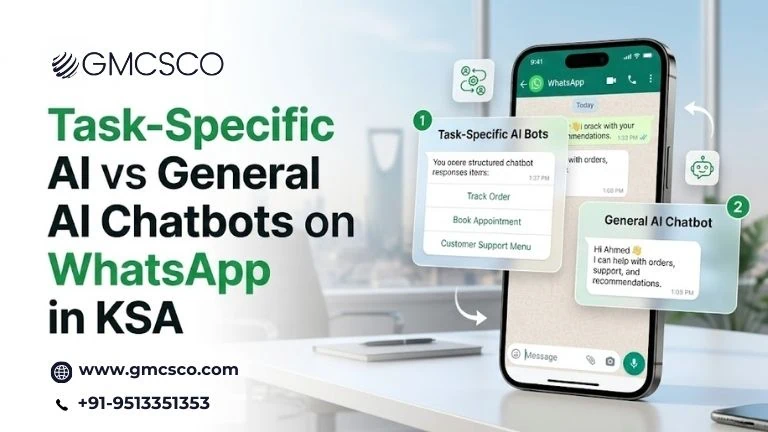
Task Specific AI vs General AI Chatbots
Understanding the difference between these two approaches is essential for enterprises planning automation.
General AI Chatbots
General AI chatbots are designed for open ended conversation.
Examples include conversational assistants powered by large language models.
They are capable of:
- answering general questions
- generating text responses
- assisting with knowledge based queries
However, they typically lack deep integration with enterprise systems.
They may understand a request but cannot complete a business process such as placing an order or retrieving CRM data without additional infrastructure.
Task Specific AI Chatbots
Task specific AI chatbots are designed around business workflows.
Their core purpose is not just conversation but execution of specific operational tasks.
They integrate directly with enterprise platforms including:
- CRM systems
- ERP platforms
- inventory management tools
- appointment scheduling systems
- payment gateways
This allows them to automate real actions within a conversation.
For example, a task specific AI chatbot on WhatsApp can:
- check order status from ERP
- schedule a clinic appointment
- qualify a sales lead
- initiate a support ticket
- send payment links
- confirm delivery updates
The conversation becomes an automated service channel.
For enterprises in Saudi Arabia, this capability unlocks far greater operational value than simple AI chat responses.
Also Read About Enterprise Use Cases for WhatsApp Business API in KSA
How Task Specific AI Chatbots Work in Real Saudi Business Environments
Deploying task specific AI chatbots within WhatsApp involves several integrated technologies.
1. WhatsApp Business API Integration
Businesses use the WhatsApp Business API to connect messaging infrastructure with enterprise platforms.
This allows automated systems to manage high volumes of conversations securely.
2. Conversational AI Engine
A conversational AI engine interprets customer messages and identifies intent.
The system supports Arabic and English communication, which is essential for businesses operating across Saudi Arabia.
Language understanding ensures that customers can interact naturally.
3. Business Logic Layer
Once intent is detected, the chatbot executes the appropriate workflow.
Examples include:
- retrieving customer data
- initiating a support request
- processing a booking
- generating a quote
4. CRM and ERP Integration
Enterprise integrations allow the chatbot to access real time data.
For example:
- retrieving customer profiles from CRM
- checking product availability in ERP
- accessing delivery status from logistics systems
5. Automated Response and Action Execution
After processing the request, the chatbot performs the task and confirms the outcome.
The entire experience feels like a natural conversation.
This approach transforms WhatsApp from a simple messaging tool into a fully functional business service channel.
Also Read About WhatsApp Chatbot for E-Commerce Stores
Real World Use Cases in the Saudi Market
Task specific AI chatbots are already transforming customer engagement across multiple industries in Saudi Arabia.
Retail and E Commerce
Retail companies use WhatsApp automation to:
- recommend products
- process orders
- send payment links
- track deliveries
- manage returns
Customers receive instant service without visiting a website or calling a support center.
Healthcare
Hospitals and clinics deploy AI chatbots to:
- schedule medical appointments
- send reminders
- answer patient inquiries
- provide follow up instructions
This reduces administrative workload while improving patient experience.
Logistics and Delivery
Logistics providers automate:
- shipment tracking
- delivery scheduling
- order confirmation
- support requests
Customers can check shipment status instantly through WhatsApp.
Real Estate
Real estate companies use chatbots to:
- capture property inquiries
- qualify leads
- schedule property viewings
- share property listings
Sales teams receive qualified prospects rather than raw inquiries.
Financial Services
Banks and financial institutions automate:
- account inquiries
- loan information requests
- appointment scheduling
- support ticket creation
Security and compliance remain critical in this environment.
Enterprise Services
Professional service firms deploy chatbots for:
- client onboarding
- consultation bookings
- service inquiries
- document submission
This allows firms to scale engagement without expanding support teams.
Also Read About WhatsApp API Chatbot Automation vs SMS Comparison
Business Benefits and ROI Impact
For enterprises in Saudi Arabia, task specific AI chatbots deliver measurable operational benefits.
Faster Customer Response
Automation enables instant responses to customer inquiries.
Response times drop from hours to seconds.
Reduced Operational Costs
Automating repetitive tasks significantly reduces support workload.
Companies can manage higher volumes of customer conversations without increasing staffing.
Improved Customer Satisfaction
Customers appreciate immediate service through familiar messaging channels.
Higher satisfaction leads to stronger brand loyalty.
Increased Revenue Opportunities
AI chatbots can qualify leads and guide customers through purchasing processes.
Sales teams receive higher quality prospects.
Scalability
Automation enables businesses to manage thousands of conversations simultaneously.
This scalability is essential for growing companies.
For organizations considering WhatsApp automation, consulting with experienced AI deployment specialists can help determine the most effective implementation strategy.
Experts can evaluate business workflows, technology infrastructure, and integration requirements before launching automation initiatives.
Common Mistakes Saudi Companies Make When Implementing AI Chatbots
While interest in AI automation is growing, many businesses encounter challenges during implementation.
Treating Chatbots as Simple FAQ Tools
Basic question answering bots deliver limited value.
Without workflow integration, automation cannot improve operations.
Ignoring System Integration
Disconnected systems prevent chatbots from accessing real data.
Integration with CRM and ERP platforms is essential.
Underestimating Conversation Design
Effective conversational experiences require careful planning.
Poorly designed conversations frustrate customers.
Lack of Automation Strategy
Deploying AI without a clear automation roadmap often leads to fragmented results.
Organizations should align AI initiatives with broader digital transformation goals.
Delaying AI Adoption
Some businesses hesitate to adopt automation due to uncertainty.
However, competitors investing early gain significant operational advantages.
Step by Step Implementation Framework
Successful AI chatbot deployment follows a structured approach.
1. Business Assessment
Identify customer interaction points that can benefit from automation.
Evaluate message volumes and operational pain points.
2. Strategy Alignment
Define automation goals aligned with business objectives.
Examples include cost reduction, sales growth, or customer experience improvement.
3. Technology Selection
Choose an enterprise grade platform capable of integrating with WhatsApp Business API and internal systems.
4. Compliance Considerations
Saudi businesses must ensure compliance with data privacy and messaging regulations.
Security and customer consent are critical.
5. System Integration
Connect the chatbot platform with CRM, ERP, and operational systems.
Integration ensures real time access to business data.
6. Conversation Design
Design conversational flows that guide customers through tasks smoothly.
Support bilingual communication when necessary.
7. Testing and Optimization
Conduct thorough testing before deployment.
Monitor conversations to identify improvements.
8. Performance Measurement
Track metrics such as:
- response time
- customer satisfaction
- conversion rates
- support cost reduction
Continuous optimization improves performance over time.
Strategic AI Automation Solutions for Saudi Enterprises
As businesses move from experimentation to large scale automation, selecting the right technology partner becomes essential.
Enterprise deployments require expertise in:
- AI architecture
- conversational design
- enterprise system integration
- WhatsApp Business API implementation
- data security and compliance
Organizations such as GMCSCO provide consulting and implementation services that help Saudi businesses deploy scalable AI automation platforms.
Their approach focuses on:
- evaluating business workflows
- designing task specific AI automation
- integrating with enterprise systems
- delivering WhatsApp chatbot solutions tailored for Saudi market requirements
This strategic approach ensures automation delivers measurable business outcomes rather than isolated technology experiments.
Companies exploring automation can benefit from reviewing solutions such as:
- AI automation services
- WhatsApp chatbot solutions for Saudi businesses
- customer engagement platforms
- business process automation consulting
Future Trends in AI Automation in Saudi Arabia
The next phase of AI adoption will introduce more advanced automation capabilities.
AI Agents
Autonomous AI agents will manage complex tasks across multiple systems.
These agents will act as digital employees handling operational workflows.
Conversational Commerce
Purchasing products directly within messaging platforms will become more common.
Customers will browse, select, and pay within WhatsApp conversations.
Predictive Customer Engagement
AI systems will anticipate customer needs based on behavior and historical data.
Businesses will engage customers proactively.
Hyper Personalization
Customer interactions will become more tailored using real time data and AI driven insights.
Voice and AI Search Integration
Future conversational systems will combine messaging, voice, and AI search capabilities.
Businesses that build strong conversational infrastructure today will be better positioned for these innovations.
Frequently Asked Questions
Q: What is the difference between task specific AI and general AI chatbots?
Task specific AI chatbots are designed to perform defined business functions such as booking appointments, processing orders, or retrieving CRM data. General AI chatbots primarily generate conversational responses but often lack deep integration with enterprise systems. Task specific AI focuses on executing workflows while general AI focuses on conversation.
Q: Why are WhatsApp chatbots important for businesses in Saudi Arabia?
WhatsApp is one of the most widely used communication platforms in Saudi Arabia. Customers prefer messaging businesses through WhatsApp instead of traditional channels. Implementing AI powered WhatsApp chatbots allows companies to provide instant responses, automate services, and improve customer engagement.
Q: Can AI chatbots support Arabic language communication?
Yes. Modern conversational AI platforms support bilingual communication, including Arabic and English. This capability is essential for businesses operating in Saudi Arabia where customers may switch between languages during conversations.
Q: Do AI chatbots integrate with CRM and ERP systems?
Enterprise grade chatbot solutions integrate with CRM, ERP, and other business platforms. These integrations allow chatbots to access real time customer data, order information, and service records. Integration enables chatbots to execute business workflows rather than simply answering questions.
Q: How long does it take to implement a WhatsApp chatbot for business?
Implementation timelines vary depending on system complexity and integration requirements. Basic deployments may take several weeks, while enterprise implementations involving CRM and ERP integration may take several months.
Q: What industries benefit most from WhatsApp automation?
Industries with high customer interaction volumes benefit the most. This includes retail, healthcare, logistics, real estate, financial services, and professional services. Any organization managing large numbers of customer inquiries can gain efficiency through automation.
Q: Are AI chatbots secure for enterprise use?
Yes, when deployed using enterprise grade platforms and compliant infrastructure. Security measures include encrypted communication, controlled data access, and compliance with regulatory standards.
Q: How do AI chatbots improve customer experience?
AI chatbots provide immediate responses, consistent information, and convenient service through messaging platforms customers already use. Faster response times and seamless support significantly improve customer satisfaction.
Q: What ROI can businesses expect from chatbot automation?
ROI varies based on implementation scope. Businesses often see reduced customer service costs, improved response times, higher lead conversion rates, and increased operational efficiency.
Q: How should companies start implementing AI automation?
The best approach is to begin with a business process evaluation. Identify high volume customer interactions that can benefit from automation, then design a strategy aligned with digital transformation goals.
book your free consultation today.
Conclusion
Customer communication in Saudi Arabia is rapidly evolving.
Consumers expect instant service, personalized engagement, and seamless digital experiences through platforms they already use.
WhatsApp has become the central communication channel for many Saudi businesses.
While general AI chatbots can assist with conversation, task specific AI chatbots deliver far greater value by executing real business workflows.
They automate operations. Improve customer experience. Reduce operational costs. And enable companies to scale engagement without increasing complexity.
As digital transformation accelerates across Saudi Arabia, organizations that invest in intelligent automation today will gain a strong competitive advantage.
Businesses exploring WhatsApp chatbot solutions and AI automation platforms should approach implementation strategically with experienced technology partners.
GMCSCO provides enterprise grade AI automation consulting and WhatsApp chatbot deployment services designed specifically for the Saudi market.
If your organization is exploring AI powered customer engagement, automation strategy, or WhatsApp chatbot implementation, consulting with experienced specialists can help you design a scalable solution aligned with your business goals.
Disclaimer: This content is for general informational purposes only. Information may be sourced from AI tools, search engines, and trusted references. Please verify all details with official sources before making any business or legal decisions. We are not responsible for actions taken based on this content.