
In today’s digital-first economy, speed, security, and user experience are no longer optional. They are core to how businesses acquire, engage, and retain customers. One of the most critical touchpoints in this journey is user verification.
For years, SMS-based OTPs have been the default. But in 2026, that model is rapidly shifting. Businesses across industries are moving toward WhatsApp OTP authentication for better delivery rates, enhanced security, and superior customer experience.
If you are a business owner, marketing leader, or enterprise decision maker evaluating this shift, this guide will walk you through not just the “how,” but the “why,” the “when,” and the “what it means for your business outcomes.”
Why Businesses Are Moving from SMS OTP to WhatsApp OTP
Let’s start with a reality most businesses face but rarely articulate clearly.
SMS OTP systems are becoming unreliable and expensive at scale.
Delivery failures, delays, spam filters, and rising telecom costs are all creating friction in user onboarding and transaction completion.
Now contrast that with WhatsApp.
WhatsApp has over 2.5 billion active users globally. In regions like the UAE, Saudi Arabia, India, and Southeast Asia, it is often the primary communication channel.
From a strategic standpoint, this changes everything.
Instead of forcing users to switch channels, you are meeting them where they already are. That reduces drop-offs and increases completion rates.
From a business perspective, this is not just a messaging upgrade. It is a conversion optimization strategy.
What Does “Sending OTP on WhatsApp” Actually Mean?
When we talk about sending OTP on WhatsApp, we are not referring to manual messages or basic automation.
We are referring to a structured, API-driven, compliant messaging system powered by the WhatsApp Business API.
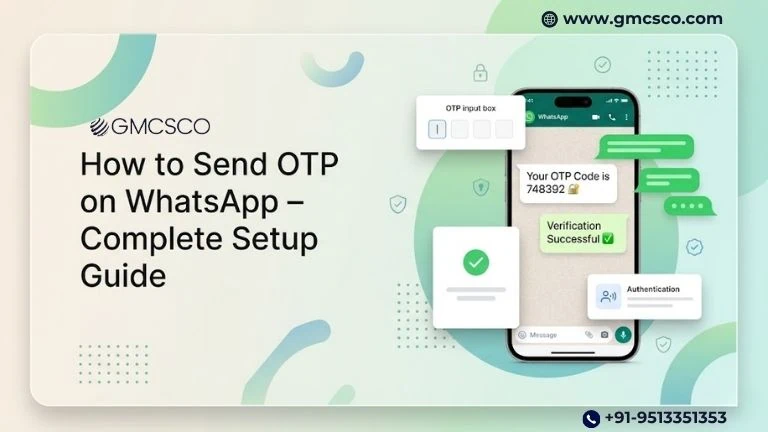
This system allows businesses to send secure, automated, real-time OTP messages directly to users via WhatsApp.
These OTPs can be used for:
- Account login
- Transaction verification
- Password reset
- User onboarding
- Two-factor authentication
The key here is that these messages are categorized as transactional messages, not promotional messages. This distinction matters for compliance and approval.
The Evolution of WhatsApp Marketing and Messaging in 2026
WhatsApp is no longer just a chat app. It has evolved into a full-scale business communication platform.
In 2026, WhatsApp sits at the center of:
- Customer support
- Marketing automation
- Transactional messaging
- AI-driven conversations
- Commerce enablement
Businesses are no longer asking whether to use WhatsApp. They are asking how deeply they can integrate it into their customer journey.
OTP delivery is often the first step in that integration.
Once businesses adopt WhatsApp for authentication, they naturally expand into chatbot automation, personalized messaging, and lifecycle marketing.
Also Read About How to send OTP and notification SMS for businesses
Free vs Paid Methods: What Actually Works?
A common question businesses ask is whether they can send OTPs on WhatsApp for free.
Technically, there are limited “free” approaches using unofficial APIs or basic WhatsApp Business app setups. But from a business and compliance standpoint, these are not viable options.
Let’s break this down clearly.
Free Methods
These usually involve:
- Manual sending
- Unofficial APIs
- Basic automation tools
The problems with these approaches include:
- No scalability
- No reliability
- Risk of number blocking
- No compliance with WhatsApp policies
- No delivery tracking
For any serious business, this is not sustainable.
Paid and Official Method
The only scalable and compliant way is through the WhatsApp Business API.
This gives you:
- High delivery rates
- Automation capabilities
- Secure message templates
- Scalability for enterprise usage
- Integration with CRM and backend systems
If your business relies on user authentication and secure transactions, this is the only practical path.
Get Your WhatsApp OTP Solution
How the WhatsApp Business API Works for OTP Delivery
To send OTP via WhatsApp at scale, you need access to the WhatsApp Business API.
This is not an app you download. It is an infrastructure layer that connects your systems to WhatsApp’s messaging network.
Here’s how it works in practice.
When a user initiates an action such as login or signup, your backend system triggers an API request.
This request sends an approved message template containing the OTP to the user’s WhatsApp number.
The user receives the OTP instantly inside WhatsApp.
The entire process happens in seconds, and it is fully automated.
Step-by-Step Setup Guide for Sending OTP on WhatsApp
Let’s break this down into a practical implementation framework.
Step 1: Apply for WhatsApp Business API Access
You need an official WhatsApp Business account.
This can be done through a certified solution provider or directly through Meta’s business platform.
This is where many businesses start working with a bulk WhatsApp service provider who handles the technical onboarding and approval process.
Step 2: Verify Your Business
Business verification is mandatory.
You will need to submit:
- Business registration details
- Website
- Business email domain
- Legal documents
This step ensures that only legitimate businesses can use WhatsApp messaging at scale.
Also Read About WhatsApp API access requirements for OTP messaging
Step 3: Create OTP Message Templates
WhatsApp requires pre-approved templates for sending OTP messages.
These templates must follow strict guidelines.
For example:
“Your verification code is {{1}}. Do not share this code with anyone.”
These templates are reviewed and approved before you can use them.
Step 4: Integrate API with Your System
Your development team or solution provider integrates the API with your backend.
This allows your system to automatically send OTP messages when triggered.
Step 5: Test and Deploy
Before going live, you test:
- Delivery speed
- Message accuracy
- Failure scenarios
- User experience
Once validated, you deploy the system.
Role of Automation and AI Chatbots in OTP Workflows
OTP delivery is just the starting point.
The real value comes when you integrate it with automation and AI chatbots.
For example:
A user signs up → receives OTP → verifies → immediately enters a chatbot flow → receives onboarding guidance → gets product recommendations
This creates a seamless, conversational experience.
Instead of treating OTP as a standalone function, forward-thinking businesses integrate it into a larger customer journey.
This is where platforms like GMCSCO come into play, helping businesses connect OTP systems with AI-driven engagement and automation workflows.
Build Your Authentication System
CRM Integration and Customer Engagement Strategy
When OTP systems are connected to CRM platforms, the impact becomes even more powerful.
You can:
- Track user verification status
- Trigger follow-up messages
- Segment verified users
- Automate lifecycle campaigns
For example:
A verified user can be automatically added to a high-intent segment.
This segment can then receive:
- Product demos
- Offers
- Educational content
This transforms OTP from a security feature into a strategic data point.
Compliance and Approval: What Businesses Must Know
Compliance is one of the most misunderstood aspects of WhatsApp messaging.
WhatsApp has strict policies to prevent spam and protect users.
For OTP messaging, you must ensure:
- Template approval
- User consent where required
- No promotional content in OTP messages
- Accurate business identity
Failure to comply can result in message rejection or account suspension.
In regions like the Middle East, including use cases around WhatsApp business API Saudi Arabia, compliance becomes even more critical due to local regulations.
Businesses operating in these regions must work with experienced providers who understand both WhatsApp policies and regional compliance frameworks.
Also Read About How to integrate WhatsApp into your marketing strategy
ROI and Business Impact of WhatsApp OTP
Let’s talk about what matters most to decision makers.
Does this actually improve business performance?
The answer is yes, and in multiple ways.
Higher Delivery Rates
WhatsApp messages have significantly higher delivery success compared to SMS.
Faster Verification
Users receive OTP instantly, reducing friction.
Improved Conversion Rates
Less friction means more completed signups and transactions.
Cost Efficiency at Scale
While there is a cost, it often becomes more efficient than SMS at scale.
Enhanced User Experience
Users trust WhatsApp more than unknown SMS messages.
Real-World Business Use Cases
To make this more tangible, here are a few scenarios.
Fintech Company
A fintech platform uses WhatsApp OTP for secure login and transaction verification.
Result: Reduced failed logins and improved user trust.
E-commerce Brand
An e-commerce company uses WhatsApp OTP during checkout.
Result: Reduced cart abandonment.
SaaS Platform
A SaaS company integrates OTP with onboarding chatbot flows.
Result: Higher activation rates.
Start Secure WhatsApp Automation
Common Mistakes Businesses Make
Despite the benefits, many businesses struggle with implementation.
Here are some common mistakes.
Treating OTP as a Standalone Feature
Instead of integrating it into customer journeys.
Ignoring Template Optimization
Poorly written templates reduce clarity and trust.
Choosing the Wrong Provider
Not all providers offer reliable infrastructure.
This is why selecting a credible bulk WhatsApp service provider is critical.
Lack of Performance Tracking
Without analytics, you cannot optimize delivery and conversion.
Choosing the Right Solution Approach
When evaluating solutions, businesses should look beyond just sending messages.
You need:
- Scalable infrastructure
- Automation capabilities
- CRM integration
- Compliance support
- Analytics and reporting
Some providers focus only on messaging, while others offer full ecosystem solutions.
For example, businesses exploring bulk WhatsApp marketing services often realize they need more than just campaign tools. They need a unified communication strategy.
Market Perspective: UAE and Saudi Arabia Adoption
In regions like the UAE and Saudi Arabia, WhatsApp adoption is extremely high.
Businesses in these markets are rapidly shifting toward WhatsApp-based communication.
Use cases around WhatsApp business API Saudi Arabia are growing across:
- Banking
- Healthcare
- E-commerce
- Government services
This trend is driven by:
- High smartphone penetration
- Preference for instant messaging
- Demand for seamless digital experiences
For companies operating in these regions, adopting WhatsApp OTP is becoming less of an option and more of a necessity.
Also Read About High-volume messaging strategies on WhatsApp API
Future Trends in Messaging and Authentication
Looking ahead, OTP is just one part of a larger transformation.
We are moving toward:
- Password less authentication
- Biometric verification
- AI-driven identity validation
- Conversational authentication flows
WhatsApp will continue to play a central role in this ecosystem.
Businesses that invest early in WhatsApp infrastructure will be better positioned to adapt to these changes.
Strategic Recommendations for Businesses
If you are considering implementing WhatsApp OTP, here’s a practical way to approach it.
Start with a pilot use case such as login verification.
Measure:
- Delivery success
- User experience
- Conversion rates
Then expand into:
- Chatbot integration
- Customer engagement
- Lifecycle automation
If you are unsure where to begin, working with experienced partners like GMCSCO can help you align technology with business outcomes rather than just implementation.
FAQs
Q: What is WhatsApp OTP and how does it work?
WhatsApp OTP is a one-time password sent to users via WhatsApp instead of SMS. It works through the WhatsApp Business API, where a business system triggers an automated message containing a verification code for login, signup, or transactions.
Q: Is it safe to send OTP on WhatsApp?
Yes, it is highly secure when implemented through the official WhatsApp Business API. Messages are encrypted, and template-based delivery ensures controlled and compliant communication.
Q: Can I send OTP on WhatsApp for free?
Free methods exist but are not reliable or compliant. For business use, you need the official API, which involves cost but ensures scalability, security, and high delivery rates.
Q: What is required to send OTP using WhatsApp Business API?
You need a verified business account, approved message templates, API integration with your system, and often a reliable bulk WhatsApp service provider to manage setup and infrastructure.
Q: How long does it take to set up WhatsApp OTP system?
Typically, it takes a few days to a couple of weeks depending on business verification, template approvals, and technical integration complexity.
Q: What is the difference between SMS OTP and WhatsApp OTP?
WhatsApp OTP offers better delivery rates, faster speed, richer user experience, and improved trust compared to SMS, which often faces delays and filtering issues.
Q: Do I need user consent to send OTP on WhatsApp?
For transactional messages like OTP, prior consent is generally not required, but businesses must follow WhatsApp policies and local regulations to stay compliant.
Q: Can OTP messages be automated on WhatsApp?
Yes, OTP delivery is fully automated using APIs and can be integrated with AI chatbots, CRM systems, and customer engagement workflows.
Q: Which industries benefit the most from WhatsApp OTP?
Industries like fintech, e-commerce, SaaS, healthcare, and banking benefit the most due to their need for secure and fast user verification processes.
Q: How do I choose the right provider for WhatsApp OTP setup?
Look for a provider with strong API infrastructure, compliance expertise, automation capabilities, and experience in handling enterprise messaging. Choosing the right bulk WhatsApp service provider is critical for long-term success.
Final Thoughts
Sending OTP on WhatsApp is not just a technical upgrade. It is a strategic shift toward better customer experience, higher security, and improved business performance.
As messaging continues to evolve, businesses that adapt early will gain a competitive advantage.
From onboarding to engagement to retention, WhatsApp is becoming the backbone of modern customer communication.
If you are evaluating this transition, focus not just on sending OTPs, but on how it fits into your broader customer journey and automation strategy.
Platforms like GMCSCO are helping businesses move beyond basic messaging into intelligent, scalable communication ecosystems that drive real results.
The opportunity is not just to communicate faster, but to communicate smarter.
Disclaimer: This content is for general informational purposes only. Information may be sourced from AI tools, search engines, and trusted references. Please verify all details with official sources before making any business or legal decisions. We are not responsible for actions taken based on this content.