
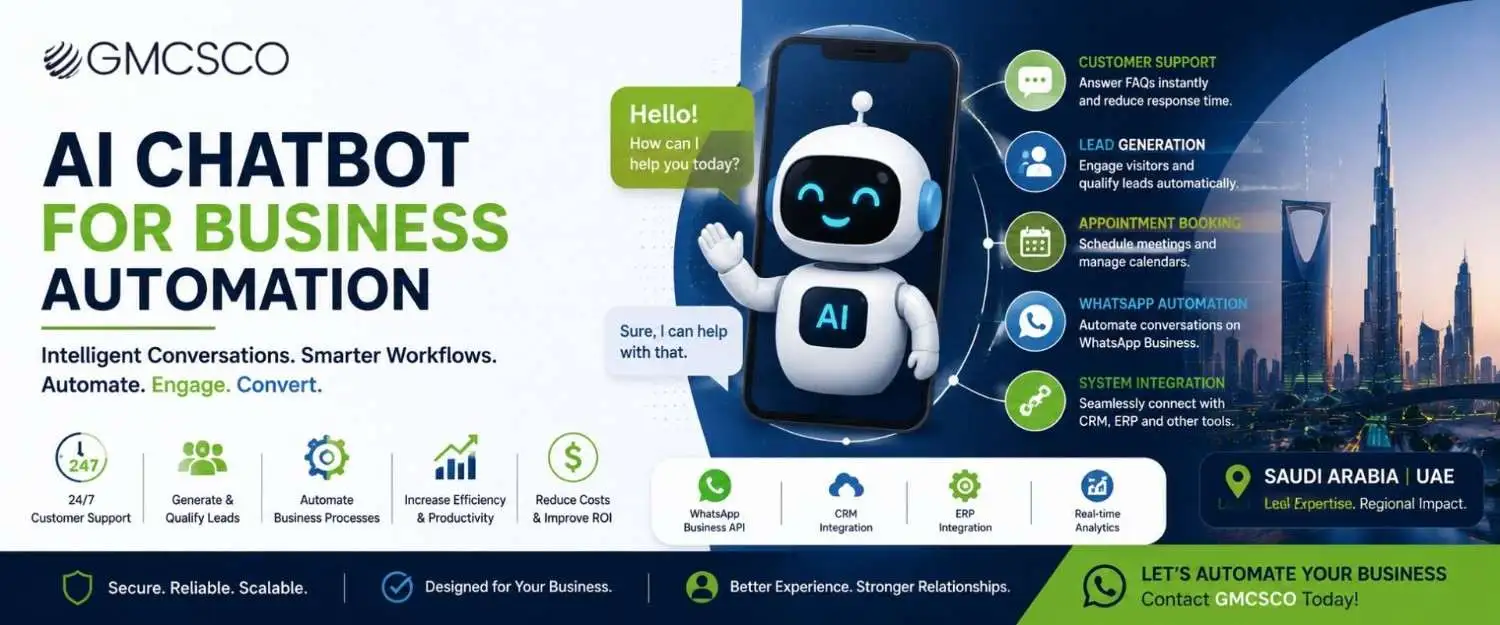
🤖 AI Business Automation — 2026
AI Chatbot for Business Automation: The Complete 2026 Guide for Saudi Arabia & UAE
20 ways an AI chatbot becomes an intelligent business automation layer — not just a customer service widget.
Quick Answer
An AI chatbot for business automation is a software system that uses artificial intelligence and conversational interfaces to handle repetitive business interactions, understand customer requests, provide information, collect data, qualify leads, and trigger business workflows. Unlike a basic rule-based chatbot limited to predefined buttons, an AI chatbot understands natural language and responds according to the customer’s intent. The strategic objective isn’t simply to “add AI” — it’s to reduce repetitive work, improve response times, capture opportunities, and make operations more scalable.
Beyond Fixed Rules
Traditional automation followed fixed rules — if a form is submitted, send an email. But a customer might type “I need a quotation for your WhatsApp API solution for our company in Riyadh, and we also need CRM integration.” A traditional chatbot may struggle if the exact phrase wasn’t programmed. An AI chatbot understands the broader intent — Service: WhatsApp Business API, Requirement: CRM integration, Location: Riyadh, Intent: Commercial enquiry — and starts the appropriate workflow, becoming an intelligent interface connecting customers, employees, CRM systems, and business processes.
Why AI Chatbots Matter in 2026
Saudi Arabia’s latest Internet Report shows 99.6% internet penetration, 61.3% of users online seven or more hours daily, and 45.2% AI tool adoption — more than double the previous year — with ChatGPT the most downloaded AI application, followed by Google Gemini, DeepSeek, Grok, and Microsoft Copilot. SDAIA’s strategies explicitly highlight business efficiency, productivity, automation, and human decision support as key AI objectives. The UAE Strategy for Artificial Intelligence similarly aims to improve government performance and build an integrated smart digital system, positioning the UAE as a leading market for AI investment. The practical question for businesses: how can AI connect to real processes instead of remaining a conversational experiment?
Chatbot vs AI Chatbot
📋 Traditional Chatbot
Follows predefined rules and button paths — works well when customers follow the expected menu.
🤖 AI Chatbot
Interprets natural language — “we need WhatsApp API for 20 sales agents and want CRM integration” gets understood and routed correctly.
| Capability | Rule Based Chatbot | AI Chatbot |
|---|---|---|
| Predefined FAQs | Yes | Yes |
| Natural language | Limited | Stronger |
| Intent detection | Basic | Advanced |
| Complex questions | Limited | Better suited |
| Lead qualification | Rules | AI + rules |
| Personalization | Limited | More flexible |
| CRM integration | Possible | Possible |
| Human handover | Yes | Yes |
| Business workflow automation | Yes | Yes |
| Learning from business data | Limited | Depends on architecture |
The best enterprise systems don’t necessarily choose one over the other — a hybrid approach can combine AI understanding with deterministic workflows for important business processes.
How AI Chatbots Automate Business Processes
Customer
AI Chatbot
Intent Detection
Business Logic
CRM / ERP
Workflow
20 Ways AI Chatbots Automate Business
1. Automate Customer Support
Working hours, location, services, appointments, order tracking, required documents — an AI chatbot handles routine questions instantly, transferring complex requests to a human. AI handles repetitive communication; humans handle complex conversations.
2. Automate Lead Generation
Instead of a static Name/Email/Phone form, the AI has a conversation: “What service are you interested in?” → “SEO and Google Ads” → “Which market?” → “Saudi Arabia” → “What type of business?” → “B2B technology” — the system now classifies the enquiry with far more useful information for the CRM and sales team.
💬 Turn Conversations Into Qualified Leads
Want an AI chatbot that can capture and qualify leads automatically? Chat with GMCSCO about your business workflow.
3. Automate Lead Qualification
Questions built around the Ideal Customer Profile — company size, industry, location, budget range, timeline — let the system categorize leads as High Priority (immediate sales notification), Qualified (sales pipeline), Nurture (relevant information), or Not a Fit, so sales spends time where it matters most.
4. Automate Sales Conversations
An AI sales chatbot can explain services, compare options, identify requirements, capture contact information, recommend next steps, and book meetings — while never making unsupported promises or pretending to be human, handing over to a person when needed.
5. Automate Appointment Booking
“I want to book a consultation next week” → which service, preferred date, time, name, contact — then connects with the scheduling system where integrated. Useful across healthcare, dental, consulting, education, real estate, and travel.
6. Automate WhatsApp Customer Communication
The Saudi Internet Report lists WhatsApp at 92.7% usage — the official WhatsApp Business Platform is built for medium and larger businesses to communicate programmatically at scale. The bigger opportunity isn’t automated replies — it’s WhatsApp → AI chatbot → Lead qualification → CRM → Sales as a connected conversational workflow.
7. Connect AI Chatbots With CRM
The AI identifies the customer → checks the CRM → finds previous interactions → understands the current requirement → updates the record → creates a sales task. Without CRM integration, useful conversations remain isolated; with it, they become part of the sales process.
8. Connect AI With ERP and Business Systems
Beyond CRM, chatbots can connect with ERP, inventory systems, order management, booking systems, and helpdesk platforms — “Is Product A available?” routes through the AI to the inventory system and back, eliminating unnecessary manual checks.
9. Automate Internal Employee Support
Employees asking about leave policy, sales documents, or the customer onboarding process can get answers from an internal AI assistant searching approved knowledge sources — reducing repetitive questions to HR, IT, and operations.
10. Automate HR Processes
Company policies, leave procedures, benefits, onboarding, and training questions get answered from approved company information, with sensitive or complex cases routed to HR — particularly useful for larger organizations with multiple departments.
11. Automate IT Support
“I cannot access my account” or “how do I connect to the VPN” gets approved troubleshooting steps immediately; unresolved issues create or route a support ticket — Employee → AI Assistant → Troubleshooting → Ticket → IT Team instead of Employee → Email → Wait → IT Response.
12. Automate FAQs Without a Poor Experience
A good chatbot complements the website rather than replacing its information architecture — concise answers for simple questions, and relevant pages, case studies, or a human contact option for complex topics.
13. Use AI for Multilingual Communication
A customer starting in Arabic gets Arabic responses; switching to English continues seamlessly. Multilingual automation should be tested carefully — literal machine translation isn’t always sufficient for professional, natural Arabic business communication.
14. AI Chatbots for Saudi Arabia
45.2% AI tool adoption, with tools used primarily for information search, idea generation, and education — work-related tasks account for 17.3% of usage. SDAIA describes AI as improving business efficiency, quality, productivity, and decision support, extending chatbot applications beyond support into lead generation, sales, HR, IT, and WhatsApp automation.
15. AI Chatbots for UAE Businesses
The UAE Strategy for Artificial Intelligence aims to improve government performance and create economic value from AI investments; Dubai’s Universal Blueprint for AI aims to accelerate adoption across strategic sectors — customer experience, sales, real estate, healthcare, financial services, and logistics.
16. Automate Customer Follow Up
Day 0 request received, Day 1 check if more information is needed, Day 3 provide a resource, Day 7 offer a consultation — timing based on the customer journey and applicable messaging requirements, never becoming excessive.
17. Automate Customer Feedback
“How would you rate your experience?” — responses get categorized Positive, Neutral, or Negative, with serious issues escalated to the appropriate team, helping businesses identify recurring problems.
18. Use AI for Customer Intent Detection
“I want pricing,” “can someone call me,” “I need help with my order,” “I need your enterprise solution” — each triggers a different workflow: Pricing → Sales, Support → Customer Service, Enterprise → Senior Sales — improving routing and reducing manual sorting.
19. Build AI Powered Lead Scoring
With 500 enquiries, the system evaluates service requirement, company size, engagement, and requested timeline to help sales identify higher priority opportunities — decision support, not an unquestionable automated judgment.
20. AI Chatbots and Business Scalability
A team can manage 100 conversations a day manually; 1,000 becomes far harder. An AI chatbot handles repetitive first-line interactions and routes complex cases to humans — AI handles volume, humans handle value.
AI Chatbot + CRM + WhatsApp
Customer
AI
Qualification
CRM
Sales
Follow Up
For many businesses in Saudi Arabia and UAE, this transforms WhatsApp from a simple communication channel into part of a broader business automation system.
📅 Connect AI, WhatsApp and CRM
Want to build an AI chatbot that does more than answer FAQs? Schedule a meeting with GMCSCO.
AI Chatbot Security and Data Protection
A chatbot may process names, phone numbers, emails, conversations, and business or transaction details. Businesses need to understand what data is collected, why, where it’s stored, who can access it, and how long it’s retained.
🇸🇦 Saudi Arabia
The Personal Data Protection Law governs personal data processing. SDAIA maintains an AI adoption framework and AI ethics principles. High-risk or regulated use cases need appropriate legal and compliance advice before deployment.
🇦🇪 UAE
Businesses should account for data collection purpose, consent where applicable, security, third-party processors, retention, international transfers, and customer rights — treating AI automation as both a technology and a governance project.
AI Should Not Automate Everything
Complex complaints, sensitive customer situations, high-value negotiations, legal matters, medical decisions, and escalations should remain human-led — the AI should recognize when it’s outside its appropriate scope, with a clear human handover mechanism.
🤖 AI Handles
Routine questions, lead qualification, information retrieval, basic support, data collection, routing.
🧑💼 Humans Handle
Negotiation, strategy, complex support, high-value customers, sensitive situations, relationship management.
How to Measure AI Chatbot Performance
Customer Support
Resolution rate, escalation rate, handling time, satisfaction.
Sales
Qualified leads, meeting bookings, conversion rate, pipeline value.
Operations
Tasks automated, time saved, processing time, error reduction.
Customer Experience
Response time, completion rate, drop-off rate, feedback.
Common AI Chatbot Mistakes
No Business Objective
“Let’s build an AI chatbot” isn’t a strategy.
Automating Everything
Some interactions need humans.
Poor Knowledge Base
AI quality depends on the information it can use.
No CRM Integration
Creates another disconnected silo.
No Human Handover
Customers need a clear escalation path.
Uncontrolled Responses
Business-critical info needs guardrails.
Ignoring Governance
Customer data must be handled responsibly.
Measuring Chats, Not Outcomes
More chats ≠ more business.
How to Choose an AI Chatbot Development Partner
Business Understanding
Does the provider understand your actual workflow?
Integration Capability
Can it connect with your CRM, ERP, and other systems?
AI Expertise
Can they build reliable conversational experiences?
Automation
Can the system trigger real business workflows?
Security
Are appropriate security controls considered?
Scalability
Can it handle growing conversation volumes?
Human Handover
Can complex conversations transfer to employees?
Analytics
Can business performance be measured?
Regional Expertise
Does the provider understand Saudi and UAE markets?
How GMCSCO Can Help With AI Chatbot Automation
The approach begins with understanding the business process:
Need more leads?
Build AI lead qualification.
Too many support questions?
Build AI customer support.
Too many WhatsApp chats?
Build WhatsApp AI automation.
Sales follow up inconsistent?
Connect AI with CRM workflows.
Employees searching for info?
Build an internal AI knowledge assistant.
Depending on requirements, GMCSCO can support:
📅 Automate Your Business With AI
Ready to turn repetitive customer and business processes into intelligent workflows? Schedule a meeting with GMCSCO.
A Practical AI Chatbot Implementation Roadmap
Identify the Problem
Customer FAQs, lead qualification, appointment booking, support requests, internal employee questions.
Map the Workflow
Customer input → AI understanding → decision → business action → response → human escalation.
Connect Business Systems
CRM, ERP, knowledge base, WhatsApp, website, scheduling, support platform.
Add AI
Natural language understanding, intent detection, information retrieval, lead qualification.
Add Guardrails
Define what AI can/cannot answer, when humans must intervene, what data can be accessed.
Test
Real questions, different languages, misspellings, complex requests, escalation scenarios.
Measure and Improve
Resolution, lead quality, conversion, satisfaction, escalation, time saved — then iterate.
Industry Applications of AI Chatbots
Healthcare
FAQs, appointment requests, clinic information — sensitive decisions need additional governance.
Dental Clinics
Treatment enquiries, appointment requests, lead qualification, follow up.
Real Estate
Property enquiries, matching, lead qualification, viewing requests.
Ecommerce
Product discovery, order questions, returns, delivery queries.
Education
Course enquiries, admissions, program information, application support.
Logistics
Shipment enquiries, tracking requests, documentation.
Professional Services
Service enquiries, lead qualification, meeting booking, client support.
AI Chatbot vs Human Support
| Area | AI Chatbot | Human Team |
|---|---|---|
| Repetitive FAQs | Excellent | Time consuming |
| 24/7 availability | Excellent | Limited by staffing |
| Complex negotiation | Limited | Strong |
| Emotional situations | Limited | Strong |
| Lead qualification | Strong | Strong |
| High value sales | Support role | Primary |
| Routine data collection | Excellent | Repetitive |
| Sensitive decisions | Should escalate | Required where appropriate |
| Scalability | High | Requires additional capacity |
The most effective business model combines both.
AI Chatbot and SEO, AEO, GEO
A chatbot can answer customer questions directly, while your website should publish useful content discoverable through Google Search, AI search, and voice search. For AEO and GEO, content should clearly answer “What is an AI chatbot?”, “Can an AI chatbot integrate with CRM?”, and “How can Saudi businesses use AI automation?” — making information easy for both users and modern search systems to understand, without artificial keyword stuffing.
Frequently Asked Questions
What is an AI chatbot for business automation?
An AI chatbot for business automation uses artificial intelligence to understand conversations, answer questions, collect information, and trigger business workflows across customer service, sales, and operations.
How does an AI chatbot automate a business?
It can automate repetitive conversations, lead qualification, appointment booking, FAQs, customer support, internal employee questions, and workflows connected to CRM, ERP, and other business systems.
What is the difference between an AI chatbot and a traditional chatbot?
Traditional chatbots generally rely on predefined rules and flows. AI chatbots can understand natural language and identify user intent more flexibly.
Can an AI chatbot generate leads?
Yes. AI chatbots can ask qualifying questions, collect contact information, identify customer intent, and send qualified prospects into a CRM or sales workflow.
Can an AI chatbot integrate with WhatsApp?
Yes. Businesses can build WhatsApp based conversational workflows using the appropriate WhatsApp Business Platform setup and integrations.
Can AI chatbots integrate with CRM systems?
Yes. A chatbot can be integrated with a CRM to create leads, update records, assign sales tasks, and support customer journeys, depending on the CRM and integration architecture.
Can AI chatbots work in Arabic?
Yes. AI chatbots can be designed for Arabic and English conversations. However, Arabic responses should be tested for accuracy, tone, and regional context.
Are AI chatbots suitable for Saudi Arabia?
Yes. Saudi Arabia’s rapidly growing AI adoption and highly connected digital environment create opportunities for AI chatbots across customer service, sales, lead generation, and business automation.
Are AI chatbots suitable for UAE businesses?
Yes. The UAE has made AI a strategic national priority and businesses can apply conversational AI across customer experience, sales, operations, and other functions.
Do AI chatbots replace employees?
Not necessarily. The strongest implementations automate repetitive tasks while transferring complex, sensitive, or high-value interactions to human employees.
How much does AI chatbot development cost?
There is no universal price. Cost depends on AI complexity, integrations, number of workflows, knowledge base, WhatsApp requirements, CRM or ERP integration, security requirements, and ongoing maintenance.
How long does AI chatbot development take?
The timeline depends on scope. A simple FAQ chatbot can be developed much faster than an enterprise AI system connected to CRM, ERP, WhatsApp, and multiple internal workflows.
Final Thoughts
An AI chatbot shouldn’t be viewed simply as a digital version of a customer support representative – its bigger potential is as an intelligent business automation layer connecting Customer → Website/WhatsApp → AI Chatbot → Intent Detection → Lead Qualification → CRM → Business Workflow → Human Team. For Saudi Arabia, the opportunity is particularly relevant as AI adoption continues to grow, while the UAE embeds AI into its broader digital transformation strategy. Successful AI automation isn’t about adding the most advanced model – it’s about solving the right problem: automate repetitive work, improve customer response, capture better leads, connect your CRM, and keep humans involved where they matter.
Ready to Build Your AI Automation Strategy?
GMCSCO can help you design AI chatbot and business automation workflows for customer service, sales, lead generation, WhatsApp, and CRM integration.