
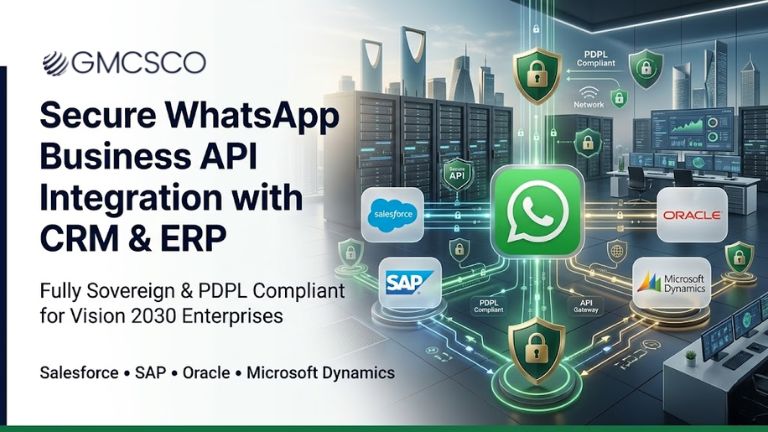
As Saudi Arabia accelerates toward Vision 2030 and the UAE advances its Centennial 2071 goals, large organizations are demanding unified communication platforms that connect directly with their existing CRM, ERP, and core business systems — all while maintaining strict data sovereignty and full PDPL compliance.
In 2026, secure end-to-end integration of WhatsApp Business API with enterprise systems has become a strategic priority for government-related entities, energy companies, banks, retail conglomerates, smart city projects, and large private sector players. Organizations no longer want fragmented tools; they want a single, secure communication layer that works seamlessly with their core technology stack.
This authoritative, in-depth guide is written for CIOs, Digital Transformation Leaders, IT Directors, and Enterprise Architects who need reliable, secure, and scalable WhatsApp integration without compromising data control, regulatory compliance, or operational efficiency.
Ready to build a secure, sovereign WhatsApp integration for your organization? Contact our enterprise team today for a confidential consultation tailored to Vision 2030 and PDPL requirements.
Why Seamless Integration Matters for Vision 2030 Organizations
Modern enterprises operate in highly complex environments with multiple systems — CRM for customer data, ERP for operations, HRM for employees, and specialized platforms for supply chain, finance, and logistics.
Customers and employees expect a consistent, real-time experience across all touchpoints. When WhatsApp Business API is properly integrated, it transforms from a simple messaging tool into a strategic front-end communication layer that:
- Pulls real-time customer and operational data
- Pushes automated, context-aware updates
- Maintains complete conversation history inside the organization’s own systems
- Ensures full auditability for regulators and internal governance
- Reduces manual coordination across departments
PDPL & Sovereign Data Requirements in Integration
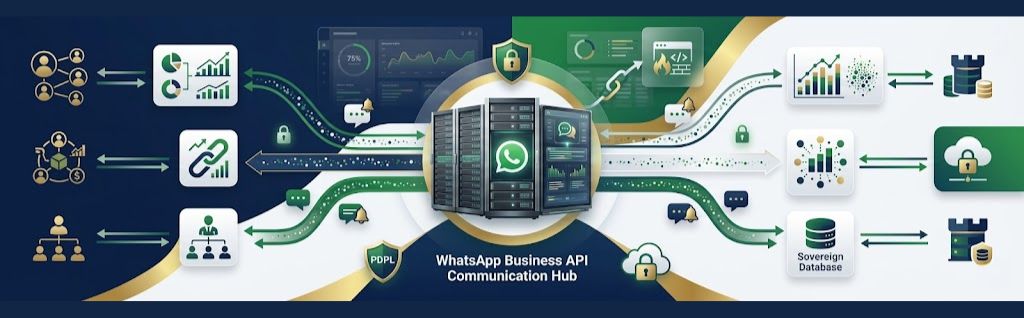
Any integration involving customer or citizen data in KSA must strictly follow the Personal Data Protection Law (PDPL). Critical requirements include data minimization, storage within approved sovereign environments, complete audit logs, right to access/correction/deletion, and explicit consent management.
We design every integration with Client-Server / Sovereign-First architecture, ensuring no sensitive data is stored on third-party clouds unless the client explicitly approves a hybrid sovereign model.
Key Integration Use Cases for Large Enterprises in 2026
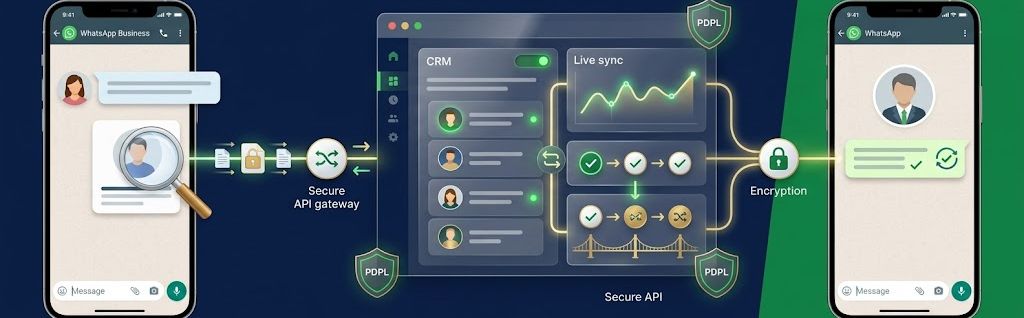
- CRM Integration — Real-time customer 360° view, automated lead nurturing, service ticket creation from WhatsApp chats.
- ERP Integration — Order status updates, invoice alerts, inventory notifications, delivery tracking.
- HR & Employee Systems — Leave requests, payroll alerts, internal communications for large workforces.
- Field Service & Operations — Technician dispatch, job completion updates, predictive maintenance alerts.
- Government & Citizen Services — Permit tracking, complaint resolution, document approval workflows.
Transform WhatsApp into your enterprise’s secure communication layer. Schedule a personalized demo and see real-time CRM & ERP integration in action.
Technical Architecture for Secure Integration
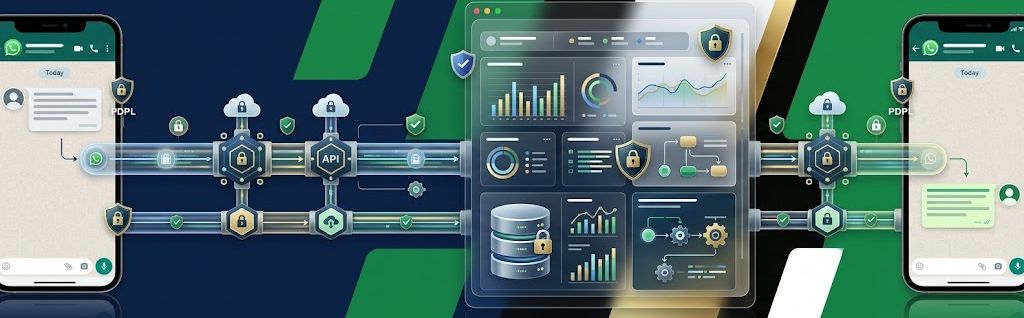
We recommend a Hybrid Sovereign Integration Layer that includes secure API Gateway with mutual TLS authentication, middleware keeping business logic inside the client environment, real-time bidirectional sync, comprehensive logging, and fail-safe mechanisms.
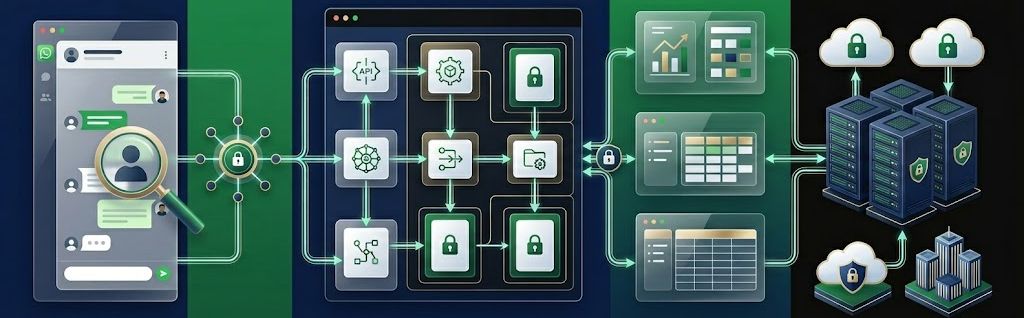
Benefits Achieved by Vision 2030 Organizations
Enterprises that have implemented secure integrations report 45-65% reduction in manual coordination efforts, 3-4x faster process completion, significant improvement in customer and employee experience, and full regulatory compliance with ready audit reports.
WhatsApp Payments Integration – The Next Frontier in KSA & UAE
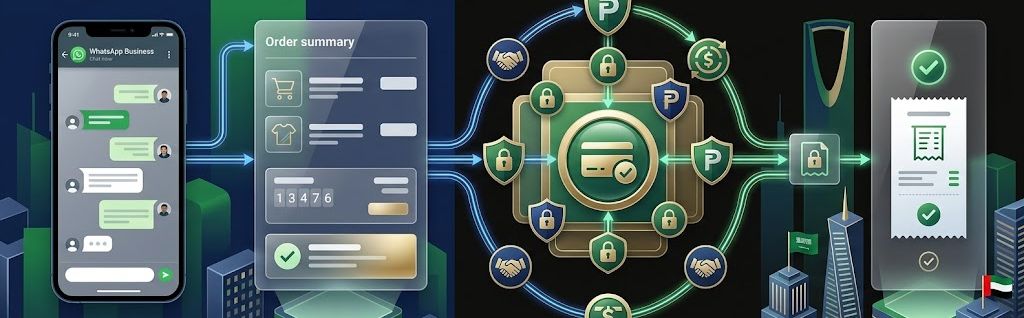
In 2026, WhatsApp Payments has become a game-changer for enterprises in Saudi Arabia and the UAE. Customers love the convenience of completing transactions without leaving the chat.
Popular Use Cases in KSA & UAE:
- Retail & E-commerce: Customers browse products, receive personalized offers, and complete payment with one tap — ideal for malls and online stores.
- Government Services: Citizens pay fines, renew Iqama, driving licenses, or utility bills instantly with digital receipt.
- Healthcare: Patients pay consultation fees, lab tests, or medicines securely inside WhatsApp.
- Logistics: Instant payment on delivery confirmation, reducing disputes and improving cash flow.
- B2B: Companies pay suppliers with automatic reconciliation in ERP.
All payments go through SAMA/Central Bank licensed partners, with strong authentication and full PDPL compliance.
This integration reduces cart abandonment, speeds up cash flow, and delivers the seamless experience that customers in KSA and UAE now expect.
Achieve 45-65% less manual work and seamless customer payments on WhatsApp. Let’s discuss how we can deliver compliant integration for your business. Book a strategy call now.
Compliance & Security Checklist for Integration Projects
- PDPL-compliant consent framework
- Data residency controls
- End-to-end encryption
- Regular penetration testing
- Role-based access control
- Disaster recovery within client environment
Take the next step toward fully integrated, PDPL-compliant WhatsApp communication. Speak with our MENA enterprise experts and accelerate your digital transformation today.
FAQs:
Q: What is seamless WhatsApp Business API integration for enterprises?
A: It is a secure, bidirectional connection between WhatsApp Business API and an organization’s CRM, ERP, HRM, and other core systems. This allows real-time data exchange, automated messaging, and full conversation history stored within the company’s sovereign environment. It turns WhatsApp into a strategic communication layer while maintaining complete data control and compliance.
Q: Why is WhatsApp integration critical for Saudi Vision 2030 and UAE Centennial 2071?
A: Large organizations need unified platforms that deliver real-time customer and employee experiences without fragmenting data across tools. Proper integration reduces manual work, speeds up processes, ensures regulatory compliance, and supports digital transformation goals in government, energy, banking, retail, and smart city projects.
Q: How does the integration comply with Saudi PDPL?
A: The solution follows a Sovereign-First architecture with data minimization, local storage in approved environments, full audit logs, consent management, and rights to access/correction/deletion. No sensitive data leaves the client’s controlled environment without explicit approval, ensuring complete regulatory adherence.
Q: Which enterprise systems can be integrated with WhatsApp Business API?
A: It integrates bidirectionally with CRM (customer 360° view), ERP (orders & inventory), HRM (employee communications), field service platforms, and custom sovereign databases. Real-time sync pulls data for contextual messages and pushes updates back into core systems.
Q: What are the main use cases for WhatsApp integration in KSA and UAE?
A: Key use cases include CRM lead nurturing and ticketing, ERP order/invoice alerts, HR payroll and leave requests, field service dispatch, and government citizen services like permit tracking and complaint resolution. All interactions remain secure and fully auditable.
Q: How does WhatsApp Payments integration work in Saudi Arabia and UAE?
A: Customers can browse, receive offers, and complete payments inside the chat using SAMA/Central Bank licensed partners. It supports retail, government fees, healthcare, logistics, and B2B transactions with instant receipts, automatic ERP reconciliation, and full PDPL compliance.
Q: What technical architecture ensures security and reliability?
A: A Hybrid Sovereign Integration Layer is used with secure API Gateway, mutual TLS authentication, client-side middleware, end-to-end encryption, real-time bidirectional sync, comprehensive logging, and disaster recovery within the client environment.
Q: What measurable benefits do organizations achieve?
A: Enterprises report 45-65% reduction in manual coordination, 3-4x faster process completion, improved customer/employee satisfaction, and ready audit reports for regulators. It also lowers cart abandonment and improves cash flow through WhatsApp Payments.
Q: Is conversation history and data stored outside the organization?
A: No. All conversation history, customer data, and logs are maintained inside the client’s own CRM/ERP or sovereign database. Third-party providers only facilitate messaging routing without accessing or storing sensitive information.
Q: Who is this secure integration solution designed for?
A: It is designed for CIOs, Digital Transformation Leaders, IT Directors, and Enterprise Architects in government entities, banks, energy companies, retail conglomerates, smart cities, and large private sector organizations across KSA and UAE.
Q: What security and compliance measures are included?
A: Measures include end-to-end encryption, role-based access control, regular penetration testing, data residency controls, PDPL-compliant consent frameworks, and disaster recovery—all tailored to meet strict sovereign data requirements in the region.
Q: How quickly can organizations see results after implementation?
A: Most enterprises achieve significant operational improvements within weeks of going live, with full integration and compliance typically completed in 6–12 weeks depending on system complexity and customization needs.
Disclaimer: This content is for general informational purposes only. Information may be sourced from AI tools, search engines, and trusted references. Please verify all details with official sources before making any business or legal decisions. We are not responsible for actions taken based on this content.