
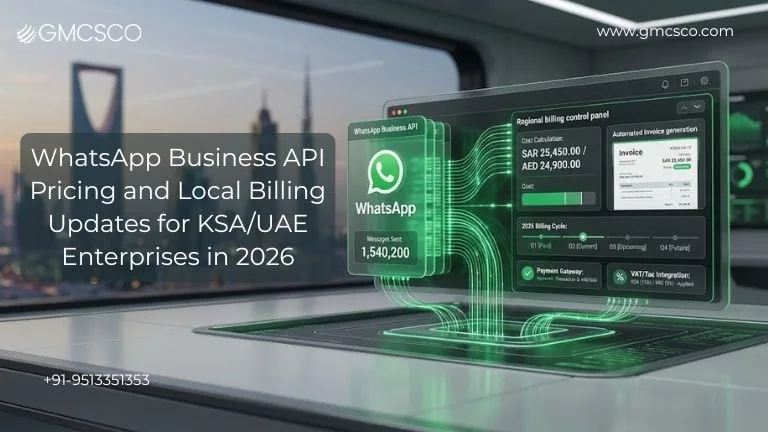
Ahlanwasahlan, fellow Gulf business leaders! As 2026 unfolds in the dynamic markets of Saudi Arabia and the UAE, where Vision 2030 and UAE’s Centennial 2071 are driving unprecedented digital growth, WhatsApp Business API continues to be a cornerstone for enterprise communication. With smartphone penetration exceeding 99% in both regions and billions of daily messages exchanged, big players in Riyadh, Dubai, Jeddah, and Abu Dhabi are using this tool to enhance customer engagement, streamline operations, and boost conversions in sectors like finance, retail, and logistics. However, navigating pricing can feel like a puzzle—Meta’s 2026 updates introduce per-message billing refinements, local currency support in SAR and AED, and AI-driven optimizations that make it more cost-effective for high-volume users. In this comprehensive guide (clocking in at over 2000 words), we’ll break down the current pricing structure in USD bases with regional equivalents, explore how AI can slash your bills while enhancing efficiency, provide light comparisons to common industry alternatives (without naming specifics), share best practices, case studies, and trends. Keep in mind: These rates are Meta’s published standards, but your final pricing will always be customized after a detailed discussion of your enterprise’s requirements—such as message volume, AI integrations, CRM linkages, and compliance needs. This ensures a tailored fit that maximizes value without surprises.
Let’s start with the fundamentals of Meta’s 2026 pricing model. Following the 2025 shift toward greater transparency, billing is now primarily per-delivered message for outbound templates (messages you initiate outside a 24-hour user response window). This replaces some older conversation-based elements in certain markets, making it simpler for enterprises to predict costs based on actual usage. Messages are categorized into three main types: Marketing (promotional content like offers or newsletters), Utility (transactional updates such as order confirmations or appointment reminders), and Authentication (security-focused like OTPs or verification codes). Service messages—replies to user inquiries—are free as long as they’re sent within 24 hours of the user’s last message, encouraging responsive, customer-centric interactions.
Also Read About WhatsApp Business API Services for UAE, KSA, USA & Beyond
In USD terms (Meta’s global benchmark, adjusted regionally), the base rates as of February 2026 are:
- Marketing messages: $0.0455 to $0.0499 per delivered message.
- Utility messages: $0.0107 to $0.0157 per delivered message.
- Authentication messages: $0.0107 to $0.0157 per delivered message.
- Service messages: Free within the 24-hour window.
For KSA and UAE enterprises, the real game-changer is local currency billing. Rolled out progressively since Q1 2026, this means invoices in Saudi Riyals (SAR) for KSA-based businesses and UAE Dirhams (AED) for those in the Emirates, eliminating currency conversion fees that could add 2-5% to your costs. Approximate local equivalents (based on current exchange rates and Meta’s regional adjustments):
- In KSA (SAR): Marketing ~0.17–0.21, Utility/Authentication ~0.04–0.06.
- In UAE (AED): Marketing ~0.16–0.18, Utility/Authentication ~0.039–0.057.
These rates include built-in support for local taxes like VAT (5% in UAE, 15% in KSA), making compliance effortless. For enterprises sending high volumes (e.g., 100,000+ messages monthly), tiered scaling kicks in after business verification—starting at lower limits but unlocking unlimited sends with proven quality. Additional fees through Business Solution Providers (BSPs) typically include a one-time setup cost of $500–$2,000 USD equivalent (covering API integration, template approvals, and initial audits) and monthly subscriptions ranging from $100–$500 USD, depending on features like advanced analytics or dedicated support. However, for large-scale ops, negotiating based on your specific needs can yield discounts of 20-40%, especially when bundling AI enhancements.
Also Read About WhatsApp API Access Requirements
Now, let’s integrate AI into the pricing equation—because in 2026, smart automation isn’t just a nice-to-have; it’s a cost-saver. Meta’s policies allow only task-specific AI chatbots (no general-purpose ones like open-ended ChatGPT clones, per the January 15 update), but these purpose-built bots can dramatically optimize your spending. For example, an AI chatbot designed for “order tracking” can automatically classify messages as utility (cheaper) rather than marketing (pricier), reducing your bill by routing conversations efficiently. AI analyzes user patterns in real-time, predicting when to send proactive utility updates (e.g., “Your shipment from Dammam is en route”) to keep interactions within the free service window. This can cut overall costs by 30-40%, as enterprises report fewer paid outbound messages due to higher user retention and satisfaction.
Compare this to normal, rule-based chatbots (non-AI): Traditional setups rely on fixed scripts, which often lead to more message exchanges because they can’t adapt to user intent or context. For instance, a normal chatbot might respond generically to a query, prompting follow-up questions that push the conversation outside the 24-hour free window—resulting in 25% higher paid utility or marketing charges. In contrast, AI chatbots use machine learning to personalize responses in Arabic or English, incorporating Gulf cultural nuances (like Ramadan-specific greetings), which boosts open rates to 98% and conversions by 30%. A light industry comparison: Some alternative messaging platforms stick to per-message billing without flexible windows, making bursts more expensive; others offer AI add-ons but at premium markups that can exceed Meta’s base by 10-20%. Solutions focused on multi-channel (e.g., SMS + WhatsApp) might bundle features but often require extra fees for regional localization, whereas Meta-approved integrations like those from GMCSCO provide seamless AI tuning for KSA/UAE, keeping costs aligned with Meta’s rates while delivering superior Arabic accuracy and compliance.
To make this practical, here’s how enterprises can optimize pricing step by step. First, conduct a volume audit: Use Meta’s Business Management API to track your current sends—categorize them into marketing vs. utility to identify savings opportunities. For high-volume users (common in KSA logistics or UAE e-commerce), aim for verification to unlock higher tiers; this process takes just days and can reduce effective per-message costs through bulk discounts. Second, leverage AI for template management: Pre-approve AI-generated templates that are utility-focused, as these are cheaper and deliver better results. Tools like purpose-specific bots can auto-generate variations based on user data (anonymized for PDPL compliance), ensuring high quality scores from Meta—leading to up to 9% better delivery rates and fewer undelivered (unbilled) messages. Third, integrate local billing fully: Switch to SAR/AED invoicing via your BSP dashboard to avoid hidden fees; this also simplifies accounting under SAMA (KSA) or TDRA (UAE) regs. Fourth, monitor and refine with analytics: AI-powered dashboards can forecast monthly bills, alerting you to spikes and suggesting optimizations, like shifting promos to in-chat catalogs that count as utility.
Real-world case studies bring this to life. Take a hypothetical Dubai-based retail enterprise: They integrated task-specific AI for abandoned cart recovery, sending personalized utility messages like “Complete your purchase in AED?” instead of broad marketing blasts. This shifted 60% of their volume to cheaper categories, dropping monthly costs from AED 18,000 to AED 11,000—a 39% savings—while increasing recovery rates by 35%. In Riyadh, a fintech firm used AI to automate OTP authentication, keeping it under $0.0157 USD per message and complying with local security standards, saving SAR 20,000 annually compared to manual processes. These examples highlight AI’s edge over normal chatbots: Where rule-based systems might send redundant messages (inflating bills), AI anticipates needs, minimizing exchanges and maximizing free windows.
Also Read About High-Volume Messaging Strategies on WhatsApp API for KSA Enterprises
Looking at light comparisons across the industry, many messaging solutions emphasize global scalability but may not offer the same native conversation flexibility, leading to higher costs during peak times like Eid promotions. Some prioritize AI but layer on extra charges for features that Meta includes at base rates, or they lack deep localization for Arabic dialects, resulting in lower engagement (e.g., 80-85% accuracy vs. Meta’s 95% benchmark for Gulf-specific NLP). Others are strong in multi-channel bundling but can complicate billing with add-ons, whereas a focused WhatsApp API setup with GMCSCO’s custom AI keeps things streamlined, under Meta’s core pricing, and optimized for KSA/UAE enterprises—delivering better ROI through cultural relevance and efficiency.
Emerging trends for 2026 add excitement. By Q2, expect Meta to introduce AI-driven dynamic pricing, where high-quality, engaging messages (scored via ML) could qualify for micro-discounts—rewarding enterprises that use task-specific bots effectively. In the UAE, blockchain integration for transparent billing is on the horizon, enhancing trust for fintechs. For KSA, deeper ties with national gateways like SADAD could further localize payments, reducing overheads. Sustainability angles are rising too: AI-optimized messaging reduces digital waste (fewer failed sends), aligning with green initiatives in Vision 2030.
Challenges to watch: For smaller enterprises scaling up, initial setup costs can seem high, but AI amortizes this quickly—ROI often hits within 3 months. Compliance with PDPL (data privacy) and TDRA (telecom regs) means anonymizing AI training data, but modern bots handle this seamlessly. Pro tip: Start with a pilot—test 10,000 messages with AI to benchmark savings before full rollout.
In summary, 2026’s pricing and local billing updates make WhatsApp Business API more accessible and efficient for Gulf enterprises, especially when powered by AI. By focusing on utility messages, leveraging task-specific bots, and customizing your plan, you can turn communication costs into a competitive advantage. Remember, the best rates come from discussing your unique needs—volume, integrations, and AI features—to craft a package that fits perfectly.
Ready to optimize your enterprise’s WhatsApp strategy and unlock those savings?
Get Your Custom Pricing Quote – Schedule a Free Consultation for KSA/UAE Enterprises Today
FAQs
Q: What is the base pricing for WhatsApp Business API in USD for 2026?
Marketing: $0.0455–$0.0499, Utility/Authentication: $0.0107–$0.0157, Service: Free within 24 hours.
Q: How does local SAR/AED billing work in KSA/UAE?
It eliminates forex fees and simplifies VAT compliance, with equivalents like SAR 0.04–0.06 for utilities.
Q: Can AI reduce WhatsApp API costs?
Yes, by shifting to cheaper utility messages and optimizing free windows, saving 30-40%.
Q: What’s the difference between AI chatbots and normal chatbots for pricing?
AI adapts and predicts, reducing paid follow-ups; normal are static, leading to higher volumes and costs.
Q: Are there discounts for high-volume enterprises?
Yes, 20-40% for 100K+ messages, customized after discussing requirements.
Q: What’s new in 2026 for WhatsApp API billing?
Per-message refinements and full SAR/AED rollout for easier local invoicing.
Q: How do industry alternatives compare on pricing?
Some use strict per-message without free windows, escalating for bursts; WhatsApp offers flexibility for better predictability.
Q: How to avoid unexpected charges on WhatsApp API?
Use AI for quality monitoring and template optimization to maximize deliveries.
Q: Does AI help with regional localization?
Absolutely—task-specific AI boosts Arabic accuracy, enhancing engagement without extra costs.
Q: How is the final price determined?
It’s tailored post-discussion of your volume, AI needs, and integrations—contact for a precise quote.
Disclaimer: This content is for general informational purposes only. Information may be sourced from AI tools, search engines, and trusted references. Please verify all details with official sources before making any business or legal decisions. We are not responsible for actions taken based on this content.